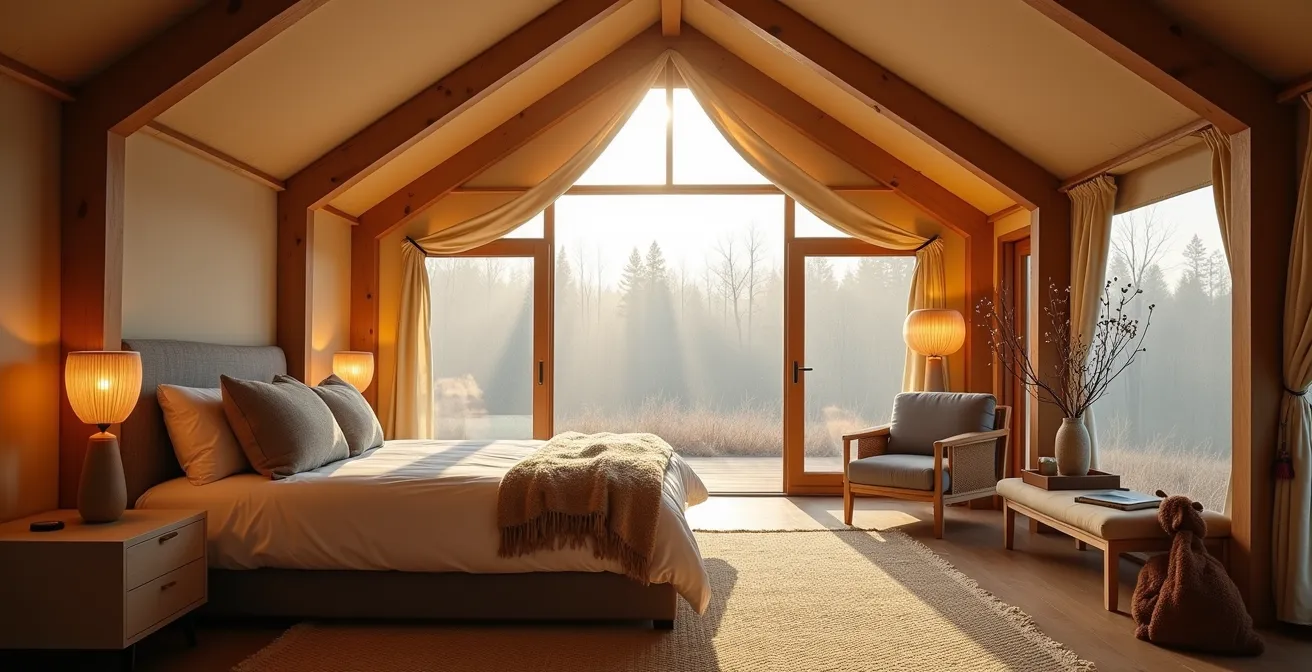
True climate control in glamping is not about having an air conditioner; it’s about a holistically engineered thermal and acoustic environment.
- Insulation quality (R-value, thermal bridging) and passive site design are more critical than the HVAC unit itself.
- The power source (silent solar vs. noisy generator) and acoustic dampening directly impact your sleep quality and overall tranquility.
Recommendation: Before booking, demand specifics on insulation type, HVAC system noise levels, and power source integrity—not just the promise of “climate control.”
The allure of glamping is the perfect paradox: the raw immersion of nature fused with the uncompromising comfort of a luxury hotel. Yet, for the discerning traveler, this promise is often broken by a single, overlooked detail: inadequate climate control. You seek stunning views but are met with a stuffy, sun-baked tent or a frigid, sleepless night. The market is flooded with operators who believe installing a portable air conditioner is sufficient to claim a “luxury” designation. This is a fundamental misunderstanding of what constitutes genuine comfort.
The common advice—to “check for AC” or “read reviews”—is dangerously superficial. It fails to address the sophisticated engineering that underpins a truly climate-resilient structure. Real comfort is not an appliance; it is a system. It is a deliberate synthesis of insulation science, acoustic design, air quality management, and intelligent energy sourcing. Merely having an HVAC unit in a poorly designed structure is like trying to cool a greenhouse with an open door—ineffective, inefficient, and certainly not luxurious.
This guide moves beyond the marketing claims. We will deconstruct the essential, often invisible, components that create a truly hotel-quality climate experience in the wild. We will analyze the physics of insulation, the crucial difference between power sources, and the subtle design choices that separate a genuinely restful retreat from a glorified, uncomfortable campsite. This is not about finding a tent with an AC unit; it is about learning to identify a site with an integrated climate philosophy.
This article will provide you with a consultant’s framework for vetting potential glamping destinations. You will learn to ask the right, incisive questions that reveal the true quality of a site’s infrastructure, ensuring your investment in a luxury experience delivers on its most fundamental promise: a perfect night’s sleep, no matter the weather outside.
Contents: Beyond the Brochure: A Deeper Look at Glamping Comfort
- Why “Canvas Walls” Mean You Still Need Earplugs at Night?
- How to Cook Gourmet Meals on a Provided Propane Grill?
- Yurt or Airstream: Which Offers Better Insulation for Winter Glamping?
- The “Composting Toilet” Surprise That Ruins Luxury Trips for Some
- When to Book to Ensure Your Tent Isn’t 10 Feet From Neighbors?
- Why Off-Grid Solar Lodges Offer a Better Sleep Experience?
- How to Pack for the Grand Canyon: The Difference Between Rim and Floor Hiking?
- How to Verify if a US “Eco-Lodge” is Truly LEED Certified?
Why “Canvas Walls” Mean You Still Need Earplugs at Night?
A common misconception in luxury glamping is that temperature control is the only metric of comfort. However, the most sophisticated HVAC system is rendered useless if your sleep is disrupted by noise. Canvas, by its nature, offers minimal acoustic dampening. This means the serene sounds of nature can be easily overpowered by the tell-tale hum of a nearby generator, the chatter from an adjacent tent, or even the HVAC unit itself. True luxury is silence, and this requires deliberate acoustic engineering.
The problem lies in how a site powers its climate control. Many rely on centralized or portable diesel generators, which create a constant, low-frequency noise that penetrates thin canvas walls. A truly premium site invests in solutions that prioritize silence. This could mean positioning power sources a significant distance from accommodations or, ideally, utilizing silent power systems. The gold standard is a robust solar-plus-battery setup, which operates without any noise, preserving the tranquility you seek.
Therefore, your vetting process must include pointed questions about sound. A host’s inability to answer these questions is a significant red flag, indicating they have not considered the holistic nature of comfort. Before you book, inquire specifically about the following points to gauge their commitment to acoustic peace:
- What type of HVAC system do you use—central, mini-split, or portable units, and what are their decibel ratings?
- What is the Sound Transmission Class (STC) rating of your tent walls, if available?
- How far is the nearest generator or mechanical equipment from guest accommodations?
- Do you use solar-battery systems that operate silently at night?
- Are the walls multi-layered with insulation specifically for sound dampening?
Do not underestimate the impact of noise on your experience. A climate-controlled tent that requires earplugs is a failure in luxury design, betraying the fundamental promise of a peaceful escape.
How to Cook Gourmet Meals on a Provided Propane Grill?
The concept of “gourmet” in a glamping context extends beyond the ingredients; it encompasses the entire cooking and dining environment. A high-end propane grill is a good start, but it’s meaningless if you’re battling the elements or poor air quality. A truly luxurious setup considers the holistic culinary experience, integrating cooking facilities with a comfortable, climate-controlled space. This means effective ventilation to manage smoke and odors and a seamless transition to a dining area where you can enjoy your meal in perfect comfort.
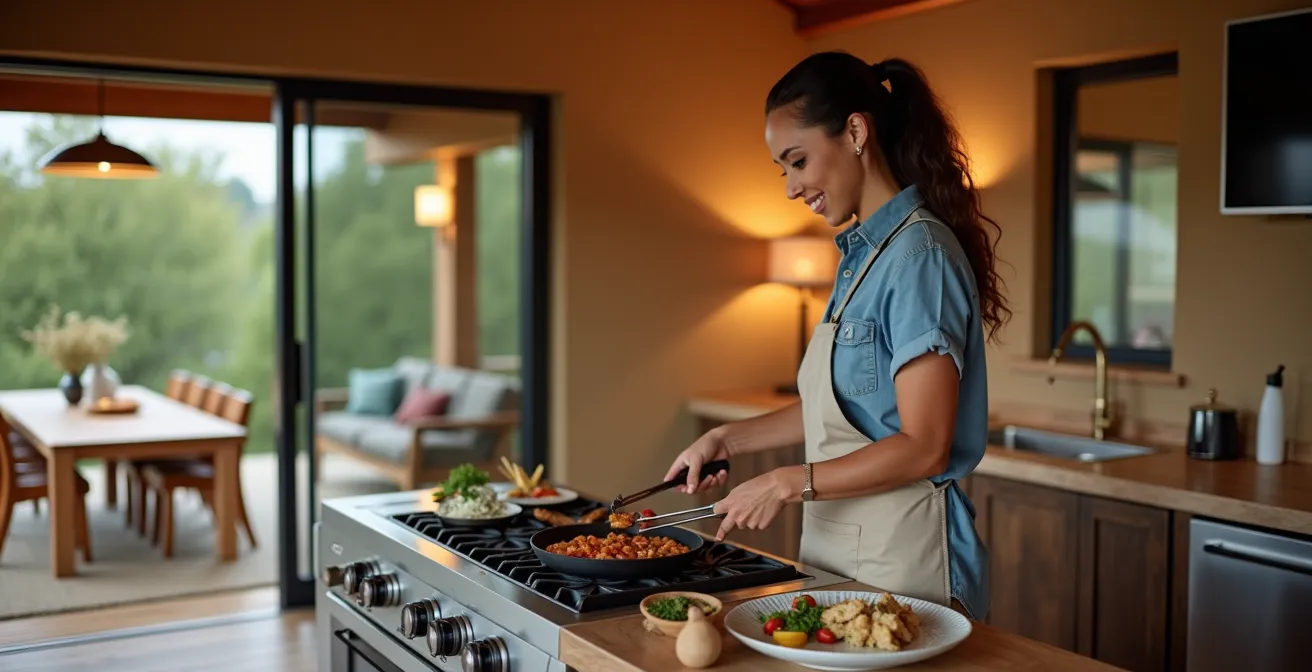
As the illustration above demonstrates, the ideal is a dedicated, well-ventilated cooking station adjacent to a fully-enclosed, climate-controlled dining pavilion. This separation is key. Furthermore, the sophistication of the site’s HVAC system plays a crucial role in maintaining air purity. Superior systems do more than just cool or heat; they actively manage air quality. For instance, high-end solutions may incorporate UV light technology to reduce odors and indoor contaminants, or use sensors to constantly monitor and filter out airborne pollutants like smoke, pollen, and dust. This ensures that the air inside your dining space remains fresh and clean, regardless of what’s sizzling on the grill.
When preparing your meal, treat the provided grill as you would a professional-grade appliance. Prioritize organization: have all ingredients prepped and ready before you begin, minimizing time spent over the heat. Use the grill’s different heat zones to your advantage—searing proteins over high, direct heat while gently warming vegetables on a cooler, indirect zone. The ultimate luxury is not just cooking a great meal, but doing so with ease and comfort, then savoring it in a perfectly tempered, pleasant environment.
Ultimately, a provided grill is just a tool. The real measure of luxury is whether the entire environment has been engineered to support a sublime culinary experience from preparation to the final bite.
Yurt or Airstream: Which Offers Better Insulation for Winter Glamping?
When selecting a winter glamping destination, the structure’s innate ability to retain heat is paramount. The choice between a yurt and an Airstream is not merely aesthetic; it’s a decision with significant thermal implications. While both can be equipped with heaters, their fundamental construction dictates their efficiency and comfort. A yurt, with its potential for thick, multi-layered insulation and round shape, often holds a distinct advantage over the iconic but thermally challenged Airstream.
The key difference lies in insulation potential and thermal bridging. A modern yurt can be outfitted with advanced insulation packages. For example, a layer of reflective insulation is remarkably effective; studies show that reflective insulation in yurts can achieve 95% to 97% radiant heat reflection, preventing warmth from escaping. This can be combined with additional layers of wool or foam to achieve high R-values. Conversely, an Airstream’s thin, curved aluminum walls offer limited space for insulation. More critically, its metal frame and ribs act as thermal bridges, conducting cold directly from the outside skin to the interior, creating cold spots and undermining the insulation’s effectiveness.
The round shape of a yurt also promotes natural air circulation and convection, helping to distribute heat more evenly from a central source. An Airstream’s rectangular shape can lead to stagnant air pockets and significant temperature variations. The following table breaks down the key differences, sourced from comparative analysis by owners and manufacturers.
| Feature | Yurt | Airstream |
|---|---|---|
| R-Value Range | R9-R10 (reflective) up to R26 (multi-layer) | R10 maximum in 1.5″ walls |
| Thermal Bridging | Minimal – round shape improves circulation | Significant – metal ribs conduct cold |
| Condensation Risk | Lower with proper vapor barriers | Higher without an HRV system |
| Air Circulation | Natural convection from round shape | Requires mechanical ventilation |
| Installation Flexibility | Can add layers seasonally | Limited by fixed wall thickness |
This comparison, based on data from sources like a detailed discussion on Airstream winter restoration, makes the conclusion clear. While an Airstream can be made comfortable, it requires a much more powerful and constantly running heating system to overcome its inherent thermal inefficiencies.
For a truly efficient and consistently warm winter glamping experience, a well-insulated yurt is structurally superior. It is designed to work with thermal dynamics, not against them.
The “Composting Toilet” Surprise That Ruins Luxury Trips for Some
Nothing shatters the illusion of luxury faster than an unpleasant bathroom experience. The term “composting toilet” can be a major red flag for travelers accustomed to five-star amenities. While modern, well-maintained units can be perfectly acceptable, they are often a symptom of a larger issue: a lack of investment in the foundational infrastructure that defines true comfort. A premium glamping site must deliver a bathroom environment that is indistinguishable from a luxury hotel, which involves sophisticated climate control, ventilation, and water systems.
The toilet is just one component. True bathroom luxury is a holistic experience. It means stepping onto a warm floor on a cold morning, enjoying consistent and plentiful hot water, and never detecting an unpleasant odor. This level of comfort is not accidental; it is the result of specific engineering choices. Features like radiant floor heating, on-demand water heaters, and active ventilation systems with negative pressure fans are not extravagant extras—they are the baseline requirements for a premium designation.
Before committing to a stay, you must probe beyond the simple question of “what kind of toilet?” Use a detailed checklist to audit the site’s commitment to bathroom comfort. A host who can confidently describe their ventilation system or the capacity of their water heaters is one who understands the non-negotiable elements of luxury hospitality.
Your Audit Checklist: Vetting Bathroom Climate Control
- Radiant Heat: Inquire specifically about radiant floor heating, especially in the bathroom and shower areas. This is a hallmark of winter-ready luxury.
- Ventilation System: Ask about the bathroom’s ventilation. Does it use an active system with negative pressure fans to completely remove moisture and odors?
- Hot Water Supply: Verify the type and capacity of the water heater. Is it an on-demand system that guarantees consistent, unlimited hot water?
- Temperature Control: Confirm if the bathroom has its own, separate temperature control zone, allowing you to maintain a warmer temperature than the main living space.
- Warming Features: Ask about subtle luxury features that indicate a higher standard, such as heated towel racks or dedicated warming drawers.
Do not be swayed by pretty pictures of freestanding tubs. The true measure of a luxury glamping bathroom is in its hidden systems. If these fundamentals are not in place, the experience will inevitably fall short of expectations.
When to Book to Ensure Your Tent Isn’t 10 Feet From Neighbors?
In luxury travel, space is the ultimate amenity. This is especially true in glamping, where a key part of the appeal is a sense of private immersion in nature. A site where accommodations are packed closely together fundamentally undermines this promise, replacing tranquility with the feeling of a crowded campground. Ensuring adequate spacing is not just about privacy; it’s a core component of passive climate design, where intelligent layout leverages natural elements for better comfort.
The issue of crowding is becoming more pronounced as the industry booms. Projections show that the glamping market is expected to grow from USD 3.45 billion in 2024 to USD 6.18 billion by 2030. This rapid expansion puts pressure on operators to maximize occupancy, often at the expense of guest experience and site integrity. Booking well in advance—typically 6 to 12 months for peak season or holidays—is your primary strategy for securing the most desirable, secluded units before they are taken.
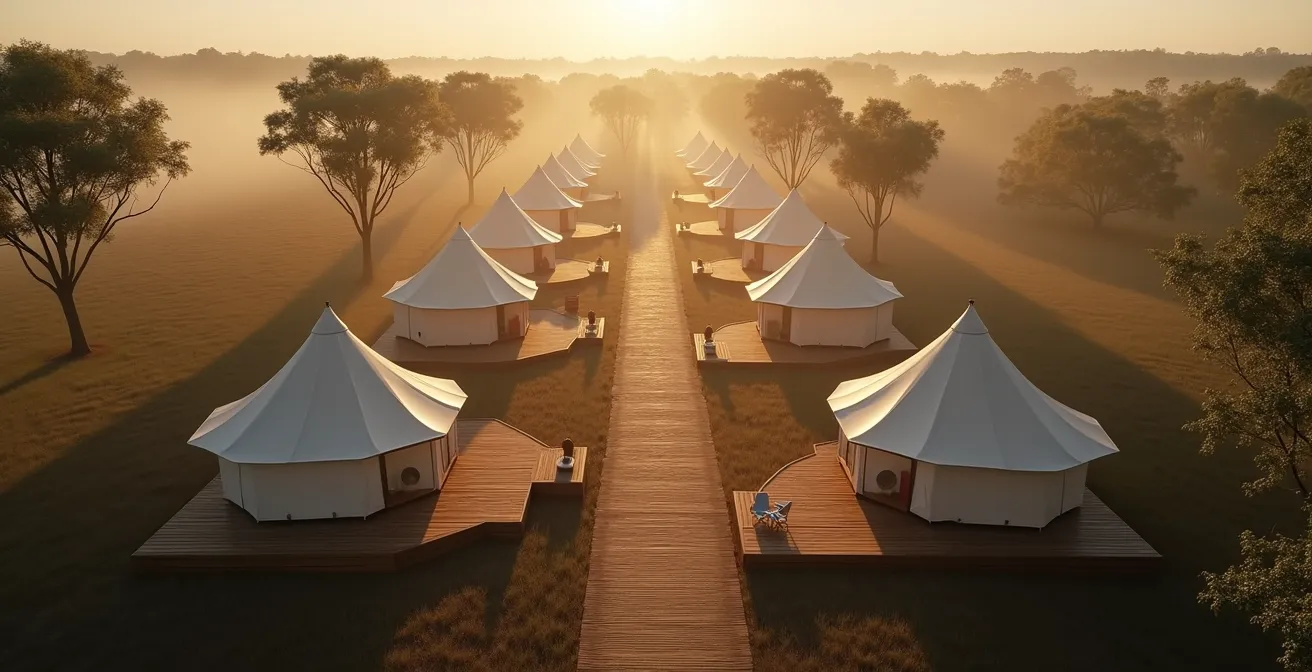
However, booking early is only effective if the site is well-designed in the first place. A superior site plan, like the one shown above, demonstrates a commitment to guest experience. Units are strategically positioned to maximize views, privacy, and natural climate advantages. They may be oriented to catch morning sun in winter, benefit from the shade of trees in summer, or be shielded from prevailing winds by natural terrain. When vetting a site, ask for a site map. Scrutinize the distance between units and their relationship to natural features. A thoughtful layout is a clear indicator of a high-end, guest-focused operator.
Do not assume all sites are created equal. Be proactive in your research and booking. By prioritizing sites with intelligent layouts and securing your reservation early, you can ensure your “escape” is not spent within earshot of your neighbors.
Why Off-Grid Solar Lodges Offer a Better Sleep Experience?
The quality of your sleep on a glamping trip is directly tied to the integrity of the site’s power source. While many off-grid locations rely on diesel generators to power amenities like air conditioning, these systems introduce a fatal flaw into the luxury experience: noise. The constant, disruptive hum of a generator shatters the natural tranquility that is the very essence of glamping. This is why discerning travelers should prioritize lodges powered by modern, silent, off-grid solar systems.
The rise of renewable energy has made this possible on a large scale. Globally, renewable energy capacity reached a record addition of nearly 510 gigawatts (GW) in 2023, with solar PV accounting for three-quarters of that growth. This technological advancement has enabled sophisticated glamping operators to build robust, independent power grids that deliver uncompromising comfort without the acoustic or environmental cost of fossil fuels. The key components are a large solar array paired with a high-capacity battery storage system.
The difference is most profound at night. As one analysis of solar battery systems notes, “Big diesel generators make noise and burn fuel. Large solar battery systems are quiet and clean. They have no moving parts and no smell.” During the day, the solar panels power the lodge and charge the batteries. At night, the system seamlessly switches to the stored battery power, running everything from your lights and mini-fridge to your climate control system in complete silence. This guarantees a deeply restful sleep, accompanied only by the natural sounds of your surroundings.
When vetting a site, asking “Do you have AC?” is the wrong question. The right question is “How do you power your AC at night?” A confident answer detailing their solar and battery infrastructure is the mark of a truly superior, modern eco-lodge.
How to Pack for the Grand Canyon: The Difference Between Rim and Floor Hiking?
The question of how to pack for the Grand Canyon, with its dramatic temperature swings from the cool rim to the hot inner canyon floor, provides a perfect metaphor for a common glamping challenge: the vertical temperature differential inside your own tent. Just as heat builds in the depths of the canyon, it also rises and accumulates in the upper levels of tall structures like yurts or safari tents. Understanding this phenomenon is key to packing correctly and staying comfortable, even in a climate-controlled environment.
Heat naturally rises. In a tall glamping tent, this creates distinct microclimates. The sleeping loft, for example, can be significantly warmer than the main floor. In fact, due to this thermal stratification, temperature differentials in glamping structures can reach a 10-15°F difference between the loft and the floor level. If you are sleeping in a loft, you may find yourself too warm, while someone on a ground-floor sofa might feel a chill. This is why, even with a sophisticated HVAC system, packing layers is non-negotiable. You need to be able to adapt to these different temperature zones within your own living space.
This internal climate variation also serves as a powerful litmus test for a site’s HVAC sophistication. When vetting a property, ask the host, “How do you manage the vertical temperature differential in your tents?” A generic answer suggests a basic, ineffective system. A truly knowledgeable operator will provide a specific solution. They might mention the use of ceiling fans to circulate air and break up stratification, the placement of multiple sensors at different heights for more accurate temperature readings, or the implementation of a zoned control system that allows for different temperature settings in the loft and main living area. This level of detail reveals a deep understanding of thermal dynamics and a commitment to genuine guest comfort.
Therefore, pack for your glamping trip as you would for a hike from the Grand Canyon’s rim to its floor: with smart, adaptable layers. Your ability to add or remove a layer will provide the final, personalized touch to your comfort, perfectly complementing even the most advanced climate control system.
Key Takeaways
- True luxury climate control is a holistic system, not just an appliance. Focus on insulation, acoustics, and power source integrity.
- Insulation R-value and the mitigation of “thermal bridging” are more critical to comfort than the brand of the air conditioner.
- Silence is a key luxury. Prioritize sites with quiet, solar-powered systems over those using noisy diesel generators.
How to Verify if a US “Eco-Lodge” is Truly LEED Certified?
In the luxury travel market, the term “eco-lodge” is frequently used but rarely substantiated. For a traveler who values both comfort and sustainability, it is crucial to look past marketing claims and seek verifiable proof. The most respected credential in the United States is LEED (Leadership in Energy and Environmental Design) certification, a rigorous, third-party standard that validates a building’s performance. Verifying this certification is a straightforward process that separates the truly green lodges from those merely “greenwashing.”
Prestigious eco-lodges proudly display their credentials because they represent a significant investment and commitment. For example, a leading property might state its achievement clearly, as demonstrated by the Nature Inn at Bald Eagle, a LEED Gold certified establishment. In a statement on their commitment to sustainability, they note:
The inn was recently voted the #1 Eco-Lodge in the United States by readers of USA Today.
– Nature Inn at Bald Eagle, LEED Gold Certified Eco-Lodge
While such accolades are impressive, the ultimate proof lies in the official registry. The U.S. Green Building Council (USGBC) maintains a public database of all certified projects. To verify a property’s status, you don’t need to take the owner’s word for it. You can perform a quick check yourself by following a few simple steps. This due diligence ensures you are supporting a genuinely sustainable operation.
To confirm a property’s LEED status, use the following verification process:
- Visit the Directory: Navigate to the official USGBC Project Directory at usgbc.org/projects.
- Search: Use the search function to look for the property by its name or location. A certified project will appear in the results.
- Check Credits: For a deeper dive, look for specific credits related to comfort, such as “IEQ Credit: Thermal Comfort,” which shows a focus on the guest experience.
- Inquire Further: Ask the property about their scores on credits like “EA Credit: Optimize Energy Performance” or if they hold other respected certifications like Passive House or the Living Building Challenge.
Your final step, before booking any “eco-lodge,” should be this simple verification. It is the definitive action to ensure that your stay aligns with your values and that the property’s commitment to both the environment and your comfort is backed by credible, measurable standards.