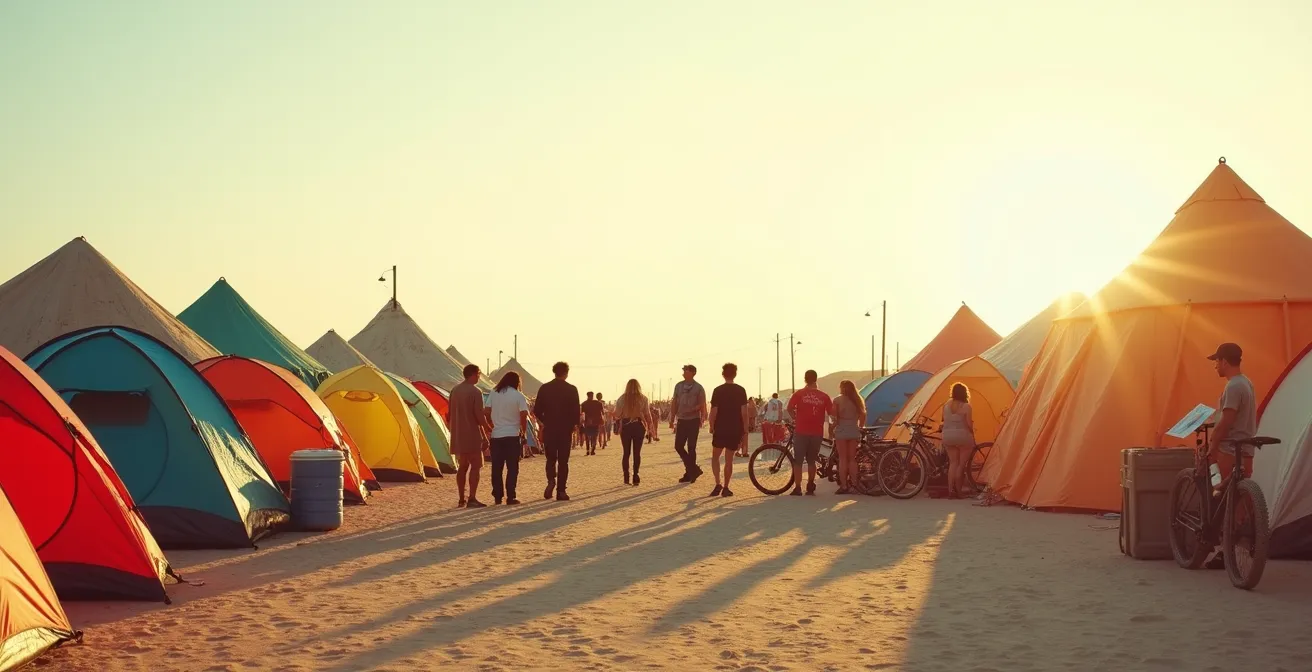
The secret to affording a top-tier festival isn’t about being cheap; it’s about hacking the hidden systems of time, energy, and money that govern the experience.
- Mastering logistics like shuttle passes over rideshares yields a massive return on investment in both time and money.
- Strategic planning for survival essentials like hydration and safety prevents costly and dangerous emergencies.
Recommendation: Shift your mindset from ‘saving money’ to ‘maximizing experience ROI’—every dollar and minute you spend should deliver premium value, even with a General Admission ticket.
The photos fill your feed every year: radiant sunsets over the Indio valley, impossible art structures rising from the desert dust, and the world’s biggest musical acts performing on iconic stages. The dream of Coachella or Burning Man feels epic, transformative, and… impossibly expensive. For a young professional, the idea of dropping $5,000 on a three-day event seems like a fantasy reserved for influencers and trust fund kids. The common advice is predictable: bring your own food, carpool, and maybe hope to win a ticket. This approach focuses on scarcity, on what you have to give up.
But what if that’s the wrong way to think about it? What if the key to unlocking these experiences on a normal person’s budget isn’t about cutting corners, but about understanding and exploiting the festival’s internal economy? These events are temporary cities with their own rules of supply and demand, traffic flow, and social dynamics. The real insiders, the ones who have an incredible time without going into debt, aren’t just saving money—they are masters of festival arbitrage. They trade a little planning for massive gains in time, energy, and comfort.
This guide isn’t about how to have a lesser experience for less money. It’s about how to achieve a premium, VIP-level experience for a General Admission price. We’ll deconstruct the systems that drain your wallet and your will to live, from transportation nightmares and ticket scams to the physical toll of the desert sun. By shifting your perspective from a passive attendee to a strategic “system hacker,” you can turn a budget trip into the festival experience you’ve always dreamed of.
To navigate this complex world, we’ve broken down the essential strategies you need to master. This guide will walk you through the core hacks that turn festival chaos into a predictable, manageable, and ultimately more enjoyable experience.
Summary: Your Guide to Festival System Hacking
- Why Buying Shuttle Passes Saves You 3 Hours Per Day at Major Festivals?
- How to survive a 3-Day Music Festival Without Heatstroke?
- VIP or GA: Is the Extra $500 Worth it for Bathroom Access Alone?
- The CraigsList Ticket Scam That Catches 20% of Last-Minute Buyers
- When to Leave the Main Stage to Get a Good Spot for the Headliner?
- The Political Topics You Must Avoid at Dinner Parties in 2024
- When to Visit Major Museums to Avoid the 2-Hour Weekend Lines?
- How to Explore Downtown Los Angeles Safely on Foot at Night?
Why Buying Shuttle Passes Saves You 3 Hours Per Day at Major Festivals?
The single biggest rookie mistake at a major commuter festival like Coachella is underestimating transportation. After a 10-hour day on your feet, the exodus from the grounds can be a soul-crushing experience. This is where the festival’s economy is most predatory. Rideshare apps become a battlefield of surge pricing and phantom cars. In fact, post-festival demand can be so extreme that news investigations have documented prices like $120 for a 3-mile ride during peak hours. This isn’t just expensive; it’s a strategic drain on your two most valuable resources: time and money.
The pro move is to opt out of this broken system entirely. The official festival shuttle pass is the single best example of festival arbitrage. For a fixed, predictable cost, you gain access to a dedicated fleet of buses that use private routes, bypassing the miles-long gridlock of general traffic. While others are staring at a 3-5x surge multiplier and a two-hour wait, you’re on an air-conditioned bus heading straight back to your hotel or designated stop. This isn’t just a ride; it’s a purchase of three extra hours of sleep and sanity per day.
The data clearly shows that shuttle passes offer an unmatched value proposition. When you compare the total cost and time investment over a weekend, the shuttle is the undisputed winner against the volatility of rideshares or the hassle of personal parking, as this recent cost analysis reveals.
| Transportation Option | 3-Day Total Cost | Average Wait Time | Surge Risk |
|---|---|---|---|
| Shuttle Pass | $150 | 15-30 mins | None |
| Uber/Lyft (off-peak) | $180-240 | 20-40 mins | Medium |
| Uber/Lyft (peak) | $450-720 | 60-120 mins | Guaranteed 3-5x |
| Parking + Gas | $380 | 45-60 mins exit | None |
Ultimately, choosing the shuttle isn’t about saving a few dollars. It’s a strategic decision to buy back your time and energy, which are far more valuable currencies inside the festival grounds.
How to survive a 3-Day Music Festival Without Heatstroke?
At desert festivals like Coachella or Burning Man, the sun is not your friend. It’s an active adversary that can end your weekend before the first headliner even takes the stage. Surviving isn’t just about “drinking water”; it’s a game of strategic resource management where your body’s hydration and core temperature are the most critical assets you have. Heatstroke is a serious medical emergency, but it’s preceded by earlier stages of heat illness like heat exhaustion, which are entirely preventable with the right protocol. Your goal is to stay ahead of the curve, treating hydration and cooling as a scheduled task, not an afterthought.
The process starts 24 hours before you even set foot on the grounds. You need to pre-load your body with water and electrolytes, creating a buffer against the inevitable depletion. Amateurs show up dehydrated from travel and start their weekend with a deficit. Pros arrive with a surplus. This includes not just water, but also balancing it with electrolytes to ensure your body can actually absorb the fluids you’re consuming. Foods rich in potassium, like bananas and avocados, become part of your tactical gear.
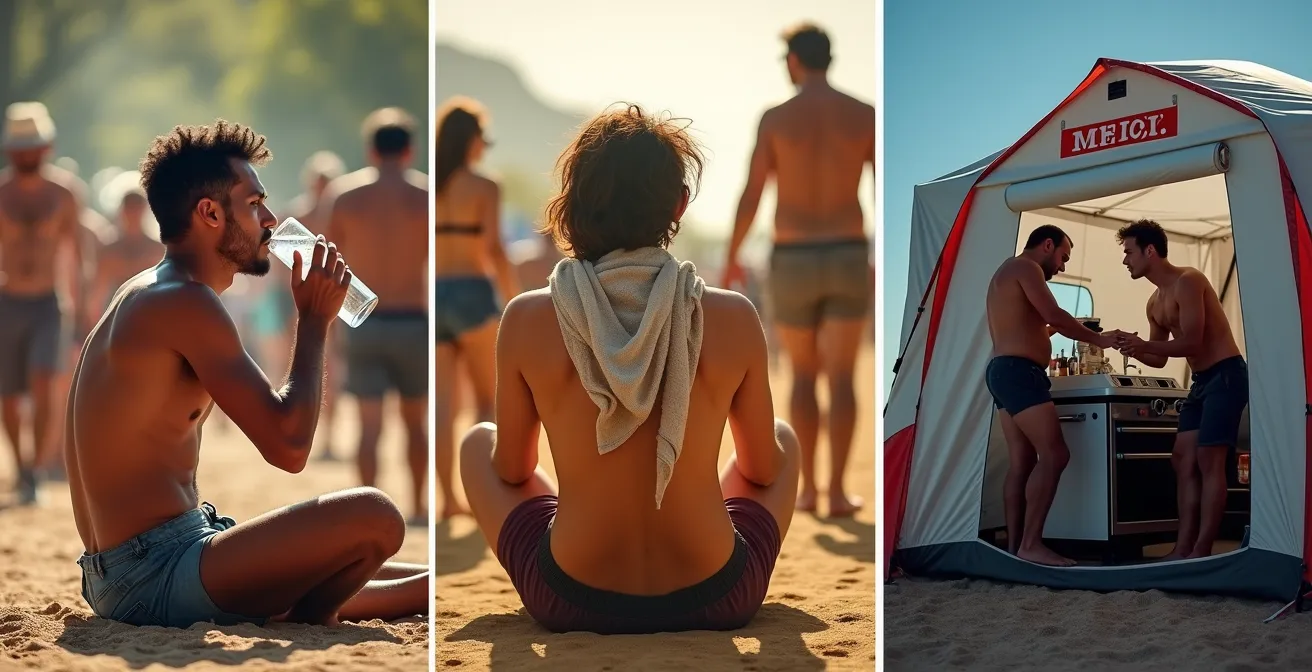
As the illustration above suggests, heat illness progresses in stages. The key is to recognize the early signs of heat exhaustion—dizziness, heavy sweating, nausea—and take immediate action. This means finding shade, applying a wet towel to your neck, and aggressively rehydrating with an electrolyte drink. Waiting until you feel “really bad” means you’ve already lost the battle. A crucial piece of gear is a reusable, insulated water bottle and a hydration pack. Fill them at every free water station you pass, even if you’re not thirsty. Think of it as reloading your most important weapon in the fight against the desert heat.
VIP or GA: Is the Extra $500 Worth it for Bathroom Access Alone?
It’s the ultimate festival dilemma: stick with a General Admission (GA) pass or splurge on VIP? With prices often soaring, as shown by official data where a $1,269 for VIP vs $549 for GA pass shows a significant price jump, the question of value is critical. Most people get it wrong by thinking of it as a simple luxury purchase. The smart way to analyze it is through the lens of Experience ROI (Return on Investment). You’re not just buying a wristband; you’re buying back time, comfort, and energy. The question is, are those benefits worth the steep price difference?
The single biggest selling point for VIP is almost always the bathrooms. GA porta-potties can have 30-minute lines and become biohazards by day two. VIP offers air-conditioned, flushable toilets with minimal waits. But is avoiding the porta-potty worth over $700? Let’s break it down. If you use the bathroom six times over the weekend, you’re paying a staggering premium for that privilege. However, the value extends beyond the toilets, as a detailed breakdown of VIP perks from Coachella demonstrates.
| Feature | GA Experience | VIP Experience | Value Per Use (3 days) |
|---|---|---|---|
| Bathroom Wait | 20-30 minutes | 2-5 minutes | $33 per visit |
| Entry Lines | 60-90 minutes Day 1 | 5-10 minutes | $166 saved time value |
| Viewing Areas | Standing only | Shaded seating | $55 per day |
| Charging Stations | Not available | Free access | $83 vs paid charging |
| Food Lines | 30-45 minutes | 10 minutes | $41 per meal |
However, the true festival hacker can replicate many of these benefits without the cost. This requires a “GA-Pro” mindset, as demonstrated by one veteran’s clever strategy.
GA-Pro Strategy: Festival Veteran’s Bathroom Hack
Julia Vaness, a 5-year Coachella veteran, documented her ‘GA-Pro’ approach: By mapping bathrooms furthest from main stages (near merchandise tents and food courts), she averaged 5-minute waits even during headliner sets. Her strategy included timing visits during the first 3 songs of popular acts when 80% of attendees rush to stages. Combined with a portable camping toilet for morning use at camp, she estimates saving $400 versus VIP while experiencing similar convenience.
The lesson is clear: VIP offers guaranteed convenience for a high price, but a strategic GA attendee can achieve a near-VIP experience by understanding and hacking the festival’s systems and crowd flows.
The CraigsList Ticket Scam That Catches 20% of Last-Minute Buyers
The desperation for a sold-out festival ticket can make smart people do dumb things. The last-minute hunt on platforms like Craigslist, Facebook Marketplace, or Reddit is a minefield of scams designed to prey on your FOMO (Fear Of Missing Out). The most common scam involves a fake ticket or wristband, a seller who ghosts you after receiving a digital payment, or a wristband that has been reported stolen and deactivated. Losing hundreds of dollars and being turned away at the gate is the ultimate festival disaster. Protecting your initial investment is the first and most important hack of all.
Scammers thrive on urgency and trust. They’ll have a convincing story, fake proofs of purchase, and will push for untraceable payment methods like Zelle or PayPal Friends & Family. These methods offer you zero buyer protection. Once the money is sent, it’s gone forever. The only way to engage in a private sale is by shifting the power dynamic and forcing the seller to prove their legitimacy through a strict verification protocol. This involves creating hurdles that a real seller can easily clear but a scammer will refuse to.

The visual red flags of a shady deal—the hesitant exchange, the pressure for cash—are often subtle. Your best defense is a non-negotiable process that verifies the ticket’s existence and the seller’s identity before any money changes hands. If a seller resists any step of this protocol, it is the biggest red flag. A legitimate seller who wants to make the sale will be happy to cooperate to prove they are genuine. A scammer will make excuses and try to rush you. Walk away.
Your Action Plan: Digital Verification Protocol for Private Sellers
- Request a 30-second personalized video showing the seller logged into their official ticket account (e.g., Ticketmaster, AXS) where the ticket is held.
- In the same video, ask the seller to show your name (or a unique code word you provide) written on a piece of paper next to their computer screen.
- Verify that the ticket transfer can and will happen exclusively through the official festival ticketing platform’s secure transfer function. Never accept PDF printouts or screenshots.
- Use PayPal Goods & Services for payment. The small fee is insurance. Absolutely refuse to use Friends & Family, Zelle, Venmo, or wire transfers.
- If conducting a cash transaction, insist on meeting in a safe, public place, preferably at the entrance of a bank or a police station.
- Before payment, screenshot all conversations, the seller’s profile, and any “proof” they’ve sent. This creates a paper trail.
When to Leave the Main Stage to Get a Good Spot for the Headliner?
One of the great festival mysteries is how people get to the very front for the headliner. Do they camp out all day? Do they have a secret tunnel? The reality is a mix of endurance and, more importantly, a deep understanding of crowd physics. Most people try to move through the crowd like a bulldozer, pushing forward and creating friction. This is exhausting and ineffective. The system hacking approach is to move with the crowd’s natural ebb and flow, using the moments of chaos to your advantage.
The golden opportunity arises during the changeover between the sub-headliner and the main headliner. A significant portion of the crowd—often 30-40%—will exit after the previous set ends. This creates a temporary vacuum and natural pathways toward the stage. Instead of pushing forward *during* a set, the pro move is to hold your ground and wait for the exodus. By moving against this “counter-current,” you can make huge progress with minimal effort. This strategy was perfectly documented by a festival veteran.
The Counter-Current Method Success Story
Festival photographer Pinny documented the ‘counter-current’ strategy during Coachella 2023: When the EDM act before rock headliner Guns N’ Roses ended, approximately 40% of the crowd exited, creating natural pathways. By waiting 5 minutes into the exodus and moving against the flow along the fence lines, her group advanced from back-third to front-quarter position in under 10 minutes without pushing, compared to 45 minutes of aggressive crowd-fighting earlier in the day.
For groups, this can be combined with the “Anchor and Scout” method. Designate one person as the ‘Anchor’ who holds the desired spot. The other ‘Scouts’ can then leave in pairs for food, water, or bathroom breaks. They can easily find their way back to the Anchor, who acts as a fixed point in the chaos. This prevents the entire group from losing a prime spot just because one person needs a break. It’s a simple but highly effective way to maintain a premium viewing experience for hours.
The Political Topics You Must Avoid at Dinner Parties in 2024
This might seem like a strange topic for a festival guide, but it’s a perfect metaphor for managing your most underrated resource: social energy. A festival like Burning Man or Coachella is a temporary community. The collective “vibe” is a real, tangible thing that affects everyone’s experience. Just as a heated political debate can ruin a dinner party, a negative, confrontational, or aggressive interaction at your campsite or in a chill-out tent can drain your social battery and ruin your day. The goal is radical inclusion and good vibes, not winning an argument.
You will encounter people from all walks of life, with vastly different opinions. The unspoken social contract of the festival is to focus on the shared experience: the music, the art, the community. Getting drawn into a heavy debate about politics, conspiracy theories, or other divisive topics is a rookie mistake. It’s a waste of precious energy that you should be saving for dancing until 4 AM. Your mission is to connect, not to convert.
The expert move is to master the “Enthusiasm Pivot.” When a conversation veers into negative or contentious territory, you don’t have to engage or awkwardly disagree. Instead, you pivot back to the reason you’re all there. It’s a gentle, non-confrontational way to protect your own headspace and the positive atmosphere of the group. Think of it as social self-defense. A toolkit of simple, friendly deflections is more valuable than any well-reasoned argument in this context. Keep the energy positive and focused on the magic around you.
When to Visit Major Museums to Avoid the 2-Hour Weekend Lines?
The strategy for avoiding lines at a major museum is the exact same strategy for maximizing your time at a festival. It’s all about counter-cyclical behavior. Most people operate on the same herd-mentality schedule: they go to the main stage for the big acts, they eat during the dinner rush, and they try to see the popular art installations when everyone else does. This results in massive crowds, long lines, and a frustrating experience. The “Museum Method” is about zigging when everyone else zags.
Want to see the massive, iconic art piece that everyone is posting on Instagram? Don’t go in the middle of the afternoon. The best time to experience it is during the first hour of the headliner’s set. The vast majority of the festival’s population will be packed in front of the main stage, creating a vacuum elsewhere. This is your window to explore the art with a fraction of the crowd, get incredible photos without a thousand strangers in the background, and actually appreciate the work. The same principle applies to everything from merchandise tents to food stalls.

By observing the festival’s crowd flow, you can identify these pockets of opportunity. The merch tent is a nightmare at 3 PM but often empty during the dinner hours (6-7 PM). Bathrooms are mobbed between sets but quiet during the third song of a popular artist’s performance. By applying this simple logic across the entire festival, you can effectively build an itinerary that minimizes time spent in lines and maximizes time spent enjoying what you paid for. It’s the ultimate application of system hacking, turning the festival’s biggest weakness—crowds—into your strategic advantage.
Key Takeaways
- Festival success is a game of resource management: your budget, time, and physical energy are all interconnected.
- Opting out of broken systems (like rideshare surge pricing) by using fixed-cost alternatives (like shuttles) provides the highest ROI.
- A “GA-Pro” mindset, focused on hacking crowd flow and timing, can deliver a near-VIP experience for a fraction of the cost.
How to Explore Downtown Los Angeles Safely on Foot at Night?
At night, a sprawling festival ground like Burning Man’s playa or Coachella’s campgrounds transforms into a disorienting, temporary city. The safety principles you’d apply to exploring a real city like Downtown LA at night are directly applicable here. Your personal safety is the foundational resource upon which your entire festival experience is built. If you don’t feel safe, or if you get lost, nothing else matters. Navigating this nocturnal landscape requires a plan, the right gear, and a strong sense of situational awareness.
The number one rule is light. Your phone’s flashlight is not enough. A powerful headlamp is essential for hands-free navigation, and you should always carry a backup flashlight. Just as important is making your own “home base” visible. Marking your tent or camp with a unique, battery-powered LED light pattern is the equivalent of a lighthouse, guiding you back from a hundred feet away. Relying on memory alone in a sea of identical-looking tents is a recipe for a long, frustrating night.
Beyond gear, the most powerful tool is a shared safety strategy. The “buddy system” is non-negotiable, but it can be enhanced with modern tech and a bit of pre-planning. A successful method pioneered by a regional Burning Man community highlights the power of creating a collective mental map.
Creating Your Festival Mental Safety Map
The Houston Burning Man community developed a safety mapping system adopted by 200+ campers: Upon arrival, groups spend 30 minutes walking the entire festival perimeter in daylight, physically visiting each medical tent, security post, and designated ‘Safe Haven’ tent. Members take photos at each location and share them in a group chat. This mental mapping exercise reduced lost camper incidents by 75% and decreased emergency response time from an average of 15 minutes to under 5 minutes when members needed assistance.
This proactive approach transforms safety from a passive hope to an active strategy, ensuring that you and your group can navigate the festival’s vast nightscape with confidence and get help quickly if needed.
Start planning your festival adventure today by adopting this strategic mindset. The experience of a lifetime is within your reach—not by spending more, but by thinking smarter.