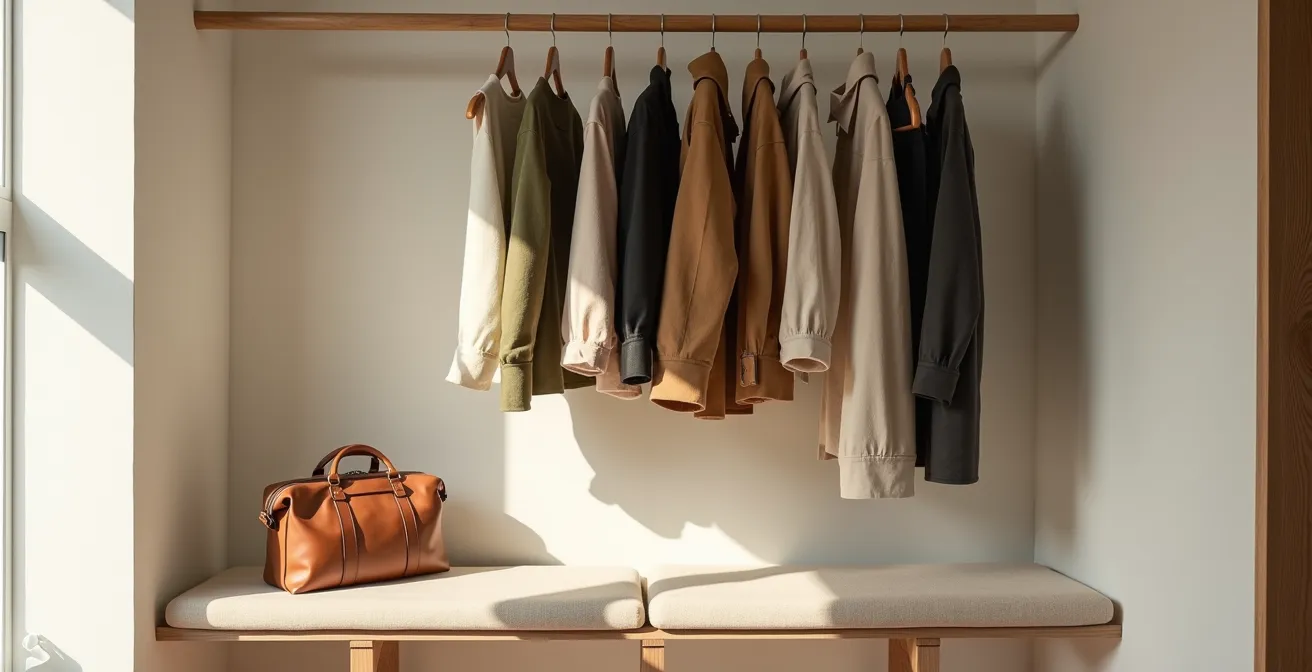
In summary:
- Reduce morning stress by eliminating trivial clothing choices, freeing up mental energy for what truly matters.
- Build a versatile ‘wardrobe architecture’ on a neutral base, ensuring every single piece works together.
- Adopt a ‘cost-per-wear’ mindset to invest in high-quality, ethical pieces that last for years, not weeks.
- Use a dynamic system of seasonal swaps and smart layering to adapt your 30 core pieces to any climate or occasion.
Standing before a closet packed with clothes, yet feeling like you have nothing to wear, is a uniquely modern frustration. This paradox leads to decision fatigue before the day has even truly begun. The common advice is to declutter, pick a few neutral colors, and hope for the best. But this often results in a boring, restrictive wardrobe that feels more like a uniform than a source of personal expression.
What if the solution isn’t just about having fewer items, but about building a smarter system? A true capsule wardrobe isn’t a rigid set of rules or a specific number of hangers. It is a functional, dynamic piece of personal infrastructure—a ‘wardrobe architecture’ designed for efficiency, versatility, and freedom. This approach transforms your closet from a daily source of stress into a streamlined tool for intentional living.
This guide moves beyond the basics. We will deconstruct the psychology behind why less is more freeing, provide a structured framework for building your foundational palette, and reveal the strategies to keep your small wardrobe feeling fresh and adaptable. We will also explore how to apply this minimalist ethos to travel and, crucially, how to ensure your curated collection is built on ethical practices, not exploitation. This is your blueprint for creating a 30-piece wardrobe that truly works for you, all year round.
To help you navigate this process, this article is structured to guide you step-by-step from the foundational ‘why’ to the practical ‘how’. The following table of contents outlines the complete journey to building your perfect capsule wardrobe.
Table of Contents: A Guide to Your 30-Piece All-Season Wardrobe
- Why Having Fewer Clothes Reduces Morning Stress Levels?
- How to Select a Neutral Base Palette That Matches Everything?
- Project 333 or 10×10:How to Verify if a US “Eco-Lodge” is Truly LEED Certified?
- The Accessory Mistake That Makes Capsule Wardrobes Feel Repetitive
- When to Swap Out Items: The Seasonal Capsule Strategy?
- How to Pack for Florida Humidity and Colorado Snow in One Carry-On?
- Why a $5 T-Shirt is Impossible Without Exploitation?
- How to Vet a Fashion Brand’s Supply Chain for True Ethical Practices?
Why Having Fewer Clothes Reduces Morning Stress Levels?
Having fewer clothes reduces morning stress by drastically minimizing decision fatigue. Every small choice we make, from what to eat for breakfast to what to wear, depletes a finite pool of mental energy. By the time you face a closet overflowing with options, you’ve already made several decisions, making the seemingly simple task of choosing an outfit a genuine cognitive burden. This mental strain is a key reason why many successful individuals, like former President Barack Obama, famously streamlined their daily attire to preserve their focus for more significant matters.
The link between a simplified wardrobe and mental clarity is not just anecdotal. The concept of decision fatigue is a well-documented psychological phenomenon, and its effects on our daily lives are measurable. As highlighted by in-depth research on decision fatigue, limiting trivial choices is a powerful strategy for improving overall productivity and well-being. A writer who experimented with wearing the same outfit for two weeks found it freed up significant brain space, noting that the mental energy previously spent on clothing could be reallocated to more important tasks. This demonstrates that a capsule wardrobe’s primary benefit is the restoration of your most valuable asset: your cognitive resources.
Ultimately, a capsule wardrobe functions as a system designed to automate a recurring daily task, thereby eliminating a consistent source of low-level stress and freeing you to start your day with focus and intention.
How to Select a Neutral Base Palette That Matches Everything?
Selecting a cohesive neutral base palette is the architectural foundation of a successful capsule wardrobe, ensuring every piece can be mixed and matched effortlessly. Instead of thinking about individual items, think in terms of a color system. A strong neutral foundation acts as the canvas, while a few carefully chosen accent colors provide personality and visual interest. This systematic approach is what guarantees maximum versatility from a minimal number of items.
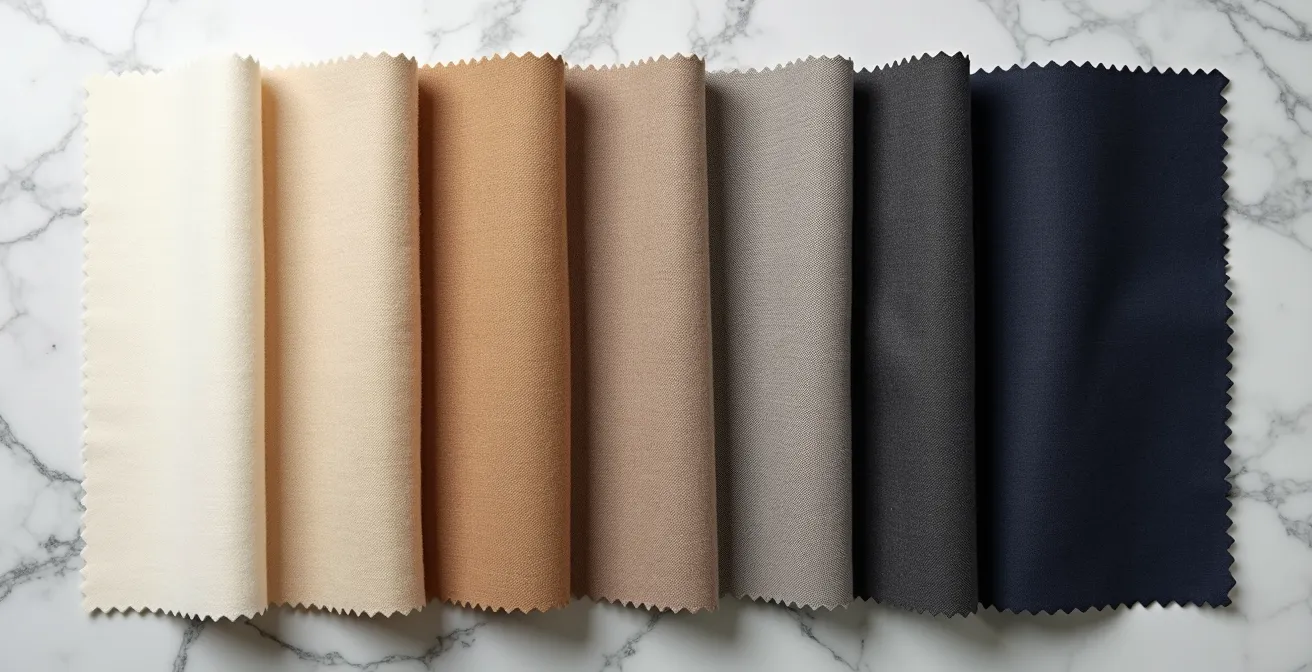
To visualize this, consider your wardrobe’s color story. The image below showcases how different neutral tones and textures can work in harmony, creating a palette that is both sophisticated and endlessly adaptable. Notice how the variety in texture adds depth, preventing the collection from feeling flat or one-dimensional.
Building this foundation is a structured process, not a guessing game. By following a clear set of guidelines, you can create a palette that is both personal and practical. The goal is to establish a core set of colors that work seamlessly with each other and with your chosen accent colors.
- Start with a base of classic neutrals like black, navy, gray, camel, cream, and white. These form the versatile backbone of your wardrobe.
- Choose one or two accent colors that you love and feel confident wearing. These will inject your personality into the neutral base.
- For maximum cohesion, commit to either a warm-toned palette (cream, tan, brown, olive green) or a cool-toned one (black, grey, burgundy, navy).
- Universally flattering shades like blue denim and crisp white can bridge the gap and work well with both warm and cool palettes.
- Before committing to a piece, test its versatility: can it be combined with at least three other items in your capsule to create distinct outfits?
By establishing this strong color foundation, you eliminate the daily guesswork and ensure that any combination you pull from your closet looks intentional and put-together.
Project 333 or 10×10:How to Verify if a US “Eco-Lodge” is Truly LEED Certified?
While the world of minimalism intersects with sustainable living, it’s important to distinguish between different frameworks. Certifications like LEED are specific to green building and travel, a separate topic from our focus here. For structuring a minimalist wardrobe, the most effective tools are personal challenges like Project 333 or the 10×10 Challenge. These provide a concrete framework for applying minimalist principles to your closet.
The most renowned of these is Project 333, a minimalist fashion challenge created by Courtney Carver. The premise is simple yet powerful: dress with only 33 items for 3 months. This count includes clothing, accessories, jewelry, and shoes, forcing a high degree of intentionality. Since its creation in 2010, participants worldwide have reported significant benefits, including reduced decision fatigue, lower spending, and a newfound appreciation for the clothes they own. One key aspect of the framework is that it encourages you to simply hide, not discard, your excess items at first, which makes the transition less intimidating.
This challenge is not about deprivation but about discovery. As its founder explains, it’s a method for finding joy in what you already have. Courtney Carver, the creator of the challenge, defines its purpose clearly:
A small collection of 33 items including clothing, jewelry, accessories and shoes that encourage you to wear your favorite things every day
– Courtney Carver, Be More with Less
Ultimately, using a challenge like Project 333 provides the clear, finite boundaries needed to curate your initial 30-piece collection, transforming an overwhelming task into a manageable and even enjoyable game.
The Accessory Mistake That Makes Capsule Wardrobes Feel Repetitive
The most common mistake that makes a capsule wardrobe feel repetitive is treating accessories as an afterthought. Many people focus so intently on the core clothing items that they neglect the power of accessories to transform an outfit. When accessories are not integrated into the wardrobe’s core system, the result is a collection of outfits that, while functional, lack personality and variety. The secret is to view accessories not as extras, but as multipliers.
The power of this is mathematical. A simple formula, often called the capsule wardrobe multiplication principle, shows that just 3 tops and 3 bottoms create 9 distinct outfits. Add one versatile layering piece, like a cardigan or blazer, and you instantly double your options to 18. Accessories work on the same principle, dramatically expanding the versatility of your core 30 items. The solution is to curate multifunctional accessories and a dedicated “accessory pod”—a mini-capsule of 5-6 pieces that work with every single outfit.
To avoid this pitfall and maximize variety, adopt a strategic approach to selecting and using your accessories:
- Focus on multifunctional pieces. A quality silk scarf can be worn as a necktie, a headband, a belt, or tied to a handbag for a pop of color.
- Create a dedicated “accessory pod” of 5-6 versatile pieces (e.g., a classic watch, a statement necklace, a leather belt, elegant earrings) that complements your entire color palette.
- Use your accent colors strategically. Accessories in your chosen accent shades are the perfect way to inject personality without disrupting your neutral base.
- Invest in high-quality basics that elevate any combination. A great pair of sunglasses, a well-made watch, or a timeless leather belt can make simple pieces look far more expensive.
By integrating accessories into your core wardrobe architecture, you ensure your 30-piece collection feels endlessly fresh, versatile, and expressive, effectively silencing any fears of sartorial boredom.
When to Swap Out Items: The Seasonal Capsule Strategy?
A capsule wardrobe is not a static museum collection; it is a dynamic, living system designed to adapt to your life and the changing seasons. The key to all-season success is a planned strategy for seasonal swaps. Rather than a complete overhaul four times a year, this involves rotating a small number of weather-specific items in and out of your core collection. The majority of your items should be transitional “bridge” pieces that work for at least three seasons.
This approach requires identifying your true core items—the all-season workhorses—and a smaller, rotating selection of seasonal specialists. A helpful framework, as shown in the table below, provides a suggested breakdown of item counts per category. This structure helps you maintain the 30-item discipline while accommodating everything from summer heatwaves to winter chills.
| Category | Recommended Range | Example Items |
|---|---|---|
| Bottoms | 5-7 pieces | Jeans, trousers, skirts, shorts |
| Tops | 8-12 pieces | T-shirts, blouses, sweaters |
| Dresses | 2-4 pieces | Casual and formal options |
| Outerwear | 2-3 pieces | Jacket, coat, cardigan |
| Shoes | 4-6 pairs | Sneakers, boots, flats, heels |
Use this table as a guideline, not a rigid rule. The goal is to create two small storage boxes: one for your “off-season” summer items (e.g., linen shorts, sandals) and one for your “off-season” winter items (e.g., heavy wool coat, thermal layers). The swap, which happens twice a year, should take less than an hour and serves as a perfect opportunity to reassess, mend, or replace any worn-out pieces.
By implementing a disciplined seasonal rotation, you ensure your 30-piece wardrobe remains perfectly aligned with the weather, highly functional, and perpetually clutter-free.
How to Pack for Florida Humidity and Colorado Snow in One Carry-On?
Packing for wildly different climates in a single carry-on is the ultimate test of a capsule wardrobe’s power and flexibility. This seemingly impossible challenge is solved not by packing more, but by packing smarter. The solution lies in a strategic layering system composed of high-performance, multipurpose pieces. Instead of packing bulky, climate-specific outfits, you pack versatile layers that can be combined or stripped away to handle any temperature.
The architecture of this system is based on three distinct levels: a moisture-wicking base layer for comfort, an insulating mid-layer for warmth, and a protective shell layer for wind and rain. Choosing fabrics that are thermoregulating, like merino wool, is critical, as they perform well in both hot and cold conditions. This systematic approach allows you to create a “micro-climate” for your body that adapts to any environment.
- Base Layer: Pack 3-4 moisture-wicking pieces. Merino wool or modern synthetics are ideal as they pull sweat away from the skin in heat and provide a warm foundation in cold.
- Mid Layer: Include 2 insulating options. A packable down jacket and a fleece or wool sweater provide significant warmth with minimal bulk.
- Shell Layer: Bring 1 packable waterproof and windproof jacket. This lightweight outer layer is essential for blocking elements in both humid rain and dry snow.
- Smart Fabrics: Prioritize versatile textiles like merino wool (breathes in heat, insulates in cold) and Tencel/Lyocell (breathable and drapes well).
- Compression: Use compression packing cubes to drastically reduce the volume of your mid-layers and other soft items.
Case Study: Three-Week, Multi-Climate Travel with Only a Carry-On
This strategy is field-tested. One traveler successfully packed for a three-week trip to China, which included diverse climates from humid cities to cooler mountain regions, using only carry-on luggage—even while traveling with two small children. The keys to success were a strict color palette, applying the outfit multiplication method, and selecting versatile pieces that could be layered effectively to manage significant temperature variations. This demonstrates that with the right system, extreme packing challenges are not only possible but efficient.
By adopting a technical layering system, your capsule wardrobe transforms into the ultimate travel tool, proving that freedom and preparedness can fit into a single carry-on bag.
Why a $5 T-Shirt is Impossible Without Exploitation?
In the context of a thoughtful capsule wardrobe, price is a powerful data point. A $5 t-shirt is not a bargain; it is a red flag. It is a mathematical and ethical impossibility to produce a t-shirt for such a low price without significant exploitation somewhere along the supply chain. Building a true capsule wardrobe—one built to last—requires shifting from a consumer mindset to a cost-per-wear mindset. While a $5 shirt may seem cheap, if it falls apart after three washes, its cost-per-wear is high. A $50 shirt that lasts for a decade is infinitely more economical and ethical.
Let’s break down the economics. The final price of a garment must cover the cost of raw materials (cotton), spinning and weaving, dyeing, cutting and sewing (labor), shipping, marketing, and retail markup. When the final price is only $5, corners have been cut at every stage, most critically in human labor and environmental standards. Garment workers are often paid poverty wages, and cheap, water-polluting dyes are used to keep costs down. Furthermore, the psychological toll of this rapid cycle is immense.
The constant churn of ultra-cheap clothing creates a culture of disposability that has real mental health consequences. As one expert notes, the pressure to keep up is relentless:
The rapid fashion cycle exacerbates concerns by pushing unrealistic beauty and lifestyle standards, which can lead to feelings of inadequacy
– Shilpi Kulshrestha, Clinical Psychology and Mental Health Care
Choosing a well-made, ethically produced item is not an act of luxury; it is a foundational principle of the capsule wardrobe system, ensuring your minimalist lifestyle is not built on a foundation of maximalist harm.
Key Takeaways
- A capsule wardrobe is a system for intentionality, not just a set number of clothes. Its primary benefit is reducing decision fatigue.
- Build your wardrobe’s architecture on a cohesive neutral palette, using accessories and layering as “multipliers” to create variety.
- True minimalism includes an ethical filter; an impossibly cheap garment always has hidden human and environmental costs.
How to Vet a Fashion Brand’s Supply Chain for True Ethical Practices?
You have decluttered your mind, architected your color palette, and embraced the “cost-per-wear” mindset. The final, crucial step is applying an ethical filter to your choices. Building a truly intentional wardrobe means ensuring your clothes align with your values. This requires looking beyond marketing claims and learning how to vet a brand’s supply chain for genuinely ethical and sustainable practices. Vague terms like “eco-conscious” or “green” are meaningless without proof.
Navigating this landscape requires a structured approach. You don’t need to be an expert investigator; you just need a framework for asking the right questions and spotting red flags. The following checklist provides a tiered system for evaluating a brand’s commitment to transparency and ethical production, empowering you to make informed decisions that go beyond the price tag.
Your Action Plan: Vetting a Brand’s Ethical Claims
- Tier 1 Verification: Start by looking for major, third-party certifications that audit the entire business. Key examples include B Corp (verifies social and environmental performance), Fair Trade (ensures fair wages and working conditions), and GOTS (Global Organic Textile Standard).
- Tier 2 Assessment: Check for material-specific certifications. Oeko-Tex certifies that a fabric is free from harmful substances, while certifications for organic cotton or recycled polyester verify the material’s origin.
- Tier 3 Transparency: Dig deeper into the brand’s website. Do they publish a list of their factories? Do they provide data or reports on wages and working conditions? A truly transparent brand will not hide this information.
- Identify Red Flags: Be wary of vague, undefined terms like ‘eco-friendly’ or ‘conscious collection’ that are not backed by any specific data or certifications. This is often a sign of greenwashing.
- Use Digital Tools: Leverage browser extensions and apps like Good On You, which provide instant ethical ratings for thousands of brands, doing much of the research for you.
Building your capsule wardrobe is a journey of liberation that extends beyond your closet. Start today by evaluating one item in your collection using this ethical framework. This single action is the first step toward a more efficient, beautiful, and intentional life.