
Building and maintaining muscle after 40 is less about brutal intensity and more about intelligently partnering with your nervous system for long-term functional strength.
- Age-related muscle loss (sarcopenia) is a primary driver of accelerated aging, but it is highly preventable with the right strategies.
- Effective training prioritizes nervous system recovery, precise form, and stress management over simply lifting heavier weights.
Recommendation: Shift your focus from aesthetic goals to functional longevity by integrating resistance training with proactive recovery techniques like Heart Rate Variability (HRV) tracking and somatic exercises.
That feeling of stiffness in the morning, the twinge in your back when you lift something, or the simple realization that you’re not as strong as you used to be. For many over 40, these are the first whispers of a deeper fear: the fear of frailty and losing independence in the future. The common response is to either resign to this fate or jump into the high-intensity workouts of our youth, often leading to burnout or injury. We’re told to just “eat more protein” and “lift heavy,” but this advice often misses the most critical variable for aging bodies.
The truth is, these platitudes ignore the fundamental shift that happens in our physiology. After 40, our ability to recover is not what it once was. Hormonal changes and accumulated life stress mean our bodies respond differently to exercise. Pushing through pain and ignoring signals of fatigue is a recipe for disaster, not progress. The game is no longer about how much you can lift, but how well you can recover from the lifting you do.
But what if the key to unlocking strength and vitality wasn’t about fighting a losing battle against time, but about working smarter? This guide is built on a different premise: building muscle for longevity is about partnering with your nervous system. It’s a holistic approach where managing stress, perfecting form, and listening to your body’s readiness signals are just as important as the exercises themselves. This isn’t about looking like a bodybuilder; it’s about building a resilient, capable body that will carry you with strength and confidence for decades to come.
In the following sections, we will explore this complete system. We’ll deconstruct why muscle is so crucial for healthy aging, show you how to train effectively even in a small space, and reveal the powerful techniques for managing recovery and stress that are the true secret to building functional, lasting strength well past 40.
Summary: A Longevity-Focused Approach to Building Muscle After 40
- Why Losing Muscle Mass Accelerates Aging More Than Any Other Factor?
- How to Set Up a Full-Body Resistance Gym in a Small Apartment?
- HIIT or Zone 2:How to Plan a 3-State US Road Trip Without Exhaustion or Burnout?
- The Form Mistake That Blows Out Knees During Squats
- When to Take a Rest Day: The Heart Rate Variability Signal?
- Why Your Body Holds Trauma Even After Your Mind Relaxes?
- Melatonin or Magnesium: Which Supplement Actually Helps Long-Term?
- How to Use Somatic Exercises to Release Chronic Stress in 10 Minutes?
Why Losing Muscle Mass Accelerates Aging More Than Any Other Factor?
For decades, we’ve associated aging with wrinkles, gray hair, and maybe a little memory loss. But the single greatest accelerator of what we perceive as “old age”—frailty, metabolic decline, and loss of independence—is sarcopenia, the involuntary loss of muscle mass, strength, and function. After the age of 30, research shows muscle mass declines by about 3-8% per decade, and this rate accelerates significantly after 60. This isn’t just a cosmetic issue; it’s a profound metabolic crisis.
Your muscles are the largest metabolic organ in your body. They are the primary site for glucose disposal, meaning they play a central role in preventing insulin resistance and type 2 diabetes. They are also a reservoir of amino acids that your body can draw upon during times of illness or injury to support immune function and repair tissue. When you lose muscle, you lose this vital metabolic engine and emergency reserve. Your metabolism slows, your risk of chronic disease skyrockets, and your ability to recover from a simple fall or a bout of flu is severely compromised. Losing muscle is, quite literally, losing your armor against aging.
The good news is that sarcopenia is not an inevitable fate. It is highly reversible with the right stimulus: resistance training. As one case study showed, a 49-year-old man named Anthony, who was struggling with chronic hip tightness from an intensive regimen, switched to a more balanced approach. By focusing on mobility and smart strength training, he not only gained significant muscle but also completely resolved his long-standing pain, demonstrating that the right kind of training builds resilience, not just size. This highlights the core principle: building muscle after 40 is the most powerful anti-aging strategy available, directly preserving your strength, metabolism, and functional independence for the long haul.
How to Set Up a Full-Body Resistance Gym in a Small Apartment?
The belief that you need a commercial gym membership and racks of heavy weights to build muscle is one of the biggest barriers for people over 40. The reality is that you can create an incredibly effective, joint-friendly, full-body resistance gym in the corner of a small apartment. The key is not the amount of weight, but the principle of progressive overload—consistently challenging your muscles to do more than they are used to. This can be achieved with a few versatile and space-efficient tools.
The goal is to select equipment that offers variability and targets the entire body, with a special focus on functional movements and stability. A minimalist setup forces you to be creative and often leads to more engaging, less injury-prone workouts than simply loading up a barbell. The following equipment forms a complete home-gym toolkit for longevity:
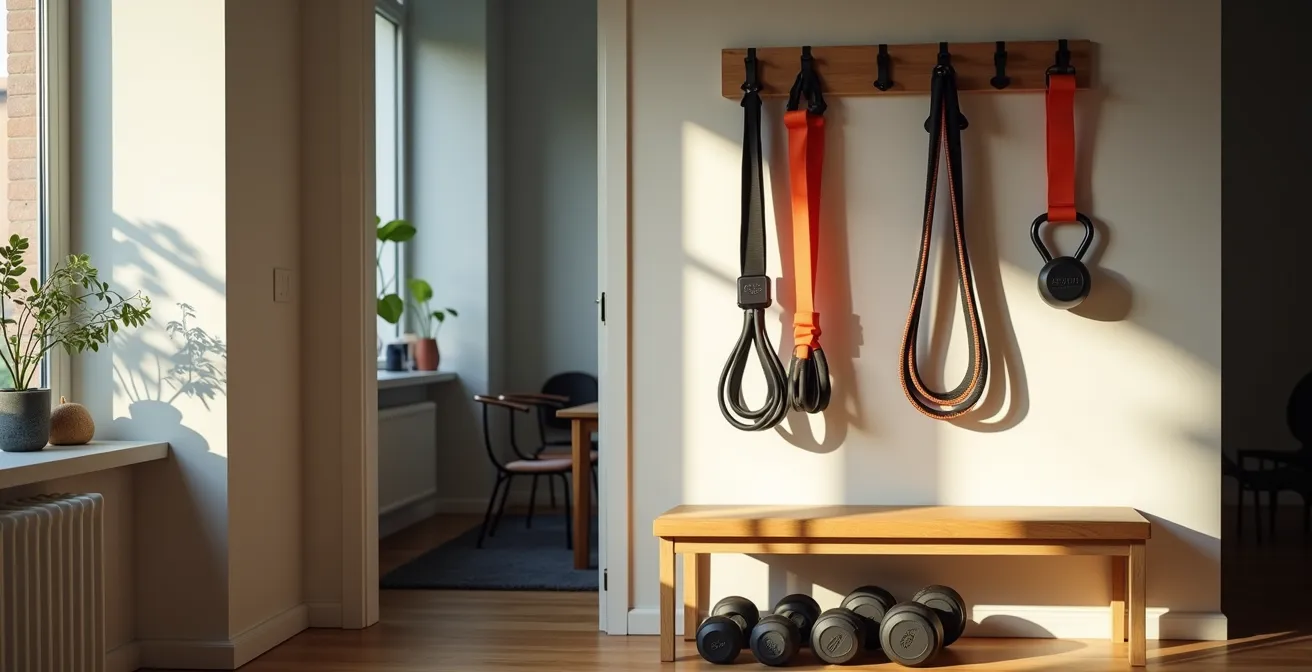
Here are the essential pieces for a small-space setup that prioritizes functional strength and joint health:
- Adjustable dumbbells or resistance bands: These are the cornerstone of progressive overload in a small space, allowing you to increase resistance as you get stronger.
- Doorway pull-up bar: This isn’t just for pull-ups. It serves as a versatile anchor point for resistance bands for rows, pull-aparts, and core exercises.
- Suspension trainer (TRX-style): A phenomenal tool for building functional strength using your bodyweight. It creates a stability challenge that engages your core and supporting muscles, making it exceptionally joint-friendly.
- Balance pad or foam cushion: Proprioception—your body’s sense of its position in space—declines with age. Training on an unstable surface improves this sense, protecting you from falls.
- Fat Gripz or grip strengtheners: Grip strength is a surprisingly powerful predictor of longevity and overall health. These simple tools can be added to any exercise to challenge your hands and forearms.
This minimalist gym isn’t a compromise; it’s a strategic choice. It allows you to focus on movement quality, stability, and consistent progress, which are the true pillars of building and maintaining muscle for a lifetime of activity.
HIIT or Zone 2: How to Plan a 3-State US Road Trip Without Exhaustion or Burnout?
This strange question holds the secret to sustainable fitness after 40. Think of your training week like planning a long road trip. If every day is a frantic, 10-hour drive packed with activities (high-intensity interval training or HIIT), you’ll be exhausted and burned out before you even reach your final destination. You’ll need days off just to recover. But if most of your trip consists of leisurely 4-hour drives with plenty of time for scenic walks and relaxation (Zone 2 training), you’ll arrive energized and have a much more enjoyable journey. The intense days become special highlights, not the draining norm.
This is the essence of polarized training, a philosophy that is particularly effective for the 40+ individual. Your fitness should be built on a large base of low-intensity work (Zone 2), which improves mitochondrial function, cardiovascular health, and your ability to recover. These are workouts where you can hold a conversation comfortably. The high-intensity, breathless efforts (HIIT) are used sparingly—like a spice—to push your top-end capacity. For most people, an 80/20 split between low- and high-intensity work is the sweet spot for progress without burnout.
Applying this “road trip” model to your weekly plan helps you manage your energy and recovery, which are your most precious resources. The table below illustrates how to think about structuring your efforts for long-term success.
| Activity Type | Zone 2 (80% of your training) | HIIT (20% of your training) |
|---|---|---|
| Duration | Longer, sustainable sessions (30-60+ min) | Short, intense bursts (10-20 min) |
| Activities | Brisk walking, cycling, light resistance training | Sprints, heavy lifting, metabolic circuits |
| Recovery Need | Minimal – builds energy & recovery capacity | Significant – 24-48 hours needed after |
| Example Days | Most days of the week for active recovery/base building | 1-2 times per week on days you feel fully recovered |
As fitness experts from Men’s Health wisely state, “The workouts we do are only as good as our ability to recover from them. No recovery, no benefit. Consistency trumps intensity.” Embracing this philosophy means you’re no longer chasing exhaustion as a sign of a good workout. Instead, you’re strategically building a foundation of health that allows you to show up consistently, week after week, which is the real secret to lasting results.
The Form Mistake That Blows Out Knees During Squats
The squat is often called the king of exercises, and for good reason. It’s a fundamental human movement that builds strength in the legs, glutes, and core. However, for many people over 40, it’s also a source of knee pain. The single most common and destructive form mistake is not knee travel, but a lack of hip-first initiation. Many people start the squat by breaking at the knees, pushing them forward and putting immense shear force on the patellar tendon. A safe, powerful squat always begins with a hip hinge—sitting your hips *back* as if aiming for a chair that’s slightly too far behind you.
This hip-dominant movement pattern loads the powerful muscles of your posterior chain (glutes and hamstrings), taking the stress off the knee joint. But getting this right requires more than just thinking “hips back.” It relies on a foundation of ankle mobility and hip stability. If your ankles are tight, your body will be forced to compensate, often by letting your knees cave inward (valgus collapse), another major cause of injury. Similarly, weak hip stabilizers will prevent you from controlling the movement on the way down.
Remember that after 40, your connective tissues recover more slowly than your muscles. While your muscles might feel ready to go in 24-48 hours, tendons and ligaments need 48+ hours or even longer to fully repair from heavy strain. This is why perfect form isn’t optional; it’s the cornerstone of longevity training. Using a checklist to audit your form before every session is a non-negotiable practice.
Your Squat Form Pre-Flight Checklist
- Ankle Mobility Check: Perform the ‘wall test.’ Stand facing a wall with your toes a few inches away. Can you touch your knee to the wall without your heel lifting? If not, work on ankle mobility daily.
- Establish a Tripod Foot: Before you descend, actively grip the floor with your big toe, little toe, and heel. This creates a stable base for the entire movement.
- Initiate with the Hips: The very first movement should be your hips traveling backward. Think “sit back,” not “bend down.”
- Control the Descent: Use a slow, 4-second negative (eccentric) to lower yourself down. This builds motor control and strength through the full range of motion.
- Knees Track Toes: As you descend and ascend, ensure your knees are tracking in the same direction as your feet, never caving inward.
By treating every rep as an opportunity to practice perfect, pain-free movement, you transform the squat from a potential risk into one of your most powerful tools for building a strong, resilient lower body for life.
When to Take a Rest Day: The Heart Rate Variability Signal?
For decades, fitness plans were written in stone: “Monday is chest day, Tuesday is leg day…” This rigid approach completely ignores the most important factor in your progress: your body’s readiness to train. After 40, life’s stressors—a poor night’s sleep, a demanding project at work, or emotional stress—have a much greater impact on your ability to recover and adapt to training. Pushing through when your body is already in a state of high stress is the fastest path to overtraining, injury, and zero progress. In fact, for many, research shows just two quality workouts per week can be highly effective when recovery is properly managed.
So how do you know when to push and when to rest? The most powerful tool for this is Heart Rate Variability (HRV). HRV is the measure of the variation in time between each of your heartbeats. A high HRV indicates that your autonomic nervous system is balanced and in a “rest-and-digest” (parasympathetic) state, ready to handle stress and adapt to training. A low or suppressed HRV indicates your system is in a “fight-or-flight” (sympathetic) state, and adding the stress of a hard workout will only dig you into a deeper recovery hole.

Tracking your HRV, typically with a wearable ring or chest strap first thing in the morning, provides an objective window into your body’s internal state. It moves you from guessing about your recovery to knowing it. This data allows you to auto-regulate your training on a daily basis, a concept known as HRV-guided training.
This approach isn’t about finding excuses to skip workouts. It’s about optimizing your efforts. On days your body is primed, you can push for progress. On days it’s not, you opt for active recovery like a walk or light mobility work, which will actually speed up your recovery and lead to better results long-term. Here is a simple guide to interpreting your daily HRV score.
| HRV Status | Training Recommendation | What it Means |
|---|---|---|
| Green Zone (High/Normal HRV) | Proceed with planned workout, push for intensity | Your body is recovered and ready to adapt to stress. |
| Yellow Zone (Slightly Low HRV) | Stick to planned workout but reduce intensity/volume | You’re not fully recovered; a hard workout may not be productive. |
| Red Zone (Very Low HRV) | Active recovery (walk, stretch) or complete rest | Your body is under significant stress; training will be counterproductive. |
By listening to your HRV, you stop treating your body like a machine and start treating it like the complex, adaptive biological system it is. This is the pinnacle of smart, longevity-focused training.
Why Your Body Holds Trauma Even After Your Mind Relaxes?
You can meditate for an hour, take a relaxing vacation, and feel mentally calm, yet your body might still be stuck in a state of high alert. This is because chronic stress and unresolved trauma are not just “in your head”; they are stored in your nervous system. Your body doesn’t distinguish between the stress of a lion attack, a hostile work environment, or a past traumatic event. To your nervous system, stress is stress, and it triggers a physiological cascade dominated by the hormone cortisol.
While cortisol is useful in short bursts, chronically elevated levels are devastating for anyone trying to build or maintain muscle. Cortisol is a catabolic hormone, which means its primary function is to break things down—including precious muscle tissue—to provide the body with a quick source of energy. As leading fitness researcher Dr. Eric Helms explains, “A dysregulated nervous system from stored trauma leads to chronically elevated cortisol, a catabolic hormone that actively breaks down muscle tissue and prevents new growth.” Essentially, you cannot be in a muscle-building (anabolic) state and a high-stress (catabolic) state at the same time. They are mutually exclusive.
This is why all the perfect training and nutrition in the world can fail if your nervous system is chronically dysregulated. This state of constant internal threat sabotages sleep, impairs digestion and nutrient absorption, and keeps your body in a perpetual state of breakdown. A powerful 2023 study in JAMDA on older adults perfectly illustrates this connection. The research found that those who slept for less than 6 hours a night—a common symptom of a dysregulated nervous system—had a three times higher risk of significant muscle loss (sarcopenia) compared to those who slept 6 to 8 hours. Your body cannot repair and build muscle tissue if it never receives the signal that it is safe to do so. True strength building, therefore, must include strategies that directly address the state of the nervous system.
Melatonin or Magnesium: Which Supplement Actually Helps Long-Term?
In the quest for better recovery, the supplement aisle can feel overwhelming. Two popular sleep aids, melatonin and magnesium, are often seen as interchangeable, but for long-term muscle building and nervous system health, they play vastly different roles. Melatonin is a hormone that your body produces to regulate the sleep-wake cycle. Supplementing with it can be effective for acute situations like jet lag, but chronic use can disrupt your body’s own natural production, creating a dependency.
Magnesium, on the other hand, is a mineral, not a hormone. It’s a crucial cofactor in over 300 enzymatic reactions in the body, many of which are directly related to muscle function and nervous system regulation. It helps the body maintain levels of GABA, a neurotransmitter that promotes calm and relaxation, and it plays a direct role in muscle relaxation by acting as a natural calcium blocker. Most people are deficient in magnesium, and this deficiency can manifest as muscle cramps, poor sleep, and a feeling of being “wired and tired.” For the 40+ individual, ensuring adequate magnesium levels is a foundational piece of the recovery puzzle, not a quick fix.
When building a supplement strategy for longevity, the goal is to support your body’s natural processes, not override them. This means focusing on core nutrients that are essential for hormonal health, energy production, and recovery. In addition to magnesium, a few other supplements have strong evidence for supporting muscle building after 40, especially as natural processes like hormone production begin to change. For example, research shows testosterone levels start declining after age 30, making nutrients that support its production, like Vitamin D, increasingly important.
A smart, minimalist supplement stack focuses on covering these essential bases:
- Magnesium Glycinate or Threonate: Take 200-400mg before bed. These forms are highly bioavailable and less likely to cause digestive upset.
- Creatine Monohydrate: A safe, extensively studied supplement. Take 5g daily to support muscle energy, strength gains, and even cognitive function.
- Vitamin D3: 2000-5000 IU daily, especially for those with limited sun exposure. Get your levels tested to determine your optimal dose.
- Whey/Casein Protein Blend: Aim for 1.4-2g of protein per kg of body weight per day to provide the building blocks for muscle repair. A supplement helps meet this target easily.
By focusing on these foundational supplements, you are directly supporting your body’s ability to recover, regulate its nervous system, and build lean tissue for the long term.
Key Takeaways
- Muscle loss (sarcopenia) is a primary driver of aging, but it is reversible with smart resistance training.
- Building muscle after 40 is a holistic practice that prioritizes nervous system regulation, recovery, and form over sheer intensity.
- Objective data like Heart Rate Variability (HRV) is more effective for guiding training than a rigid schedule.
How to Use Somatic Exercises to Release Chronic Stress in 10 Minutes?
We’ve established that a chronically stressed nervous system actively prevents muscle growth. But how do you consciously shift your body out of this “fight-or-flight” state? This is where somatic exercises come in. “Soma” is the Greek word for “living body,” and these practices are designed to help you reconnect your mind with your body’s internal sensations to release stored tension and regulate your nervous system from the inside out.
Unlike traditional stretching, which focuses on lengthening a muscle, somatic exercises involve gentle, mindful movements that help the brain “reset” the baseline level of tension in the muscles. They teach your nervous system that it is safe to let go. Practices like diaphragmatic breathing, pandiculation (the instinctive stretching and yawning you see in animals), and neurogenic tremoring can have a profound and immediate effect on down-regulating stress and shifting you into a “rest-and-digest” state conducive to recovery and growth.
Integrating a short somatic routine into your day, especially on rest days or before bed, can be a game-changer. It’s not another workout to “crush”; it’s a practice of listening and responding to your body. This 10-minute routine is a powerful way to begin discharging chronic stress and teaching your body the art of deep relaxation.
- Warm-Up (2 min): Begin with 2-3 minutes of gentle movement like walking in place or light cat-cow stretches to increase body awareness.
- Diaphragmatic Breathing (3 min): Lie on your back with knees bent. Place one hand on your chest and one on your belly. Inhale through your nose for 4 seconds, feeling your belly rise. Exhale slowly through your mouth for 6 seconds, feeling your belly fall. This long exhale stimulates the vagus nerve, a key player in the relaxation response.
- Neurogenic Tremoring (3 min): Still on your back, press your feet together and let your knees fall open into a butterfly position. Gently and slowly bring your knees toward each other until your legs begin to shake or tremble slightly. Hold in this trembling zone. This is your nervous system naturally discharging stored energy.
- Body Scan (2 min): Bring your legs to rest. Close your eyes and scan your body from your toes to your head. Simply notice any sensations of warmth, tingling, or heaviness without judgment. This anchors you in the present and solidifies the feeling of calm.
By making these practices a regular part of your routine, you are doing more than just relaxing. You are actively conditioning your nervous system for resilience, creating the optimal internal environment for your body to finally repair, rebuild, and grow stronger.
Building and maintaining muscle after 40 is not a complex puzzle, but a consistent practice of aligning your training with your body’s needs. By shifting your focus from chasing exhaustion to cultivating recovery, you create a powerful, sustainable system for lifelong strength and mobility. Start today by incorporating one of these principles—whether it’s auditing your squat form, tracking your HRV, or practicing a 10-minute somatic routine—and take the first step toward a stronger, more resilient future.