
Contrary to popular belief, style is not about following trends; it’s a powerful psychological tool for enhancing your own cognitive function and strategically managing how others perceive you.
- Your clothing directly influences your abstract thinking and focus through a principle known as “enclothed cognition.”
- Investing in classic, well-tailored staples offers a significantly higher ‘Style ROI’ than chasing fleeting trends.
Recommendation: Begin by auditing your wardrobe not for what’s fashionable, but for what empowers you and aligns with your professional goals.
In the executive world, presence is currency. You want to be taken seriously, to command a room with quiet authority, yet remain approachable enough to foster collaboration. Many professionals believe the answer lies in a rigid uniform: the predictable dark suit, the stiff white shirt. This advice, while safe, is a platitude that misses the most potent aspect of personal style. It treats clothing as a costume to be worn, rather than a tool to be wielded.
The common narrative encourages you to build a wardrobe of “essentials” and “dress for the job you want.” But what if the true key to a signature style wasn’t about the specific garments at all, but about understanding their psychological impact? What if your clothing could actively improve your cognitive performance and fine-tune the signals you send in any professional setting, from a high-stakes negotiation to a casual networking event?
This is the principle of “enclothed cognition”—the scientific reality that what you wear systematically influences how you think, feel, and act, as well as how others perceive your competence. This guide moves beyond the superficial “what to wear.” It’s a strategic brief on how to build a wardrobe that works as an extension of your ambition, giving you an undeniable edge. We will deconstruct your closet, analyze the return on investment of each piece, and master the art of sartorial signaling for maximum impact.
This article provides a complete roadmap for transforming your wardrobe into a strategic asset. Below, you will find a summary of the key areas we will explore to build your authoritative and approachable signature style.
Summary: How to Build a Signature Style for Professional Impact
- Why Dressing Up Can Actually Improve Your Cognitive Performance?
- How to Purge 50% of Your Wardrobe Without Regret?
- Trendy Pieces or Classic Staples: Which Offers Better ROI?
- The Tailoring Mistake That Makes Expensive Suits Look Cheap
- When to Wear Red vs. Blue in Negotiation Settings?
- How to Ensure Your Boss Sees Your Contributions When Working from Home?
- When to Arrive and Leave a Networking Event to Maximize Impact?
- How to Build a 30-Piece Capsule Wardrobe That Works for All Seasons?
Why Dressing Up Can Actually Improve Your Cognitive Performance?
The idea that clothing affects our mind is not just a feeling; it’s a scientifically documented phenomenon called “enclothed cognition.” This concept posits that the symbolic meaning we associate with a piece of clothing, combined with the physical act of wearing it, directly alters our cognitive processes. It’s the reason why putting on a tailored blazer before a video call can make you feel more focused and articulate, even if you’re the only one who sees it. This psychological boost is more than just a placebo effect; it’s a measurable shift in your mental state.
The foundational research in this area is compelling. In a series of experiments, participants who wore a lab coat they were told belonged to a doctor demonstrated significantly higher levels of selective attention compared to those wearing their regular clothes. However, when participants wore the same coat but were told it was a painter’s coat, this cognitive enhancement disappeared. This proves that the effect is more than an abstract theory; it depends on both the act of wearing the garment and the powerful symbolism we attach to it. A suit doesn’t just signal “professional” to others; it signals it to your own brain, priming you for more strategic and abstract thought.
For an executive, this is a powerful tool. Choosing formal attire isn’t just about adhering to a dress code; it’s about intentionally activating a more powerful, “big picture” mindset. When you dress with purpose, you are essentially giving your brain a cue to perform at its peak. This is the first and most fundamental principle of a strategic wardrobe: your clothes are a key interface for your own mind.
How to Purge 50% of Your Wardrobe Without Regret?
Before you can build a wardrobe that projects authority, you must first clear away the noise. Many closets are filled with “aspirational” purchases, items that no longer fit, or garments that simply don’t align with your current professional life. A strategic purge is not about loss; it’s about gaining clarity and making space for pieces that truly serve you. The goal is to create a curated collection where every single item makes you feel confident and empowered. Forget fleeting trends or what you think you *should* wear; this process is about radical honesty concerning your lifestyle and personal brand.
The process of culling your wardrobe should be methodical, not emotional. Instead of asking, “Does this spark joy?” ask, “Does this serve my purpose?” An item that looked good in a fitting room but is uncomfortable to wear for a full day of meetings has failed its primary function. A luxury handbag that sits in a dust bag because it’s impractical for your daily commute is a sunk cost, not an asset. True style is found in the intersection of aesthetics, comfort, and utility.
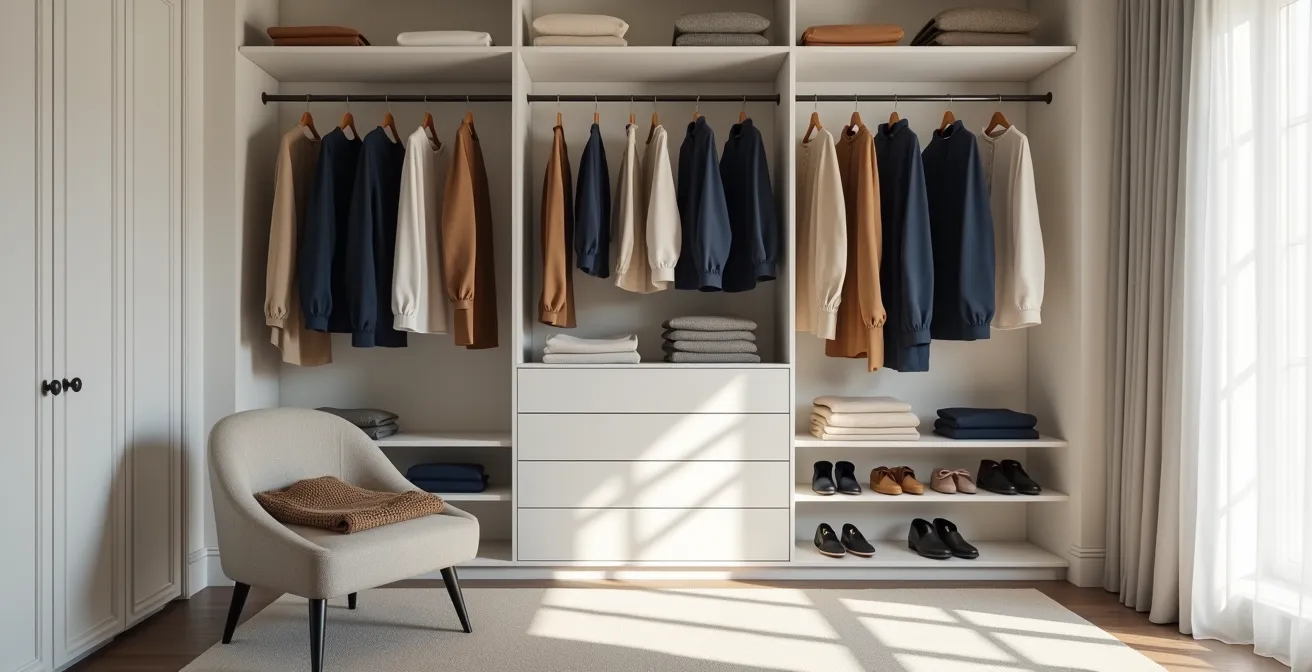
This organized, intentional approach is the visual goal of a successful purge. It represents a shift from a cluttered collection to a high-functioning system. To achieve this, you need a clear plan that prioritizes your real-world needs over sentimental attachments or past style identities.
Your Strategic Wardrobe Purge Plan
- Evaluate Lifestyle Honesty: Be brutally honest about your daily activities. Do you walk a lot? Do you spend most of your day seated? Identify garments that look good but, more importantly, make you feel confident and comfortable throughout your actual workday.
- Assess Flattery and Fit: Isolate the styles that consistently flatter your unique body shape. A piece that requires constant adjustment or makes you feel self-conscious is undermining your presence, regardless of its brand or price tag.
- Define Purpose for Accessories: Choose handbags and shoes that serve specific, practical purposes in your life. A functional, elegant tote you use daily is a better investment than a collection of rarely used luxury items.
- Prioritize Comfort with Aesthetics: When selecting which pieces to keep, especially shoes, consider both comfort and aesthetic appeal. Your wardrobe choices must support, not hinder, your daily activities. An empowered professional is one who can move through their day with ease.
- Create a ‘Maybe’ Box: If you are unsure about an item, place it in a ‘maybe’ box. If you haven’t reached for it in three months, its fate is sealed. This removes the immediate pressure of a final decision while still enforcing a strict curation process.
Trendy Pieces or Classic Staples: Which Offers Better ROI?
Once your wardrobe has been purged of clutter, the rebuilding phase begins. This is where many professionals face a critical decision: should you invest in trendy, of-the-moment pieces to appear current, or double down on timeless, classic staples? As a stylist for executives, my advice is unequivocal: approach your wardrobe with the mindset of an investor. Your goal is to maximize your Style Return on Investment (ROI), which is measured not by compliments, but by versatility, longevity, and a low cost-per-wear.
Trendy pieces—the brightly colored blazer of the season or the “it” bag—have a steep depreciation curve. They are exciting for a short period but quickly feel dated and offer limited pairing options. Classic staples, on the other hand, are the blue-chip stocks of your wardrobe. A perfectly tailored navy blazer, a high-quality silk blouse, or a pair of well-made leather loafers are foundational assets. They can be mixed and matched endlessly, transcend seasonal fads, and look appropriate in nearly any professional context. Their value is realized over years of consistent wear, not a single season.
The following table breaks down this investment analysis, illustrating why a foundation of classic staples is the most strategic approach. According to a recent investment analysis, basing your wardrobe on core neutrals provides a versatile and long-lasting foundation.
| Aspect | Classic Staples | Trendy Pieces |
|---|---|---|
| Investment Strategy | Base neutrals like black, navy, gray form wardrobe foundation | Swap 1-2 colors seasonally for freshness |
| Versatility | Mix and match with everything | Limited pairing options |
| Longevity | Multiple seasons/years | 1-2 seasons typically |
| Cost Per Wear | Lower due to frequent use | Higher due to limited wear |
This data-driven approach removes emotion from shopping and reframes it as a strategic allocation of resources. The smartest executives build their authority on a bedrock of quality and timelessness, as noted by style experts.
Avoid trends and logos at all costs. Look for generational designs that will never go ‘out of style’ and look great on you.
– Articles of Style, Essential Capsule Wardrobe Guide
The Tailoring Mistake That Makes Expensive Suits Look Cheap
Nothing sabotages a powerful first impression faster than poor fit. You can be wearing a suit crafted from the finest wool, but if the shoulders are too wide or the trousers pool around your ankles, its perceived value plummets. This is the single most common mistake professionals make: they invest in expensive garments but neglect the final, crucial step of expert tailoring. An affordable, off-the-rack suit that has been perfectly tailored to your body will always look more authoritative than a luxury suit that hangs improperly.
The most critical area to get right is the shoulder. The seam of the jacket’s shoulder should end precisely where your natural shoulder does. If it extends past this point, it creates a sloppy, borrowed look. If it’s too narrow, it will pinch and restrict movement. Another common error is incorrect sleeve and trouser length. A jacket sleeve should end to reveal about a half-inch of shirt cuff, creating a clean, deliberate line. Trousers should have a slight break or no break at all, grazing the top of your shoes for a sharp, modern silhouette.
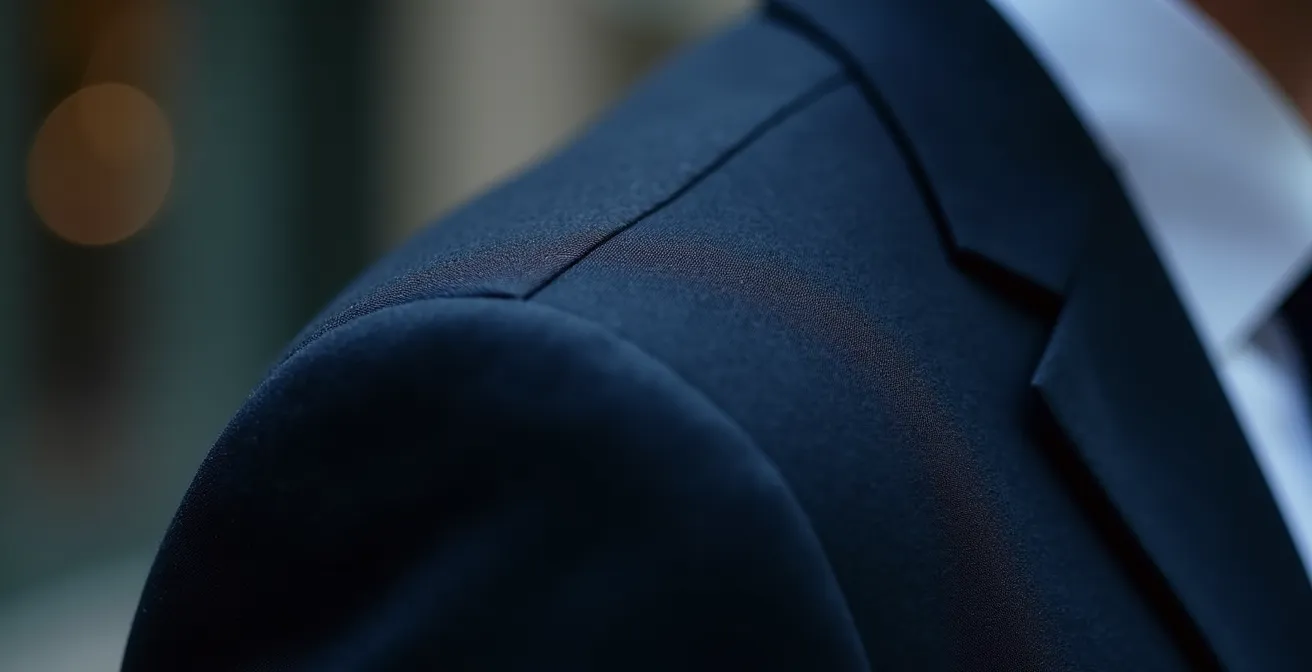
These details—the precise construction of a shoulder, the subtle stitching on a lapel—are what separate an adequate garment from an authoritative one. These are the markers of quality and attention to detail that are subconsciously registered by others. As confirmed by a statement that great fit makes you look put together, memorable, and more in shape, your style automatically becomes a tool that supports your message. A great tailor is not a luxury; they are a non-negotiable partner in building your professional brand.
When to Wear Red vs. Blue in Negotiation Settings?
Color is one of the most powerful and subconscious forms of non-verbal communication. In high-stakes environments like a negotiation, your color choice is not merely aesthetic; it’s a strategic signal. The common advice—blue for trust, red for power—is an oversimplification. A sophisticated professional understands the nuance and deploys color with surgical precision based on their objective. The psychology of color is complex; for instance, some research has shown that clothing color can be associated with attitudes on social issues, highlighting its subtle but deep impact.
Let’s move beyond the basics and consider the strategic application of red versus blue in a negotiation.
- Blue (Specifically Navy or Royal Blue): This is the color of stability, calm, and expertise. Wearing blue is an excellent strategy when your goal is to build rapport, appear credible, and foster a collaborative atmosphere. It non-verbally communicates that you are a trustworthy and rational partner. It’s the ideal choice when you are in a position of strength and want to put the other party at ease, or when you are trying to de-escalate a tense situation. It projects approachable authority.
- Red (In moderation, like a tie or a blouse): Red is the color of dominance, energy, and attention. It is physiologically arousing and demands to be seen. Wearing red is a high-risk, high-reward strategy. It should be used when you need to project unwavering confidence, command attention, or disrupt the status quo. It is particularly effective if you are in a weaker negotiating position and need to signal that you will not be overlooked. However, it can also be perceived as aggressive, so it should be balanced with otherwise conservative attire. It projects unapologetic authority.
The choice is not about which color is “better,” but which color best serves your strategic goal for that specific interaction. Are you building a bridge or are you drawing a line in the sand? Answering this question will tell you whether to reach for the calming influence of blue or the commanding power of red.
How to Ensure Your Boss Sees Your Contributions When Working from Home?
In a remote work environment, visibility is a challenge. Without the daily, informal interactions of the office, your professional image is largely defined by the small window of a video call. This is where enclothed cognition becomes a critical tool for “perception management.” Dressing professionally for your home office does more than just signal competence to your boss; it fundamentally alters your own mindset, leading to better work and, consequently, greater recognition.
Research on formal attire has found that it promotes abstract thinking and a “big picture” cognitive style. When you wear a blazer instead of a sweatshirt, you are not just dressing for your boss; you are priming your own brain for more strategic, high-level thought. This enhanced cognitive state naturally translates into higher-quality contributions—more insightful comments in meetings, more thorough strategic plans, and a more commanding presence on screen. Your boss may not consciously register your outfit, but they will absolutely notice the elevated quality of your input.
Furthermore, your attire directly influences how others perceive your intelligence and competence. This isn’t speculation; it’s backed by research.
Women who dress in a masculine fashion during a job interview are more likely to be hired, and a teaching assistant who wears formal clothes is perceived as more intelligent than one who dresses casually. The clothing you wear affects your psychological processes.
– Adam D. Galinsky, MIT Sloan Management Review
In a remote context, “dressing up” creates a powerful visual cue that you are taking your role seriously. It combats the perception of casualness that can come with working from home and reinforces your image as a dedicated, authoritative professional. It is a simple, daily action that ensures your presence and contributions are given the weight they deserve.
When to Arrive and Leave a Networking Event to Maximize Impact?
A networking event is a strategic theater, and your attire is a key part of your performance. However, a truly savvy professional knows that *what* you wear should be synchronized with *when* you are there. Your style should be dynamic, adapting to your goals as the event evolves from initial introductions to deeper conversations. The objective is to fluidly balance authority with approachability, using your wardrobe to facilitate the right kind of connections at the right time. As leadership research shows that professionalism reinforces credibility while ensuring approachability is perceived positively.
Think of the event in three phases, each with its own style strategy. Arriving too early in a power suit can seem intimidating, while staying late in overly formal attire can feel stiff. The key is to match your sartorial signals to the energy of the room and your specific networking objectives for that moment.
The following timeline offers a strategic guide to dressing for maximum impact throughout a networking event. It demonstrates how to modulate your style to align with different phases of the evening.
| Arrival Time | Style Strategy | Impact Goal |
|---|---|---|
| Early Arrival | More approachable pieces: Silk tops under cardigans | Build rapport easily |
| Peak Time | Authority pieces: Structured blazer | Make strong impression |
| Late Stay | Linen or flannel alternatives for comfort | Deep conversations |
This timeline approach transforms your outfit from a static costume into a dynamic tool. For early arrival, a softer look like a silk top under a cardigan invites conversation. As the event hits its peak, you can add a structured blazer to project more authority when making key introductions. If you plan to stay late for more in-depth discussions, having a more comfortable yet still polished layer, like a fine-gauge knit, ensures you remain engaged and approachable, not rigid.
Key Takeaways
- Your clothing is not passive; it actively influences your cognitive performance and how others perceive your authority through “enclothed cognition.”
- A strategic wardrobe is built on a foundation of timeless, perfectly tailored classics that offer a high “Style ROI,” not on fleeting trends.
- Style should be dynamic, adapting your signals (like color and formality) to specific contexts such as negotiations, remote meetings, and networking events.
How to Build a 30-Piece Capsule Wardrobe That Works for All Seasons?
The ultimate expression of a strategic wardrobe is the capsule wardrobe. This is not about minimalist deprivation; it’s about maximum efficiency and unwavering style. A well-curated 30-piece capsule ensures that you can create dozens of polished, authoritative outfits with minimal effort. It eliminates decision fatigue and guarantees that every single item in your closet is a high-performer that works in harmony with the others. The foundation of this system is a tight color palette and a focus on quality over quantity.
The core of your capsule should be built on a base of 2-3 neutral “core colors” like navy blue, charcoal gray, and white or cream. These timeless shades are unifying and provide the versatile canvas upon which you can layer accent colors. For a 30-piece all-season wardrobe, the breakdown might look something like this: 5-7 bottoms (trousers, skirts), 7-9 tops (blouses, knits, shirts), 5 outerwear pieces (blazers, coats, cardigans), 4 pairs of shoes, and 5 key accessories. This structure provides near-infinite combinations.
When selecting pieces, prioritize versatile fabrics and silhouettes. For example, breathable linen or high-quality wool trousers can transition across seasons. A long-line button-up blazer adds instant sophistication to any outfit, while classic leather loafers are appropriate for almost any business-casual setting. The key is that each piece must be able to be styled in at least three different ways with other items in your capsule.
Buy the best quality you can afford so it will last. Never buy anything that doesn’t fit properly. Avoid trends and logos. Look for generational designs that will never go out of style.
– Articles of Style, Professional Capsule Wardrobe Guide
By implementing these principles, you transform your relationship with clothing from a daily chore into a source of power. Your signature style becomes less about the clothes themselves and more about the confidence, authority, and clarity of thought they unlock. Start today by choosing one area to improve, whether it’s tailoring a favorite blazer or planning your capsule, and take the first step toward mastering your professional presence.