
Resetting your body clock after years of shift work requires systematically recalibrating your core biological signals—light, temperature, and hormonal timing—not just following generic sleep hygiene tips.
- Evening exposure to blue light from screens actively suppresses melatonin, the hormone that initiates sleep.
- A controlled drop in your bedroom’s temperature is a powerful, natural trigger for drowsiness that mimics the body’s own rhythm.
- The key is to create strong, consistent “circadian anchors” that tell your body when to be awake and when to sleep, regardless of the sun.
Recommendation: Begin by implementing a strict light-management protocol: get bright light exposure immediately upon waking (even if it’s nighttime) and eliminate all blue light 2-3 hours before your intended sleep time.
For years, you’ve felt it: a persistent, low-grade jet lag that never quite goes away. The brain fog during your shift, the struggle to stay present with family, and the frustrating inability to achieve deep, restorative sleep. As a night-shift worker, you’ve likely heard the standard advice—invest in blackout curtains, avoid caffeine, try to stick to a schedule. While well-intentioned, these tips often feel like applying a bandage to a complex biological problem.
The fatigue you’re experiencing isn’t a simple lack of sleep; it’s a profound “entrainment mismatch.” Your internal biological clock, a master timekeeper in your brain honed by millennia of sunrises and sunsets, is in direct conflict with your external world. This battle wages a war on your hormones, your metabolism, and your cognitive function. The conventional wisdom addresses the symptoms but fails to tackle the root cause: a desynchronized circadian rhythm.
But what if the solution wasn’t just about blocking out the world, but about actively sending your body the right signals at the right time? The key to reclaiming your energy and focus lies in understanding and manipulating the fundamental environmental cues your body uses to set its clock. This isn’t about willpower; it’s about biology. It’s about becoming the architect of your own internal environment by strategically using light, temperature, and timing to create powerful new circadian anchors.
This guide will walk you through the science-backed strategies to systematically recalibrate your body’s internal clock. We will explore how to manage light exposure, optimize your sleep environment, use supplements intelligently, and structure your day to work with your biology, not against it. By understanding these mechanisms, you can move beyond simple ‘tips’ and build a robust, resilient rhythm adapted to the demands of your life.
Summary: How to Fix Your Circadian Rhythm After Years of Shift Work?
- Why Looking at Your Phone at 10 PM Destroys Deep Sleep Quality?
- How to Soundproof Your Bedroom for Under $100?
- Melatonin or Magnesium: Which Supplement Actually Helps Long-Term?
- The Snoring Sign That Indicates You Are Suffocating at Night
- When to Adjust Your Thermostat to Trigger Natural Drowsiness?
- When to Schedule Meetings for Teams Across 3 Time Zones?
- The Morning Routine Mistake That Drains Your Willpower by Noon
- How to Achieve “Deep Work” States in an Open-Plan Office?
Why Looking at Your Phone at 10 PM Destroys Deep Sleep Quality?
The single most powerful signal for your internal clock is light. For a shift worker, managing light exposure is not just a preference; it is a critical medical intervention. The blue-wavelength light emitted by smartphones, tablets, and computers is particularly disruptive because it directly mimics the light of midday sun. When your brain perceives this light in the evening, it sends a powerful “wake up” signal, triggering a hormonal cascade that is the exact opposite of what you need for sleep. The most immediate victim of this process is melatonin, the hormone that signals your body it’s time to wind down.
The biological impact is not subtle. In fact, specific research confirms that exposure to an LED screen for just two hours can lead to a significant delay in the onset of melatonin release. One study on young adults found a melatonin onset delay of 1.5 hours after using a tablet before bed. Crucially, research from 2024 demonstrates a 55% decrease in melatonin after just a two-hour exposure to an LED screen. This effectively slams the brakes on your body’s natural sleep-initiation process, fragmenting your sleep architecture and robbing you of the restorative deep sleep and REM stages that are crucial for memory consolidation and physical repair.
To counteract this, you must create an artificial “sunset” in your environment. This is a non-negotiable step in establishing a strong circadian anchor for sleep. Consider this protocol your first line of defense:
- Install blue-light blocking software on all your devices (like f.lux or Night Shift) and set it to activate at least 3 hours before your intended sleep time.
- Switch your home’s evening lighting to warm-color temperature bulbs (2700K or lower) to minimize blue light exposure after sunset or post-shift.
- If screen use is unavoidable, keep the device at arm’s length and reduce the brightness to its absolute minimum setting.
- Establish a firm rule: all screens off and out of the bedroom an hour before you plan to sleep. This creates a “darkness sanctuary” that reinforces the sleep signal to your brain.
How to Soundproof Your Bedroom for Under $100?
While light is the primary driver of your circadian rhythm, your sleep can be just as easily derailed by a more primal threat: unexpected noise. For a shift worker trying to sleep during the day, the world is full of these threats—delivery trucks, lawnmowers, a neighbor’s dog. These sounds trigger a micro-arousal in the brain, pulling you out of deep sleep even if you don’t fully wake up. Creating an acoustic sanctuary is the second pillar of building a resilient sleep environment, and it doesn’t require a costly renovation.
The goal is not to achieve total silence, which is nearly impossible, but to absorb and block disruptive frequencies. This involves a layered approach targeting the weakest points in your room: doors and windows. Sound, like water, will find the path of least resistance. Small gaps around a door can let in a surprising amount of noise. Likewise, standard windows offer little defense against outside traffic.
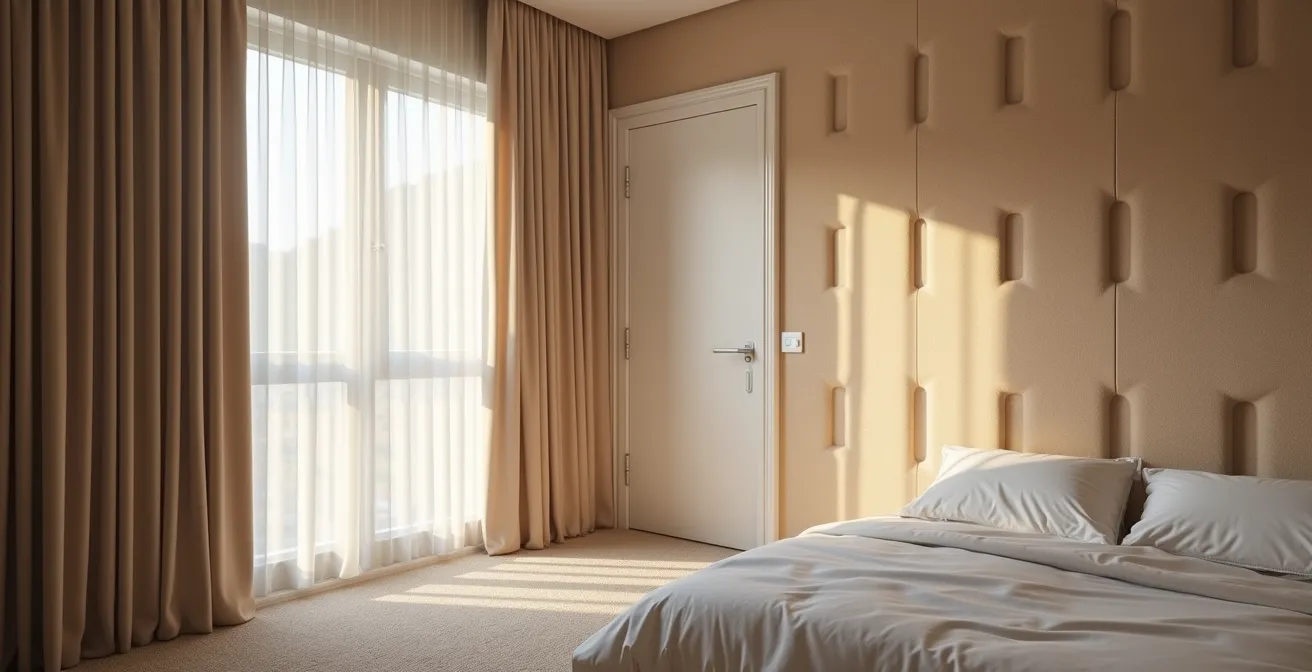
As you can see in the image, a combination of soft surfaces and physical barriers creates a powerful sound-dampening effect. Heavy, multi-layered blackout curtains do double duty, blocking both light and sound waves. Soft furnishings like thick rugs and upholstered furniture absorb ambient noise within the room. For a highly effective and budget-friendly strategy, focus on sealing air gaps and masking unavoidable sounds. A white noise machine is a shift worker’s best friend, creating a consistent, soothing auditory blanket that makes sudden noises less jarring to your sleeping brain. The following table breaks down the most cost-effective solutions.
| Solution | Cost Range | Effectiveness | Installation Difficulty |
|---|---|---|---|
| Door sweep & weatherstripping | $15-25 | High for gaps | Easy (30 min) |
| Heavy blackout curtains | $30-50 | Moderate-High | Easy (1 hour) |
| White noise machine | $25-40 | High for masking | None |
| Acoustic caulk for gaps | $10-15 | High for sealing | Easy-Moderate |
Melatonin or Magnesium: Which Supplement Actually Helps Long-Term?
In the quest for better sleep, many shift workers turn to the supplement aisle. The two most common options, melatonin and magnesium, work through vastly different biological pathways, and understanding this distinction is key to using them safely and effectively. It’s not a question of which is “better,” but which is appropriate for your specific problem. This is especially critical given that recent 2023 research involving 37,000 shift workers found that 51% report at least one clinical sleep disorder, indicating a deep-seated biological disruption that requires more than a simple sleep aid.
Melatonin can be used to shift circadian rhythms when appropriately timed and dosed. Modafinil is a stimulant that is FDA-approved to help with alertness during shift work.
– American Academy of Sleep Medicine, Circadian Adaptation to Shift Work Clinical Guidelines
Melatonin is a hormone, not a sedative. Its function is to signal “nighttime” to your brain. Taken at the wrong time, it can further disrupt your clock. For a shift worker, melatonin can be a powerful tool for *shifting* your rhythm, but it must be timed precisely. For example, taking a very low dose (0.5mg to 1mg) in the afternoon can help advance your sleep cycle if you need to go to bed earlier than usual. However, using it as a nightly “sleeping pill” can lead to dependency and mask underlying problems like sleep apnea. It is a short-term tool for adaptation, not a long-term solution.
Magnesium, on the other hand, is a mineral that plays a role in relaxation. It doesn’t directly induce sleep but can help calm the nervous system. It works by binding to GABA receptors in the brain, which are the same receptors targeted by drugs like Valium. Magnesium can help reduce anxiety and muscle tension, making it easier to fall asleep, especially if you feel “wired but tired” after a shift. Forms like magnesium glycinate or threonate are well-absorbed and less likely to cause digestive issues. Unlike melatonin, magnesium addresses the physiological state of arousal, not the circadian timing itself, making it a generally safer long-term support for sleep quality without the risk of hormonal disruption.
The Snoring Sign That Indicates You Are Suffocating at Night
Snoring is often dismissed as a mere annoyance, but for a shift worker, it can be a critical red flag for a much more dangerous condition: Obstructive Sleep Apnea (OSA). OSA occurs when the throat muscles relax excessively during sleep, causing the airway to collapse and blocking airflow. The body, starved of oxygen, forces a brief, panicked awakening to restore breathing. This can happen hundreds of time a night without your conscious awareness, completely destroying your sleep quality and putting immense strain on your cardiovascular system.
Shift work itself is a major risk factor for worsening OSA. The sleep deprivation and circadian misalignment inherent in the job can reduce upper airway muscle tone. The result is stark: clinical studies show that the Apnea-Hypopnea Index (AHI), a measure of apnea severity, can skyrocket in shift workers. One study observed the AHI in individuals with pre-existing OSA increasing from an average of 32 events per hour during normal night sleep to 50 events per hour during daytime sleep following a night shift. This means the person was effectively choking and gasping for air almost once every minute.
The key is to distinguish benign snoring from the hallmark sign of apnea. The dangerous signal is not the sound itself, but the pattern of sound and silence. A person with OSA will often snore loudly, followed by a period of dead silence (the apnea event, lasting 10 seconds or more), which is then broken by a loud gasp, choke, or snort as the body fights for air. This “silence-choke-gasp” cycle is the most definitive sign that you are suffocating in your sleep. Other tell-tale symptoms include waking up with severe dry mouth (from gasping), persistent morning headaches, and extreme daytime sleepiness that isn’t relieved even by long hours in bed.
When to Adjust Your Thermostat to Trigger Natural Drowsiness?
After light, the second most influential external cue for your body’s clock is core body temperature. Your circadian rhythm naturally orchestrates a slight drop in core temperature in the evening to help initiate sleep. You can “hack” this process and create another powerful circadian anchor by manipulating your ambient room temperature. Allowing your body to cool down is a potent, non-pharmacological signal for drowsiness.
The strategy is to create an exaggerated temperature gradient between your body and your environment, which facilitates the necessary drop in your core temperature. This doesn’t mean sleeping in a frigid room all night. The key is the timing of the temperature change. For a shift worker aiming for daytime sleep, you should program your thermostat to begin dropping one to two hours *before* your desired bedtime. This pre-cooling of the environment signals to your body that sleep is approaching, encouraging the natural release of melatonin and preparing you for rest.
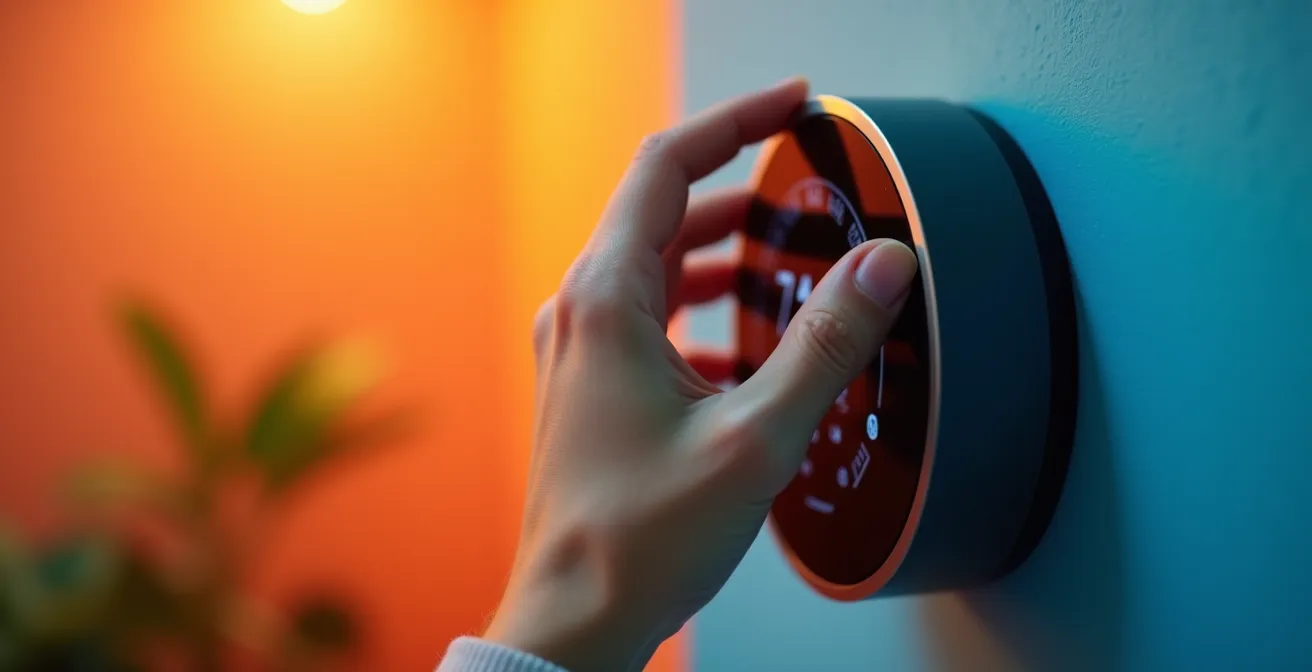
The ideal sleep temperature for most people is between 60-67°F (15-19°C), but the drop is more important than the absolute number. A compelling case study demonstrated the power of this technique: night shift workers who programmed their thermostats to drop from 70°F to 66°F (21°C to 19°C) one hour before their daytime sleep reported a 23% improvement in sleep quality scores. They also significantly reduced the number of times they woke up during their sleep period. This simple environmental adjustment actively supports the biological process of falling asleep and staying asleep, making your rest deeper and more restorative.
When to Schedule Meetings for Teams Across 3 Time Zones?
For a shift worker, the challenge of cognitive performance isn’t confined to the workplace; it extends to collaborating with colleagues on a standard 9-to-5 schedule. Scheduling meetings across multiple time zones is a logistical nightmare made worse by the reality of chronotype adaptation (or lack thereof). Your “circadian peak”—the time of day when you are most alert and cognitively sharp—is likely inverted compared to your “day-walker” colleagues. Forcing yourself into a high-stakes meeting during your biological low point is a recipe for poor decision-making and burnout.
Attempting to find a “one-size-fits-all” meeting time is often futile. A time that is acceptable for a “morning lark” in London (e.g., 9 AM) is a cognitive dead zone for a “night owl” in Los Angeles (1 AM) and may fall during the post-shift sleep period for a recovering shift worker in Tokyo. The most effective strategy is to first acknowledge these biological differences and then schedule tasks according to their cognitive demand. High-stakes, decision-making meetings should be protected, while routine updates can be handled asynchronously through email or recorded videos.
When a synchronous meeting is unavoidable, the goal is to find the “least bad” time for everyone. This often means the morning lark has to push their meeting a little later, and the night owl has to start a bit earlier. The recovering shift worker, whose rhythm is most fragile, should be given the most flexibility. Understanding your own chronotype and communicating your peak performance window to your team is not a sign of weakness; it’s a professional responsibility. This table illustrates how different chronotypes have vastly different windows for optimal performance.
| Chronotype | Peak Performance Window | Avoid Scheduling | Best Compromise Time |
|---|---|---|---|
| Morning Lark | 8 AM – 12 PM | After 7 PM | 10-11 AM |
| Night Owl | 4 PM – 9 PM | Before 10 AM | 2-4 PM |
| Recovering Shift Worker | Variable/Inverted | Early morning | Flexible/Async |
The Morning Routine Mistake That Drains Your Willpower by Noon
For a shift worker, the first hour after waking is the most critical period for setting your entire biological day. A common mistake is to immediately reach for your phone and a cup of coffee. This seemingly innocent routine actively sabotages your body’s natural waking process and depletes your finite reserves of willpower. Your body is designed to have a natural hormonal cascade upon waking, led by a sharp rise in cortisol. This cortisol peak is a healthy, natural signal that energizes you and promotes alertness.
When you flood your system with caffeine first thing, you are artificially blunting this natural cortisol response. Over time, your body learns to produce less cortisol in the morning because it expects the external stimulation from coffee. This creates a dependency cycle where you feel increasingly sluggish without it. Furthermore, checking emails and social media immediately upon waking forces your brain into a reactive, decision-fatigued state before the day has even begun. This depletes the mental energy you need for complex tasks later on. In fact, 2023 research on circadian hormones revealed that cortisol levels increased while melatonin decreased in blue light filter users, underscoring how light and hormones are intricately linked from the moment you wake.
A willpower-preserving morning routine does the opposite: it supports and amplifies your body’s natural rhythm. The goal is to get bright light exposure as quickly as possible, delay caffeine, and engage in a proactive task before letting the world’s demands rush in. This stabilizes your cortisol rhythm and protects your executive function for when you need it most.
Your Willpower-Preserving Morning Routine Checklist
- Prepare all morning decisions the night before (clothes, breakfast, first task).
- Wait 90 minutes after waking before consuming caffeine to allow your natural cortisol peak to occur.
- Expose yourself to bright natural light (or a light therapy lamp) within 30 minutes of waking.
- Complete one ‘proactive’ task (e.g., 5 minutes of journaling, planning your shift) before checking any messages or emails.
- Use a consistent wake time, even on days off, to stabilize and anchor your cortisol rhythm.
Key takeaways
- Your body clock is controlled by environmental signals (circadian anchors), primarily light and temperature, not just willpower.
- Fixing your rhythm requires a systematic approach: create an artificial sunset with zero blue light before bed and an artificial sunrise with bright light upon waking.
- Snoring that involves pauses in breathing followed by gasps is a serious medical sign of sleep apnea, a condition worsened by shift work.
How to Achieve “Deep Work” States in an Open-Plan Office?
For the shift worker, achieving a state of “deep work”—intense, distraction-free concentration—is the ultimate challenge, especially in a stimulating environment like an open-plan office. Your internal clock is already fighting against your schedule, making your windows for peak cognitive performance precious and often misaligned with the standard workday buzz. Simply trying to force concentration at 10 AM, when the office is most active but your brain is in a biological trough, is a losing battle.
The solution lies in a radical acceptance of your unique biology and a strategic defense of your personal peak time. As a chronobiologist, I urge you to see your schedule not as a defect, but as a different operating system that requires its own set of rules. As Dr. Steven W. Lockley, a leading expert in the field, advises, you must identify your own circadian peak and guard it ruthlessly.
As a former shift worker, your internal clock may be different. Instead of forcing deep work at 10 AM with everyone else, identify your personal ‘circadian peak’ and block that time religiously for your most demanding tasks.
– Dr. Steven W. Lockley, Timeshifter Chief Scientist on Shift Work Adaptation
This means first tracking your energy levels for a week to identify the 2-4 hour window when you feel most sharp. Once identified, this time block becomes a non-negotiable meeting on your calendar, protected for your most cognitively demanding work. Communicate this to your team not as an inconvenience, but as a strategy to produce your best work. During this time, employ physical “do not disturb” signals like noise-canceling headphones and a designated quiet workspace. Furthermore, studies show that structured breaks involving physical activity can significantly boost alertness. A recent study found that shift workers who used 50-minute work sprints followed by 10-minute activity breaks showed a 31% increase in within-shift alertness. This combination of temporal protection and physical intervention allows you to create a “deep work” bubble even in the most chaotic environment.
By systematically applying these biological principles—managing light, controlling temperature, timing your routines, and protecting your cognitive peaks—you can move from a state of surviving shift work to thriving in it. The next logical step is to begin tracking your current habits to identify the single biggest point of friction, and start with the one change that will have the most immediate impact on your sleep quality.
Frequently asked questions on How to Fix Your Circadian Rhythm After Years of Shift Work?
What’s the difference between normal snoring and sleep apnea?
Normal snoring is continuous and often improves with position changes. Sleep apnea involves periods of silence lasting 10+ seconds followed by gasping or choking sounds.
What are the less obvious signs of sleep apnea in shift workers?
Persistent morning headaches, waking with extremely dry mouth, uncontrolled high blood pressure, and falling asleep during meetings or at traffic lights.
When should I seek medical evaluation for snoring?
If snoring is loud and explosive in any position, accompanied by witnessed breathing pauses, or if you experience excessive daytime sleepiness despite adequate time in bed.