In summary:
- Shift your mindset from “keeping a plant alive” to “curating a micro-ecosystem” that benefits both you and your greenery.
- Mastering the correct watering technique (from the bottom up) is the single most important factor in preventing common pests and root rot.
- Strategic plant arrangement is not just for aesthetics; it can create privacy, improve air quality, and directly reduce stress.
- Success in low light is about choosing the right species and understanding their subtle needs for rotation and care.
For the nature lover in a city apartment, the sight of a wilting houseplant in a dim corner is a familiar heartbreak. You’ve followed the basic advice, perhaps bought a so-called “indestructible” snake plant or ZZ plant, yet you still find yourself with yellowing leaves and a sense of failure. This cycle can make you believe you simply lack a “green thumb,” especially when your home is starved of the bright, direct sunlight featured in idyllic gardening magazines.
The common wisdom often stops at listing a few tolerant species, failing to address the deeper environmental challenges of a low-light space. But what if the secret wasn’t about finding one magic plant, but about changing your entire approach? What if you could learn to think like a horticulturist and create a thriving indoor sanctuary, a biophilic ecosystem designed for well-being, even with limited natural light? The key is to move beyond mere survival and embrace the principles of active, intentional nurturing.
This guide provides a new framework. We will explore the science behind why plants make us feel better, how to use them for practical purposes like privacy, and the specific techniques for watering and maintenance that make all the difference. You’ll learn to read your plants’ subtle cues and build an environment where both you and your green companions can flourish.
To help you navigate this journey from plant-killer to plant-curator, we’ve structured this guide to cover every aspect of creating your low-light oasis. Explore the sections below to cultivate your knowledge and confidence.
Summary: How to Create a Thriving Indoor Garden in a Dark Apartment
- Why Looking at Fracture Patterns in Leaves Reduces Stress?
- How to Arrange Plants to Create Privacy Without Curtains?
- Living Walls or Moss Walls: Which Requires Less Maintenance?
- The Watering Mistake That Breeds Fungus Gnats in Your Home
- When to Rotate Your Plants to Ensure Even Growth?
- How to Reset Your Nervous System in 60 Seconds at Your Desk?
- Why New Carpets Can Give You Headaches for Months?
- How to Set Boundaries With a Toxic Boss Without Risking Your Job?
Why Looking at Fracture Patterns in Leaves Reduces Stress?
The calming effect of being in nature, a concept known as biophilia, is more than just a feeling; it’s a measurable physiological response. Your brain is hardwired to find solace in the patterns of the natural world, even on a miniature scale. One of the most powerful and accessible examples of this is found in the intricate network of veins on a simple leaf—its “foliar architecture.”
These branching patterns are a type of natural fractal. Fractals are complex, self-repeating patterns that are ubiquitous in nature, from snowflakes and coastlines to the very structure of our lungs. Our visual system processes these patterns with remarkable ease, inducing a state of relaxed awareness. In fact, compelling research shows that viewing fractal patterns can trigger a significant physiological shift, leading to a 60% reduction in stress levels compared to viewing simple or chaotic patterns. This response is thought to be an evolutionary holdover, as our ancestors associated these natural geometries with the presence of water and life.
So, when you pause to admire the delicate veins of a Calathea or the structured lines of a nerve plant, you are doing more than just appreciating its beauty. You are engaging in a subconscious form of therapy. You are allowing your mind to lock into a pattern it is programmed to find restorative, lowering your heart rate and blood pressure. This makes even a single, well-tended plant in a low-light apartment a powerful tool for mental well-being.
How to Arrange Plants to Create Privacy Without Curtains?
In an apartment, creating a sense of privacy without blocking precious light can be a challenge. Curtains and blinds often feel binary—either fully open or fully closed. Plants, however, offer a dynamic and beautiful solution: a living, light-filtering screen that provides seclusion while maintaining a connection to the world outside.
The key is to think in layers, just as a landscape designer would. By combining plants of different heights and forms, you can build a green veil that obscures the direct line of sight from the outside while allowing dappled light to filter through. This approach not only solves a practical problem but also adds depth and a jungle-like feel to your space.
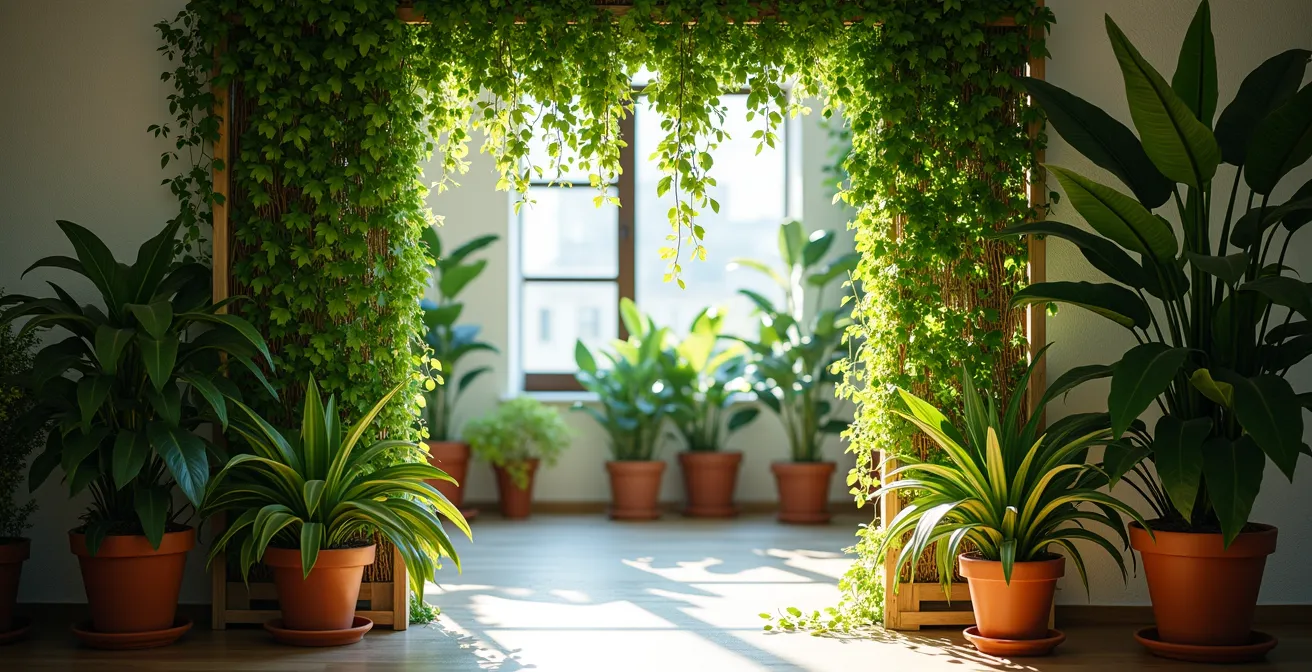
As you can see in this arrangement, the goal is not to create an impenetrable wall, but a permeable screen. The interplay of light and shadow through the leaves creates a beautiful, ever-changing pattern that enhances the room’s ambiance. This technique is surprisingly easy to implement, even without drilling holes.
- Background Layer (Tall Plants): Start with tall, slender floor plants that are well-suited for low light. Species like the Snake Plant (Sansevieria trifasciata), ZZ Plant (Zamioculcas zamiifolia), or a Lisa Cane (Dracaena ‘Lisa’) can reach heights of 5-6 feet and form a solid backdrop.
- Middle Layer (Medium Plants): Next, add medium-height, bushy plants on stands or low tables to fill in the gaps at eye level. Chinese Evergreens (Aglaonema) and Peace Lilies (Spathiphyllum) are excellent choices that provide dense foliage at the 3-4 foot mark.
- The Trailing Element (Vining Plants): Install non-damaging tension rods between walls or large pieces of furniture. This creates a trellis for vining plants.
- Train Your Vines: Gently guide the tendrils of a Pothos (Epipremnum aureum) or Heartleaf Philodendron (Philodendron hederaceum) along the rods using soft plant ties. Their cascading growth will fill the upper visual field.
- Balance Privacy and Light: Arrange the plants to achieve your desired level of privacy. Aim for about 20-30% visibility through the greenery. This maintains a psychological connection to the outdoors, which is crucial for well-being.
Living Walls or Moss Walls: Which Requires Less Maintenance?
The dream of a “living wall”—a vertical tapestry of lush greenery—is alluring for anyone looking to maximize their indoor garden. However, the reality of maintaining one in a low-light apartment can be daunting. True living walls with live plants are complex, expensive systems requiring integrated irrigation and powerful grow lights to survive. For the urban dweller, two more practical alternatives have emerged: preserved moss walls and “faux” living walls made of vining plants.
A preserved moss wall uses real moss that has been sustainably harvested and preserved through a non-toxic process. It requires no light or water and retains its soft texture and vibrant color for years. A faux-living wall is a DIY approach using easy-care vining plants trained up a trellis. To decide which is best for your low-light space, it’s crucial to compare them on key factors like maintenance, cost, and therapeutic benefit. The following comparison, based on data from environmental design studies, clarifies the trade-offs.
| Feature | Living Wall | Preserved Moss Wall | Faux-Living Wall (Vining Plants) |
|---|---|---|---|
| Light Requirements | High (grow lights needed) | None | Low to medium |
| Maintenance Level | High (daily monitoring) | Very Low | Low (weekly check) |
| Cost | $100-300/sq ft | $40-100/sq ft | $20-50 total |
| Lifespan | 5-10 years | 7-10 years | Indefinite with care |
| Therapeutic Benefit | High (if maintained) | Low (no interaction) | High (active nurturing) |
| Low-Light Suitability | Poor | Excellent | Good |
For the low-light apartment dweller focused on well-being, the choice becomes clear. While a preserved moss wall offers the lowest maintenance, the faux-living wall provides the highest therapeutic benefit for the lowest cost. The act of tending to the vines and watching them grow offers the “active nurturing” that is so central to the joy of plant ownership, making it the superior choice for creating a living, breathing space.
The Watering Mistake That Breeds Fungus Gnats in Your Home
There is perhaps no pest more annoying to the indoor gardener than the fungus gnat. These tiny, black flies flitting around your plants are not just a nuisance; they are a clear signal of a fundamental problem. Their presence is almost always tied to one single, correctable mistake: overwatering, specifically, keeping the top layer of soil constantly moist.
Fungus gnat larvae don’t feed on your plant’s healthy roots. Instead, they thrive in the decaying organic matter and fungi present in damp soil. When you water frequently from the top, you create the perfect breeding ground. The situation can escalate quickly; an adult female can lay up to 300 eggs in damp, organic debris in the top inch of soil. Once hatched, the larvae feed for a couple of weeks before emerging as adults, starting the cycle anew.
To break this cycle, you must eliminate their habitat. The solution is not pesticides, but a change in watering methodology. By adopting a “bottom watering” technique, you deliver water directly to the roots where it’s needed, while allowing the crucial top layer of soil to dry out completely. This makes it inhospitable for egg-laying and larval development.
Action Plan: Implementing the Bottom Watering Method
- Let the top 1-2 inches of soil become completely dry to the touch. This is the most critical step.
- Fill a saucer, tray, or even your sink with about an inch of water.
- Place your potted plant into the water. Ensure the pot has drainage holes.
- Allow the plant to sit and absorb water from the bottom up for 20-30 minutes. You’ll see the topsoil darken as the moisture wicks upward.
- Once the topsoil is moist, remove the pot from the tray and let any excess water drain away completely before returning it to its decorative pot or saucer.
- For extra protection, consider adding a 1-inch layer of coarse sand or decorative pebbles on top of the soil. This creates a physical barrier that adult gnats cannot penetrate to lay their eggs.
This method not only eradicates fungus gnats but also encourages deeper, stronger root growth, making your plants more resilient overall.
When to Rotate Your Plants to Ensure Even Growth?
Have you ever noticed your plant leaning dramatically towards a window, with lush growth on one side and sparse, pale leaves on the other? This phenomenon is called phototropism, and it’s the plant’s natural survival instinct to grow towards its light source. In a low-light apartment where light comes from a single, often weak direction, this can lead to lopsided, weak, and “leggy” growth, a condition known as etiolation.
To counteract this, regular rotation is not just recommended; it’s essential. Rotating your plants ensures that all sides of the plant receive some exposure to the available light, promoting balanced, symmetrical, and strong growth. But when and how often should you do it? The answer is to create a simple, consistent habit.
Case Study: The “Quarter Turn with Every Watering” Method
To combat uneven growth in their low-light display areas, many professional garden centers have implemented a simple but highly effective rule: give every plant a quarter turn in the same direction each time you water it. Linking the act of rotation to the watering schedule creates an easy-to-remember routine. This small adjustment has been shown to dramatically improve plant symmetry and prevent etiolation. In an observational study, variegated plants like the Marble Queen Pothos maintained their beautiful patterns when rotated regularly. In contrast, identical specimens that were not rotated began to lose their variegation, reverting to solid green within 8-12 weeks in low-light conditions, as the plant diverted energy away from its light-starved sections.
This simple habit prevents the plant from spending excessive energy stretching towards the light. For plants with variegated leaves, it’s even more critical, as the non-green parts of the leaf cannot photosynthesize, and the plant will shed them if they don’t receive enough light to justify their existence. If you do notice your plant has become leggy, it’s a sign it needs a brighter spot, and you may need to prune it back to encourage a bushier habit. As the experts advise:
If growth becomes tall and leggy, move plants to a spot with more light. Cut back leggy growth to encourage new growth and a bushier habit.
– Proven Winners Horticultural Team, 14 Low-Light Houseplants Guide
How to Reset Your Nervous System in 60 Seconds at Your Desk?
The modern workday, especially in a home office, can be a source of constant low-grade stress. The endless notifications, the screen fatigue, and the physical stillness can leave your nervous system in a state of high alert. While you can’t always eliminate the source of the stress, you can create a micro-habit to instantly downshift your body’s response, and the plant on your desk is the perfect tool.
Drawing on the principles of biophilia, you can perform a 60-second botanical reset to pull yourself out of a state of anxiety and into the present moment. This isn’t just about looking at something green; it’s a multi-sensory mindfulness practice that actively engages your brain’s restorative pathways. It requires no special equipment, just you and your plant companion.
Here’s how to do it:
- Disconnect (10 seconds): Turn your chair away from your computer screen. Close your eyes for a moment and take one deep breath in and out. This simple action signals a break to your brain.
- Observe (20 seconds): Open your eyes and focus your full attention on one part of your plant. Don’t just glance at it; truly see it. Trace the fractal patterns of a single leaf with your eyes, as discussed earlier. Notice the subtle variations in color, the texture of its surface, the way light hits it.
- Connect (20 seconds): Gently touch a leaf. Is it waxy, fuzzy, or smooth? Is it cool to the touch? This tactile input grounds you in the physical world, pulling your mind away from digital stressors. Note the resilience and life in that small leaf.
- Breathe (10 seconds): Take one final, deep breath. As you exhale, imagine releasing the tension you were holding. Turn back to your work, feeling more centered and present.
This simple practice acts as a pattern interrupt for your nervous system. By shifting your focus to the complex, non-threatening, and living patterns of a plant, you are giving your overstimulated brain a much-needed respite, proving that well-being can be cultivated one minute at a time.
Why New Carpets Can Give You Headaches for Months?
That “new carpet smell” might seem like a sign of freshness, but it’s often an indicator of off-gassing. Many new household items—from carpets and furniture to paint and cleaning supplies—release Volatile Organic Compounds (VOCs) into the air. These chemicals, including formaldehyde, benzene, and trichloroethylene, can cause a range of health issues, from headaches and dizziness to long-term respiratory problems. In a sealed apartment, these compounds can accumulate to surprisingly high levels.
While ventilation is the first line of defense, it’s not always practical in a city environment. This is where your indoor garden can play a crucial role as a living air-purification system. In a landmark study, NASA researched ways to clean the air in sealed space stations and discovered that common houseplants are remarkably effective at removing VOCs from the air.
Case Study: The Snake Plant’s Night-Shift Photosynthesis
The Snake Plant (Sansevieria trifasciata) is a superstar of air purification, thanks to its unique ability to perform Crassulacean Acid Metabolism (CAM) photosynthesis. Unlike most plants, which release oxygen during the day, CAM plants open their pores to exchange gases at night. This allows them to convert carbon dioxide into oxygen while you sleep, making them ideal for bedrooms. As reported by House Beautiful editor Jessica Cherner, her snake plant has thrived since 2020 with watering only every 6-8 weeks, proving its hardiness. This combination of low maintenance and nighttime oxygen production makes it a perfect choice for improving indoor air quality in the very room where you are most vulnerable.
The NASA research provides a tangible goal for your greening efforts. To achieve effective air purification, their work suggests a density of approximately one air-purifying plant per 100 square feet of indoor space. By strategically placing plants like the Snake Plant, Spider Plant, or Peace Lily throughout your apartment, you are not just decorating; you are actively creating a healthier breathing environment for yourself, mitigating the unseen threats from everyday materials.
Key Takeaways
- The key to a thriving low-light garden is a mindset shift: you are not just a plant owner, but the curator of a personal, biophilic ecosystem.
- Strategic placement and layering of plants do more than decorate; they actively create privacy and enhance psychological well-being by filtering light.
- Mastering bottom-watering is non-negotiable. It solves the number one problem of overwatering, preventing root rot and eliminating fungus gnat infestations.
How to Set Boundaries With a Toxic Boss Without Risking Your Job?
The principles you learn from nurturing plants in a challenging environment have surprising and profound applications in other areas of your life, including the workplace. A plant in low light teaches you about resilience, patience, and the critical importance of setting the right conditions for growth. These are the very same lessons that can help you navigate a difficult professional environment, such as dealing with a toxic boss.
Caring for a plant is an exercise in setting boundaries. You learn that overwatering (over-extending yourself) can be just as deadly as underwatering (neglect). You learn to prune dead leaves (saying “no” to draining tasks) to redirect energy towards healthy growth. You recognize that some plants simply will not thrive in a certain spot, no matter how much you want them to (recognizing a poor job-person fit). This metaphorical link isn’t just a poetic idea; it’s a practical framework for self-preservation and professional growth, as lifestyle and design analyses often highlight.
| Plant Care Principle | Workplace Application | Practical Example |
|---|---|---|
| Pruning dead leaves redirects energy | Say ‘no’ to draining tasks | Decline non-essential meetings to focus on core responsibilities |
| Overwatering kills plants | Over-extending leads to burnout | Set limits on overtime and after-hours availability |
| Plants need the right environment | Job-person fit matters | Recognize when a role doesn’t match your strengths and seek better alignment |
| Tolerating vs. thriving | Surviving vs. flourishing at work | Identify whether you’re merely coping or genuinely growing professionally |
| Low light slows growth | Toxic environments stunt development | Limited opportunities for advancement signal the need for a change |
Just as you wouldn’t blame a fern for failing to thrive in a desert, you must learn not to internalize the failure of a toxic work environment. Your success in keeping a low-light plant alive is proof that you can create the right conditions for thriving against the odds. It is a testament to your ability to observe, adapt, and nurture—skills that are directly transferable to managing your career and protecting your own well-being.
Your journey into low-light gardening is more than just about home decor; it’s an act of self-care and an investment in your personal sanctuary. Start today by choosing one small plant and applying one principle from this guide. Watch as your confidence—and your urban jungle—grows.