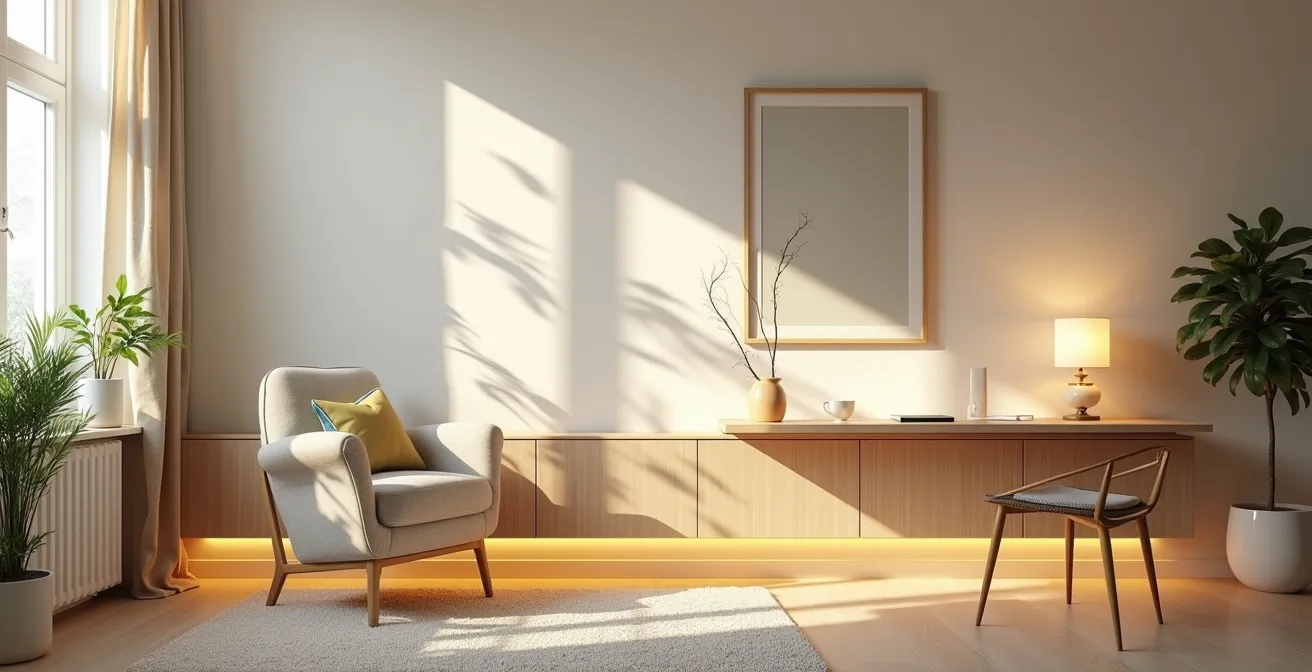
The secret to unlocking flow in a small apartment isn’t just decluttering; it’s mastering the unseen sensory energies of light, sound, and spatial arrangement.
- Overhead lighting and poor acoustics can create “stagnant energy” that makes a space feel oppressive and small.
- Strategic use of warm-temperature bulbs, layered light sources, and soft textures can fundamentally alter the psychological perception of your home.
Recommendation: Instead of a major overhaul, start with one small act of “energetic acupuncture”—like changing a light bulb or floating your sofa six inches from the wall—to feel an immediate shift.
That feeling of being “blocked” or “cramped” in a small apartment is a familiar energy. It’s a subtle but persistent friction in your daily life, the sense that your own home is working against you. When you look for solutions, the advice is often the same: declutter, buy smaller furniture, and hang a mirror. While these tips have merit, they only address the physical symptoms of a much deeper issue. They treat the space as a container to be organized, not an environment to be energized.
But what if the key to unlocking true flow wasn’t about getting rid of things, but about orchestrating the invisible forces already in your home? This is the core of Sensory Feng Shui. It’s an evolution of ancient principles, adapted for modern living. It recognizes that the most powerful shifts come not from major renovations, but from a conscious manipulation of light, sound, color, and placement. This approach is a form of energetic acupuncture for your home, where small, precise adjustments can release blockages and create a profound sense of psychological ease and expansion.
This guide moves beyond the surface-level tips to explore the sensory triggers that define your home’s energy. We will explore how the color of your walls can impact your sleep, how layering light can banish gloom, and why the texture of your decor is as important as its appearance. Prepare to see your small space not as a limitation, but as a dynamic environment you can tune to support your well-being and release its full potential.
To navigate this journey into the sensory soul of your home, this article is structured to address the key energetic levers you can pull. The following sections will provide practical, intuitive strategies to transform how your apartment looks, sounds, and feels.
Summary: How to Use Feng Shui to Unblock the Energy in Your Small Apartment
- Why Painting Your Bedroom Red Might Be Causing Insomnia?
- How to Layer Lighting to Banish “The Big Light” Depression?
- 2700K or 4000K: Which Bulb Temperature Suits the Living Room?
- The Acoustic Mistake That Makes Modern Homes Echo Unpleasantly
- When to Float Furniture vs. Pushing It Against the Wall?
- How to Soundproof Your Bedroom for Under $100?
- When to Use Voice vs. Physical Switches for Smart Lights?
- How to Keep Indoor Plants Alive in a Low-Light Apartment?
Why Painting Your Bedroom Red Might Be Causing Insomnia?
Color is not merely decoration; it is a form of energy with a distinct frequency that influences your mood and physiology. In Feng Shui, red is the color of the Fire element. It represents passion, high energy, and action. While this is powerful for social spaces like a dining room or a home gym, introducing this intense energy into the bedroom can create significant energetic disruption. Your bedroom should be a sanctuary of Yin energy—calm, restorative, and passive. A red wall actively works against this, stimulating the nervous system and making it difficult for your mind and body to wind down into deep, restorative sleep.
If you love red but struggle with sleep, it doesn’t mean you have to banish it entirely. The key is strategic placement. The goal is to enjoy the color’s vibrancy without letting it dominate the room’s primary function of rest. By moving red away from your direct line of sight from the bed, you can contain its powerful Yang energy and preserve the tranquility of your sleeping area. Consider these steps to balance the energy:
- Step 1: Remove any red paint or wallpaper from direct sight lines from the bed.
- Step 2: If keeping red elements, place them as single accent pieces, such as a vase or a small throw pillow, at least six feet from the bed.
- Step 3: Position red artwork or cushions away from the bed’s direct line of sight, ideally on a wall you don’t face while resting.
- Step 4: Replace dominant red tones with calming blues or serene greens. Studies have shown these colors are more conducive to longer, more peaceful sleep.
- Step 5: Reserve bold red for spaces meant for activity and social engagement, where its energetic properties can be fully and positively expressed.
By treating color as an active element in your environment, you can create a bedroom that not only looks good but also feels deeply supportive of your rest and well-being.
How to Layer Lighting to Banish “The Big Light” Depression?
The single, harsh overhead fixture—often called “the big light”—is an enemy of good Feng Shui. It casts a flat, uniform glare that eliminates shadows, flattens textures, and creates an oppressive, stagnant energy. This type of lighting is psychologically draining and can contribute to a feeling of gloom or listlessness, especially in a small space where it has nowhere to hide. To create flow and a sense of well-being, you must practice “light-scaping,” the art of layering multiple light sources at different heights to create pools of warmth, intrigue, and comfort.
Layered lighting breaks up the monotony of a room, creating visual interest and distinct functional zones. It allows you to tailor the atmosphere to your activity, whether you’re reading, relaxing, or entertaining. The goal is to use a combination of ambient (overall), task (focused), and accent (decorative) lighting to build a rich, dynamic environment. This visual variety is what makes a space feel cozy, expansive, and alive.

As you can see in the image, a combination of a table lamp, a floor uplighter, and accent lights creates a welcoming and sophisticated atmosphere. This principle is so effective it’s being used in therapeutic settings. For example, a compelling case study shows how this works on a larger scale. Freedom House, a 72-bed memory care center in San Antonio, implemented a layered lighting system with general ceiling lights, mid-level wall sconces, and low-level LED strips. The facility reported a 15-30% reduction in patient stay times after adopting human-centric lighting that mimics natural circadian patterns. This demonstrates the profound impact that thoughtful light-scaping has on our psychological and physical health.
2700K or 4000K: Which Bulb Temperature Suits the Living Room?
Beyond brightness (lumens), the most crucial aspect of a light bulb is its color temperature, measured in Kelvin (K). This is the “mood” of the light, and choosing the right temperature is a powerful act of Sensory Feng Shui. Color temperature dictates whether a space feels like a cozy fireside retreat or a focused, clinical workspace. A 2700K bulb emits a warm, yellowish-white light, similar to a traditional incandescent bulb or the glow of a sunset. This is the energy of relaxation and comfort. In contrast, a 4000K bulb produces a cool, neutral-white light that mimics overcast daylight, promoting alertness and focus.
For a living room, which serves as a multi-functional space for both relaxation and activity, the answer is rarely one or the other. It’s about matching the light’s energy to the time of day and the desired activity. Using a cool 4000K light in the evening can suppress melatonin production, making it harder to wind down. Conversely, a warm 2700K light during the day might make you feel lethargic. The ideal solution is often a dynamic one. As Consumer Reports notes, “Smart bulbs offer circadian lighting settings that automatically progress from warm/red hues in the morning to cool/blue hues during the day, then back to warm/red hues at night.”
This comparative table breaks down the distinct energetic impact of each temperature. As a detailed analysis of circadian rhythms shows, aligning your home’s light with natural patterns is key to well-being.
| Aspect | 2700K (Warm White) | 4000K (Cool White) |
|---|---|---|
| Psychological Effect | Campfire/sunset feeling, promotes relaxation | Overcast daylight, promotes focus and alertness |
| Best Time of Day | Evening (6pm onwards) | Morning to afternoon (9am-5pm) |
| Wall Color Interaction | Makes warm beige/greige walls look rich | Can make warm walls look dull and sad |
| Circadian Impact | Supports melatonin production | Suppresses melatonin, increases alertness |
| Multi-use Solution | Smart bulbs allow switching between both temperatures based on activity and time | Smart bulbs allow switching between both temperatures based on activity and time |
By investing in smart bulbs, you give yourself the power to tune your living room’s energy on demand, ensuring the light is always supporting, never draining, your personal flow.
The Acoustic Mistake That Makes Modern Homes Echo Unpleasantly
In our quest for clean, minimalist aesthetics, we often make a critical sensory mistake: we create acoustically harsh environments. Hardwood floors, large windows, plaster walls, and minimalist furniture create a space full of hard, reflective surfaces. This causes sound waves to bounce around uncontrollably, resulting in an unpleasant echo and a “sharp” auditory character. This constant, subtle reverberation creates a chaotic energy that keeps your nervous system on high alert. It prevents a space from feeling truly calm, cozy, or safe. A home that echoes is a home where energy cannot settle.
Achieving acoustic comfort is about introducing soft, absorbent, and irregular surfaces that trap and diffuse sound waves. This isn’t about complete soundproofing; it’s about adding “acoustic texture” to soften the room’s energetic signature. Think of it like adding seasoning to a bland dish—you are adding depth and complexity to the sensory experience of the room. A well-balanced acoustic environment feels immediately more welcoming and psychologically comforting. The energy becomes grounded rather than chaotic.
You can dramatically improve your apartment’s acoustics by incorporating materials that absorb sound. Here are several multi-sensory solutions that add both acoustic and aesthetic value:
- Install felt acoustic panels that provide both sound absorption and a rich visual texture.
- Hang thick, heavy curtains (like velvet) from ceiling to floor for maximum sound dampening.
- Create a “library wall” filled with books; the paper and irregular shapes are excellent natural sound diffusers.
- Add large textile wall hangings or tapestries to break up large, flat wall surfaces.
- Place area rugs with thick padding, especially in high-traffic zones or under seating areas.
- Use open-backed bookcases or decorative screens as room dividers to create smaller, more intimate acoustic zones.
By consciously adding these soft elements, you transform your home from an echo chamber into a serene sanctuary where sound is warm and conversation is clear.
When to Float Furniture vs. Pushing It Against the Wall?
In a small apartment, the instinct is to maximize floor space by pushing every piece of furniture against the walls. While logical, this often creates stagnant energy and makes a room feel more static and box-like. It blocks the flow of “qi” (life force energy), which needs to circulate freely. Floating furniture—pulling it away from the walls, even by a few inches—creates pathways for this energy to move, instantly making a space feel more dynamic and alive. It introduces breathing room and creates subtle shadow lines that add a sense of depth and dimension.
The key is to create clear, defined pathways for movement. You should be able to walk around your main furniture pieces without feeling squeezed or obstructed. According to Feng Shui principles that demonstrate maintaining clear pathways and avoiding furniture directly aligned with doorways improves qi circulation. This simple act of creating space signals to your subconscious that there is room to move, to breathe, and to live. It prevents the feeling of being “hemmed in” that is so common in small apartments.
Case Study: Cliff Tan’s Modern Feng Shui Approach
Architect and modern Feng Shui expert Cliff Tan, known to millions through his social media presence on Dear Modern, masterfully demonstrates this principle. His method involves pulling sofas just six inches from the walls to create shadow lines that give the illusion of depth. He then often places a slim console table, a tall plant, or an uplight behind the floating piece. This technique restores the psychological “refuge” feeling of having something solid behind you while simultaneously creating clear, unimpeded pathways for energy flow. It’s a perfect balance of security and openness, proving that floating furniture can make a small apartment feel both larger and more intentional.
The decision to float furniture is about choosing psychological flow over raw square footage. By allowing energy to circulate around your furniture instead of being blocked by it, you transform a static box into a dynamic, flowing living environment.
How to Soundproof Your Bedroom for Under $100?
A quiet bedroom is not a luxury; it is a prerequisite for restorative sleep and mental peace. Even low-level, ambient noise from traffic, neighbors, or household appliances can disrupt your sleep architecture without fully waking you. As the National Institute of General Medical Sciences explains, these sounds cause “micro-arousals,” which fragment sleep cycles and prevent you from reaching the deepest, most restorative stages of sleep. The goal of soundproofing isn’t just silence, but a higher quality of uninterrupted rest.
Even low-level noises cause ‘micro-arousals,’ fragmenting sleep cycles and preventing restorative deep sleep. The goal isn’t just quiet, but a higher quality of sleep.
– National Institute of General Medical Sciences, Circadian Rhythms and Sleep Research
Creating an acoustic sanctuary doesn’t have to be expensive. By identifying the type of noise you’re dealing with—airborne (voices, TV) or impact (footsteps, vibrations)—you can apply targeted, budget-friendly solutions. Most noise enters a room through its weakest points: doors and windows. By focusing your efforts there and adding mass and absorption to your walls, you can make a significant difference for under $100.
Action Plan: DIY Budget Soundproofing by Noise Type
- For Airborne Noise (voices, traffic): Hang heavy moving blankets on the walls. They are designed for density and absorption and can be found for around $30-40.
- For Impact Noise (footsteps from above): Place thick yoga mats under your area rugs. The dense foam is excellent at dampening vibrations for about $20-30.
- DIY Acoustic Panels: For a more aesthetic solution, stretch thick towels or felt over inexpensive wooden frames from a dollar store. This creates effective, custom panels for a total cost of $15-20.
- Seal Door Gaps: A surprising amount of noise comes from under and around your door. Install a simple adhesive door sweep and foam weather stripping to seal these gaps for $10-15.
- Tackle Window Noise: Apply a bead of acoustic caulk around the interior of your window frames to seal tiny air gaps that transmit sound. This simple fix costs around $10.
If some noise still penetrates, you can use sound masking. A white noise machine or even a fan can create a consistent, soothing soundscape that covers up jarring, irregular noises, helping your brain to disengage and rest.
Key Takeaways
- True flow comes from managing sensory inputs—light, sound, and color—not just physical objects.
- Layering multiple warm, low-level light sources is more important than a single bright overhead light.
- Soft textures like rugs, curtains, and books are essential for “acoustic comfort” and absorbing chaotic energy.
When to Use Voice vs. Physical Switches for Smart Lights?
In a smart home, the flow of energy is also about the flow of interaction. The choice between using a voice command, a physical switch, an app, or an automation is a decision that impacts your cognitive load and physical ease. The best method is the one with the least friction for the specific scenario. Tapping into the right control method at the right time is a form of digital Feng Shui, ensuring your home’s technology serves your flow instead of disrupting it.
A physical smart switch or motion sensor is ideal for transitions, like entering or leaving a room. It relies on muscle memory and provides an instant, thoughtless response. Voice commands, on the other hand, are perfect when you are settled, such as on the sofa or in bed. They require zero physical effort but a moderate cognitive one (formulating the command). For daily routines, like waking up or winding down, automation is the ultimate goal—a zero-friction system where the light adjusts automatically, requiring no conscious thought at all. In fact, many smart home systems now include motion sensors with integrated daylight sensors that only trigger lights when natural light is insufficient, maximizing efficiency and effortless flow.
This table outlines the best control method based on the scenario, helping you design an intuitive system that feels like an extension of your own intentions.
| Scenario | Best Control Method | Cognitive/Physical Friction |
|---|---|---|
| Entering/Leaving Room | Physical Smart Switch or Motion Sensor | Low cognitive (muscle memory), instant response |
| Settled on Sofa/Bed | Voice Command | Low physical (no movement), moderate cognitive |
| Hands Full (groceries, baby) | Voice or Motion Sensor | Zero physical friction needed |
| Daily Routines | Automation/Schedule | Zero friction – completely automatic |
| Fine-tuning Brightness | App or Dimmer Switch | Precise control worth the friction |
By thinking about interaction in terms of energetic cost, you can create a smart home that feels truly intelligent, anticipating your needs and reducing daily friction.
How to Keep Indoor Plants Alive in a Low-Light Apartment?
Plants are the living embodiment of “qi” or life force energy. They bring vitality, growth, and a connection to nature into our homes, which is especially crucial in a cramped urban apartment. However, the fear of killing them in a low-light environment prevents many from enjoying their benefits. The secret is not just choosing the right plant, but also understanding how to “hack” the light you have to create an environment where they can thrive.
First, choose truly low-light tolerant plants. Varieties like Snake Plants (Sansevieria), ZZ Plants (Zamioculcas zamiifolia), and dark-leafed Pothos are your best allies. Their darker leaves contain more chlorophyll, the pigment responsible for photosynthesis, making them exceptionally efficient at capturing what little light is available. Next, create “light oases” by using full-spectrum LED grow bulbs in stylish, non-industrial fixtures. Placing one in a floor or table lamp near your plants can provide the supplemental light they need to flourish. Finally, use your environment to your advantage. Placing plants near your brightest window and using reflective surfaces like mirrors or even just white walls can help bounce and amplify the available natural light, directing it to your green companions.
Watching things grow and caring for them as they grow is the most awesomely simple way to tap into your own life expansion.
– Dana Claudat, Feng Shui expert interview
Caring for plants is an active meditation. It connects you to the cycles of growth and renewal, and their success becomes a reflection of your own ability to nurture life. Start with one plant, learn its needs, and feel the subtle but powerful shift in your home’s energy.
Start today by choosing one small sensory change—a new light bulb, a well-placed rug, or a single plant—and feel the energy in your home begin to shift. The path to a more expansive, flowing life begins with a single, intentional act.