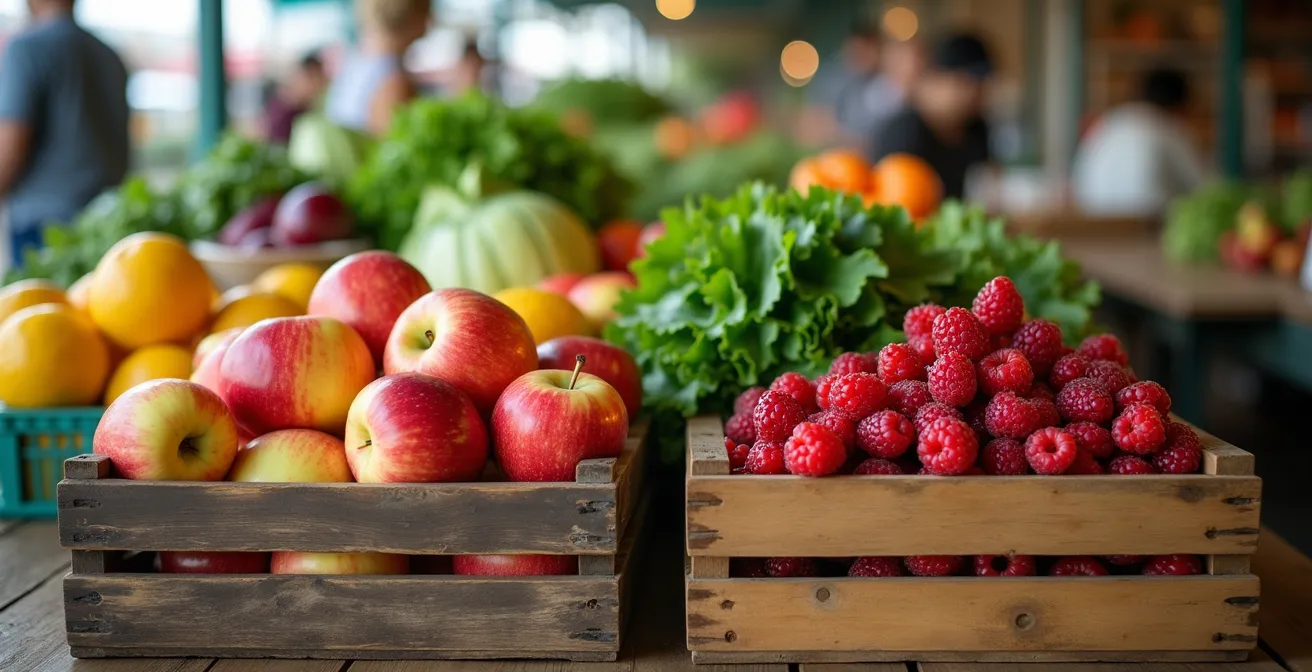
The key to affordable healthy eating isn’t buying everything organic, but strategically allocating your budget to where it matters most—a concept we’ll call maximizing your ‘cost-per-nutrient’.
- Focus your organic spending on the “Dirty Dozen” list, as these items carry the highest pesticide loads.
- For many items, frozen organic produce offers superior nutrient retention at a lower price point than fresh conventional alternatives.
- Labels like “All Natural” are often meaningless; true value lies in understanding nutrient density and bioavailability.
Recommendation: Use the “Dirty Dozen” list to guide your organic purchases and consider frozen organic options to stretch your food budget without compromising on nutrients.
As a parent, the grocery aisle can feel like a minefield of conflicting advice and escalating costs. You want to provide the healthiest food for your family, but the “organic” label often comes with a price tag that strains the weekly budget. The common narrative suggests a stark choice: either you spend a premium on all-organic everything, or you resign yourself to feeding your family conventional produce laden with chemicals. This all-or-nothing approach is not only stressful but also economically inefficient and often based on marketing rather than nutritional science.
Many guides simply tell you to “buy organic” or point you to lists without explaining the economic trade-offs. They rarely discuss the significant nutritional differences between fresh, frozen, raw, or cooked options, nor do they equip you to see past misleading labels like “all natural.” The result is often confusion and guilt, forcing you to make decisions based on fear rather than data. This leaves you wondering if the extra cost is truly translating into better health for your family or just a lighter wallet for you.
But what if the most effective strategy wasn’t about blindly following labels, but about adopting the mindset of a nutritional economist? The real key to feeding your family well on a budget is to analyze the cost-per-nutrient. It’s about understanding which organic purchases deliver a real return on investment in terms of reduced pesticide exposure and which conventional items are perfectly safe. It’s about knowing when frozen organic beats fresh conventional, and how simple preparation techniques can unlock more nutrients from the food you already buy.
This article will provide a pragmatic, data-driven framework to navigate these choices. We will deconstruct the “Dirty Dozen” to make it a practical budgeting tool, explore smart sourcing strategies that cut out the middleman, and analyze the real nutritional value behind different food states and labels. By the end, you will be equipped to build a grocery plan that maximizes health benefits without declaring bankruptcy.
This guide offers a structured approach to making smarter, data-driven decisions in the grocery store. Explore the sections below to build a cost-effective and nutritious shopping strategy for your family.
Summary: A Nutritional Economist’s Guide to Smart Shopping
- Why the “Dirty Dozen” List Should Dictate Your Grocery Budget?
- How to Source Organic Meat Directly From Farmers to Save 20%?
- Frozen Organic vs. Fresh Conventional: Which Has More Nutrients?
- The “All Natural” Label Trap That Misleads 60% of Shoppers
- When to Eat Raw vs. Cooked Vegetables for Maximum Bioavailability?
- Farmers Market or Grocery Store: Comparing the Real Cost per Nutrient?
- The Refillable Bottle Strategy That Saves You $50 on Bottled Water
- How to Shop at a Farmers Market for a Week of Meals Under $100?
Why the “Dirty Dozen” List Should Dictate Your Grocery Budget?
The “Dirty Dozen” list, published annually by the Environmental Working Group (EWG), is not a scare tactic; it’s a strategic budgeting tool. For a cost-conscious parent, it provides a clear roadmap on where to allocate your premium “organic” dollars for the greatest impact. The logic is simple: prioritize spending on the 12 non-organic produce items with the highest levels of pesticide residues and save money by purchasing conventional versions of the “Clean Fifteen,” which have the lowest. This data-driven approach moves you away from an all-or-nothing organic mindset to one of targeted, efficient spending.
The numbers behind this strategy are compelling. Data shows that a staggering 75% of conventional produce contains pesticide residue. However, the concentration varies wildly. For items on the Dirty Dozen list, the risk is significantly higher. The EWG’s analysis provides concrete evidence of this disparity.
EWG’s 2025 Dirty Dozen Analysis
The Environmental Working Group’s 2025 analysis, based on over 47,000 produce samples, confirmed that certain items are consistently more contaminated. Strawberries remained the top offender, with samples showing traces of up to 23 different pesticides. Spinach was found to have the highest pesticide residue by weight. Critically, items like blackberries and potatoes were added to the list after concerning findings, including the detection of the chemical chlorpropham in 90% of tested potato samples. This data highlights that focusing your organic budget on these specific items is a rational way to reduce your family’s pesticide exposure.
Even if buying organic versions of the Dirty Dozen isn’t always feasible, you can still take practical steps to mitigate pesticide exposure on conventional items. Proper washing and preparation can significantly reduce surface residues, providing a crucial layer of defense for your family when the budget is tight.
Your Action Plan: Damage Control for Conventional Produce
- Rinse and Scrub: Rinse all produce under cold running water for at least 15-20 seconds. Use a soft brush to scrub firm-skinned items like potatoes and apples to physically remove surface residues.
- Separate and Soak Greens: For leafy greens like spinach or kale, separate the individual leaves and rinse them thoroughly. Soaking them in a baking soda solution (1 teaspoon per 2 cups of water) for 12-15 minutes can further reduce pesticide loads.
- Peel When Possible: For fruits with inedible peels (like bananas) or even edible ones on high-risk items (like apples), peeling can remove a significant amount of surface pesticides. This simple step can remove over 75% of residues on some fruits.
- Choose Your Cooking Method Wisely: The way you cook vegetables can also impact pesticide levels. Boiling vegetables has been shown to reduce certain pesticide loads by up to 50%, making it a better choice than roasting for high-risk conventional produce.
- Prioritize High-Risk Items: Focus these cleaning efforts on items from the “Dirty Dozen” list. This targeted approach ensures you’re dedicating your time and effort where it provides the most significant risk reduction.
How to Source Organic Meat Directly From Farmers to Save 20%?
While produce gets most of the attention in the organic debate, the cost of organic meat can be one of the biggest hurdles for a family budget. The supermarket price for organic, grass-fed, or pasture-raised meat reflects a long supply chain, with markups at every step. A powerful strategy to bypass these costs is to source meat directly from local farmers. This approach not only provides greater transparency about how the animals were raised but can also lead to significant savings, often in the range of 20% or more compared to retail prices.
The key is to buy in bulk through programs like Community Supported Agriculture (CSA) or by purchasing a “share” of an animal (a quarter or half cow, for example). While the upfront cost is higher, the per-pound price is substantially lower. This strategy transforms a luxury purchase into a manageable investment. You are essentially cutting out the distributor and the retailer, and the savings are passed directly to you. It requires more planning and freezer space, but the economic benefit is undeniable.
Building a relationship with a local farmer is central to this process. It fosters trust and gives you a direct line to the source of your food. You can ask specific questions about animal welfare, feed, and farming practices—a level of detail impossible to get from a label in a grocery store. This connection humanizes the food chain and ensures your money supports sustainable, local agriculture.

As seen in this interaction, direct purchasing is a collaborative process. Farmers are often willing to work with families to find a share size and price point that is mutually beneficial. Many farms can be found at local farmers’ markets, through online directories like LocalHarvest, or by simply searching for “local beef share” or “farm CSAs” in your area. This is a proactive step toward taking control of your food supply and your budget.
Frozen Organic vs. Fresh Conventional: Which Has More Nutrients?
One of the most pervasive myths in the grocery store is that “fresh is always best.” From a nutritional economist’s perspective, this isn’t necessarily true, especially when comparing frozen organic produce to fresh conventional options. For the budget-conscious parent, the freezer aisle can be a goldmine of high-quality, nutrient-dense foods at a fraction of the cost. The key lies in understanding the science of nutrient degradation.
Produce destined for the freezer is typically picked at peak ripeness and flash-frozen within hours, a process that locks in vitamins and minerals at their highest levels. In contrast, “fresh” conventional produce can spend days or even weeks in transit and on store shelves. During this time, exposure to heat, light, and oxygen causes significant nutrient loss, particularly for delicate vitamins like Vitamin C and B vitamins. Therefore, a bag of frozen organic spinach may contain more nutrients than its “fresh” conventional counterpart that has been sitting in the store for a week.
This table, based on data regarding nutrient retention, illustrates the stark difference. While fiber and minerals remain relatively stable, the loss of key vitamins in “fresh” produce over time is significant.
| Nutrient Type | Frozen Organic (% retained) | Fresh Conventional (after 7 days) | Winner |
|---|---|---|---|
| Vitamin C | 90-95% | 50-60% | Frozen Organic |
| B Vitamins | 85-90% | 40-50% | Frozen Organic |
| Fiber | 100% | 100% | Tie |
| Minerals | 100% | 95-100% | Tie |
| Antioxidants | 80-85% | 60-70% | Frozen Organic |
While the organic label may offer peace of mind regarding pesticides, the primary nutritional advantage often cited is not always supported by evidence. Some experts argue that the nutrient difference between organic and conventional is negligible. As Joseph D. Rosen, an emeritus professor of food toxicology, stated in a Scientific American blog:
Any consumers who buy organic food because they believe that it contains more healthful nutrients than conventional food are wasting their money
– Joseph D. Rosen, Emeritus professor of food toxicology at Rutgers
This perspective reinforces the nutritional economist’s view: focus on measurable factors like nutrient retention and cost. In many cases, frozen organic produce offers the best of both worlds: reduced pesticide exposure and higher nutrient density per dollar compared to aging fresh conventional options.
The “All Natural” Label Trap That Misleads 60% of Shoppers
In the complex world of food marketing, few terms are as misleading as “all natural.” For the discerning parent trying to make healthy choices, this label can create a false sense of security. Unlike the “USDA Organic” seal, the term “natural” is not regulated by the FDA in a meaningful way for most food products. It generally means nothing has been artificially or synthetically added, but it says nothing about the farming methods used, the presence of pesticides, or whether the ingredients are genetically modified (GMOs). This ambiguity is a trap that many shoppers fall into.
This lack of regulation means that a product labeled “natural” can still be derived from crops grown with high levels of pesticides. In fact, many items on the “Dirty Dozen” list, which are known for heavy pesticide contamination, are often marketed with “natural” branding. An NPR report highlighted this discrepancy, noting that despite marketing claims, 95% of ‘Dirty Dozen’ produce tested contained pesticide residue. This demonstrates that the “natural” label offers no guarantee of purity or safety.
The visual and textural difference between a truly organic product and a conventionally produced one can be stark, yet a simple label can blur that distinction. The term “natural” is a marketing tool designed to evoke an image of wholesome, farm-fresh goodness, regardless of the underlying reality. It capitalizes on the desire for clean eating without being held to any verifiable standard.

The only label that provides a verifiable, government-backed standard for farming practices is the “USDA Organic” seal. This certification guarantees that the food was grown and processed according to federal guidelines that address soil quality, animal raising practices, pest and weed control, and the use of additives. As a nutritional economist, the advice is clear: ignore ambiguous terms like “natural” and focus on the one label that represents a tangible, enforceable set of standards. Your money is better spent on a certified organic product from the Dirty Dozen list than on a conventionally grown “natural” product that offers no real benefits.
When to Eat Raw vs. Cooked Vegetables for Maximum Bioavailability?
Deciding between organic and conventional is only half the battle. A crucial, often-overlooked factor in maximizing nutrition is preparation. The concept of bioavailability—the proportion of a nutrient that is absorbed and utilized by the body—is profoundly affected by whether a vegetable is eaten raw or cooked. Understanding this can help you unlock significantly more nutritional value from the food you buy, regardless of its source.
Some vegetables release more nutrients when cooked, while others are best consumed raw. Heat can break down tough plant cell walls, making certain antioxidants more accessible. For other vegetables, cooking can destroy heat-sensitive vitamins and enzymes. A savvy approach involves knowing which method to use for which vegetable to optimize your family’s nutrient intake without spending an extra dime.
Unlocking Nutrients Through Cooking: The Case of Lycopene
Tomatoes are a prime example of cooking’s benefits. They are rich in lycopene, a powerful antioxidant linked to reduced risk of certain cancers and heart disease. However, in raw tomatoes, lycopene is tightly bound within the plant’s cell walls. The heat from cooking breaks down these walls, making the antioxidant more bioavailable. Scientific studies have shown that cooking tomatoes with a healthy fat like olive oil can increase lycopene absorption by over 200%. Similarly, the beta-carotene in carrots and sweet potatoes becomes more available after cooking. Conversely, cruciferous vegetables like broccoli retain more of their cancer-fighting compound, sulforaphane, when consumed raw or lightly steamed after being chopped and allowed to rest.
Beyond just raw versus cooked, you can further enhance nutrient absorption through synergistic food pairings. Certain vitamins and minerals work together, and combining them in the same meal can dramatically increase their effectiveness. This is a simple, no-cost strategy to elevate the nutritional value of your family’s meals.
Your Action Plan: Synergistic Food Pairing for Maximum Nutrition
- Iron and Vitamin C: Pair iron-rich foods like cooked spinach or lentils with a source of vitamin C, such as raw bell peppers, a squeeze of lemon juice, or strawberries. Vitamin C can increase the absorption of plant-based iron by up to six times.
- Fat-Soluble Vitamins and Healthy Fats: Combine vegetables rich in fat-soluble vitamins (A, D, E, K)—like carrots, sweet potatoes, and leafy greens—with a healthy fat source. Serving cooked carrots with nuts or adding avocado to a salad enhances the absorption of these essential vitamins.
- Tomatoes and Olive Oil: As mentioned, combining cooked tomatoes with olive oil or another healthy fat is the best way to maximize lycopene uptake. A simple tomato sauce made with olive oil is a nutritional powerhouse.
- Turmeric and Black Pepper: Curcumin, the active compound in turmeric, is poorly absorbed on its own. Pairing it with piperine, found in black pepper, can boost its bioavailability by a remarkable 2,000%.
- Raw and Cooked Combinations: For some vegetables like broccoli, a mixed approach works best. Combine raw broccoli sprouts (high in the enzyme myrosinase) with cooked mature broccoli (high in the precursor glucoraphanin) to get the maximum sulforaphane benefit.
Farmers Market or Grocery Store: Comparing the Real Cost per Nutrient?
The common assumption is that farmers’ markets are a quaint but expensive luxury. However, a nutritional economist would argue for a more nuanced analysis: the cost-per-nutrient. When you compare the price of produce based on its nutrient density rather than just its weight, farmers’ market finds, especially when in season, can offer superior value. Produce from local farms is picked at peak ripeness and travels a short distance, resulting in higher nutrient retention compared to grocery store items that have traveled for days.
Let’s analyze this with a practical example: sourcing Vitamin C. A pound of bell peppers at a farmers’ market during peak season might seem more expensive than a pound of oranges at the grocery store. But the peppers can contain more than double the Vitamin C. When you calculate the cost to obtain a specific amount of the nutrient (e.g., 100mg), the farmers’ market item is often the more economical choice. This framework shifts the focus from “cheaper per pound” to “cheaper per nutrient,” which is a far more effective way to budget for health.
The following table provides a simplified cost-per-nutrient comparison for Vitamin C, using representative pricing. It demonstrates that the seemingly more expensive farmers’ market kale is actually the most cost-effective source of this key vitamin.
| Source | Product | Price per lb | Vitamin C per lb | Cost per 100mg |
|---|---|---|---|---|
| Farmers Market | Bell Peppers (peak season) | $3.00 | 580mg | $0.52 |
| Grocery Store | Oranges | $1.50 | 240mg | $0.63 |
| Farmers Market | Kale | $2.50 | 550mg | $0.45 |
| Grocery Store | Broccoli | $2.00 | 405mg | $0.49 |
Furthermore, produce from local, small-scale farms often has a lower pesticide load, even if it’s not certified organic. This is especially true for items on the “Clean Fifteen” list. Analysis has shown that a significant portion of these items have no detectable pesticides. According to some reports, up to 60% of Clean Fifteen samples had no detectable pesticide residues. Shopping for these items at a farmers’ market further increases your chances of getting clean, nutrient-dense food at a competitive price.
The Refillable Bottle Strategy That Saves You $50 on Bottled Water
One of the most overlooked expenses in a family’s budget is bottled water. It’s often perceived as a pure, healthy, and convenient option, but from a cost-analysis perspective, it’s one of the least efficient ways to spend your money. The markup on bottled water is astronomical—you’re paying for plastic packaging, branding, and transportation, not for a healthier product. In many cases, bottled water is simply filtered municipal tap water. A family that regularly buys bottled water can easily spend over $50 a month, or $600 a year, on something they can get for nearly free from their tap.
Switching to a refillable bottle strategy is the single most effective step to immediately cut this cost. The initial investment in a quality water filter pays for itself within a month or two. Beyond the economic savings, you are also significantly reducing plastic waste and your family’s exposure to microplastics that can leach from single-use bottles. The concern for many parents, however, is the quality and taste of their tap water. Fortunately, a wide range of filtration solutions exists to address these concerns at different budget levels.

Creating a home water filtration station is a simple, aesthetically pleasing solution. It encourages the whole family to drink more water while providing peace of mind about its quality. The key is to choose a system that matches your budget and addresses the specific contaminants in your local water supply. For most homes, a simple activated carbon filter is enough to dramatically improve taste and remove common impurities like chlorine.
Your Roadmap to Upgrading Tap Water
- Level 1 – The Basic Start: Begin with an activated carbon pitcher (around $25). This is the lowest-cost entry point and is highly effective at removing chlorine, which is the primary cause of unpleasant taste and odor in tap water.
- Level 2 – The Convenient Upgrade: Install an under-sink carbon filter (around $150). This provides filtered water directly from a dedicated tap, eliminating the need to refill a pitcher. These systems are better at removing contaminants like lead and some pesticides.
- Level 3 – The Advanced System: For areas with known water quality issues, consider a reverse osmosis (RO) system (starting around $300). This is the most comprehensive solution, removing up to 99% of all contaminants, including heavy metals, arsenic, and PFAS chemicals.
- Level 4 – The Optimization Step: Some advanced filters, like RO, can strip beneficial minerals from the water. Add trace mineral drops ($15/bottle) to your filtered water to restore healthy electrolytes like magnesium and calcium.
- Level 5 – The Verification: To ensure your filtration system is working effectively, use an at-home water test kit (around $30) periodically. This allows you to verify that contaminant levels are reduced and provides ultimate peace of mind.
Key Takeaways
- Strategic Spending is Key: Focus your organic budget on the “Dirty Dozen” to minimize pesticide exposure where it counts the most.
- Frozen Can Be Better: Flash-frozen organic produce often retains more nutrients than “fresh” conventional items and is more cost-effective.
- Preparation Matters: Cooking certain vegetables (like tomatoes) and using synergistic food pairings (like iron with vitamin C) can dramatically increase nutrient bioavailability.
How to Shop at a Farmers Market for a Week of Meals Under $100?
Armed with a new understanding of cost-per-nutrient and a healthy skepticism of labels, you can transform the farmers’ market from an expensive outing into a powerful tool for budget-conscious, healthy eating. The goal of feeding a family for a week on under $100 is not only achievable but can be done without sacrificing quality or flavor. It requires a strategic shift away from rigid recipe-following to a more flexible, opportunistic approach based on what is abundant, seasonal, and affordable.
The most effective shoppers embrace a “market-first” meal planning philosophy. Instead of arriving with a fixed list, they survey the market to see what’s plentiful (and therefore cheap), what’s on sale at the end of the day, and which vendors are offering “seconds”—cosmetically imperfect produce perfect for soups, sauces, and smoothies at a steep discount. This strategy maximizes value and minimizes food waste.
The Strategic Farmers Market Shopping Approach
An analysis of farmers’ market shopping patterns revealed powerful cost-saving tactics. Shoppers who arrived in the last hour before closing were often able to negotiate 20-30% discounts on remaining produce as vendors sought to avoid taking it home. One family documented their success by prioritizing the purchase of “seconds” at a 50% discount. They built their weekly meals around these bargains and abundant seasonal items, successfully feeding a family of four for under $100. Their core strategy was flexibility: they bought what was available and then built meals, rather than hunting for specific ingredients for a pre-planned recipe.
Finally, it’s important to maintain a pragmatic, evidence-based perspective on all nutritional advice, including popular lists. While the “Dirty Dozen” is an excellent budgeting heuristic, some food scientists question its methodology, arguing it may cause unnecessary fear around consuming healthy conventional produce. As food toxicologist Carl Winter, PhD, noted in a peer-reviewed analysis:
The methodology used to create the ‘Dirty Dozen’ list does not appear to follow any established scientific procedures
– Carl Winter, PhD, Food Toxicologist, in peer-reviewed analysis
This expert critique doesn’t invalidate the list as a tool for prioritizing your organic budget. Rather, it reinforces the core principle of this guide: don’t let fear dictate your choices. Use the data as a guide, but always prioritize feeding your family an abundance of fruits and vegetables, whether they’re organic or conventional, fresh or frozen.
By adopting the mindset of a nutritional economist, you can move beyond the confusing marketing and high costs. The next logical step is to apply this framework during your next grocery trip, focusing on the cost-per-nutrient of your choices rather than just the price tag.