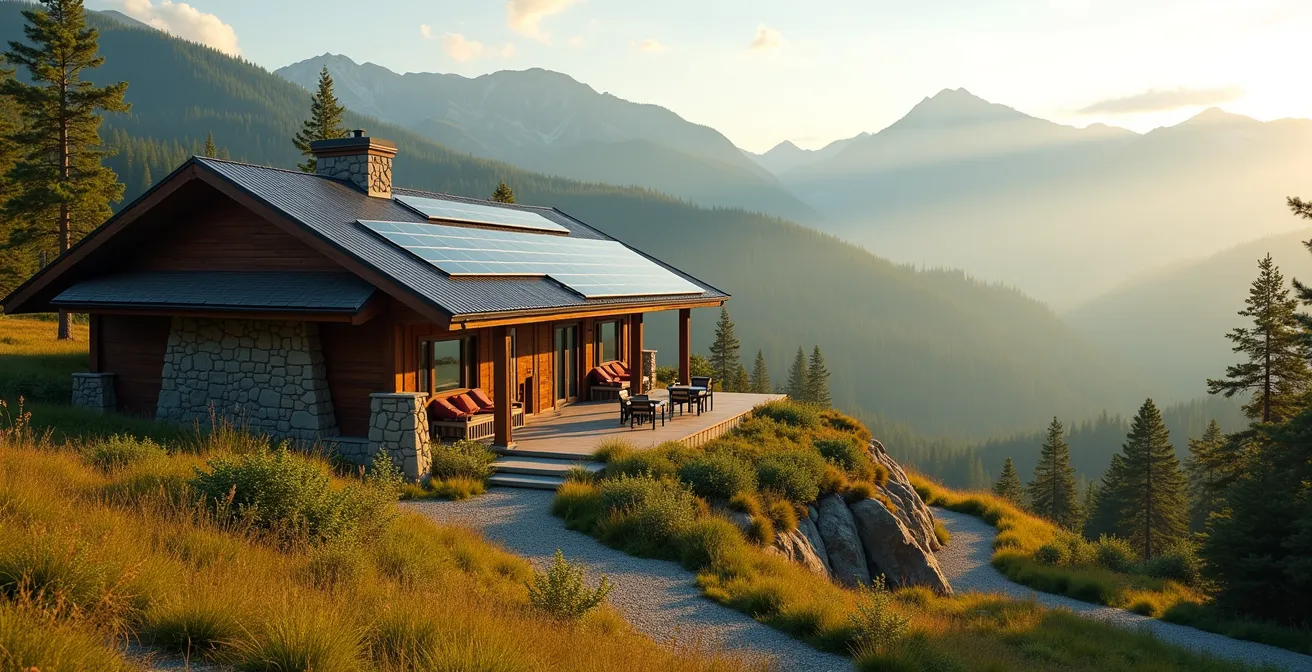
True sustainability isn’t a label you find; it’s a conclusion you reach through critical, forensic investigation of a property’s design and operations.
- LEED is a rigorous baseline, but a property’s true operational DNA—its energy autonomy, waste diversion, and site impact—is the real test of commitment.
- Use direct booking inquiries and pre-trip satellite imagery analysis as forensic tools to cut through marketing claims and assess genuine environmental integration.
Recommendation: Shift your mindset from passive guest to active critic. Demand tangible evidence for every “green” claim before you book.
The term “eco-lodge” has become nearly meaningless. In a marketplace saturated with vague promises of “green” and “sustainable” travel, the discerning traveler is right to be skeptical. You are willing to invest in an experience that aligns with your values, but you demand proof, not just marketing. The common advice—to check for towel reuse policies or look for a sustainability page on a website—is insufficient. These are the superficial signs of a marketing strategy, not necessarily the deep, structural commitments of a truly sustainable operation.
This is where certifications like LEED (Leadership in Energy and Environmental Design) enter the conversation. They promise a standardized, third-party-verified benchmark. Yet, even this gold standard can be misrepresented. A hotel might claim association with LEED while only a single, non-guest-facing building is certified. The real challenge, therefore, is not just to find a label, but to understand and verify the substance behind it. It requires moving beyond the mindset of a tourist and adopting the analytical rigor of an architectural and operational critic.
This guide is not a simple checklist. It is a framework for conducting your own forensic audit. We will dissect the key pillars of a genuinely sustainable lodge, from its energy independence and waste management systems to the intelligence of its architectural design. You will learn to identify the critical questions that reveal a property’s true operational DNA and distinguish authentic commitment from sophisticated greenwashing. The goal is to empower you to see past the brochure and critically assess the structural and systemic integrity of a lodge’s sustainability claims.
To navigate this complex landscape, it’s essential to break down the verification process into distinct, analyzable components. The following sections provide a detailed roadmap for your investigation, covering everything from energy systems to the very land the lodge is built upon.
Summary: A Forensic Guide to Vetting Sustainable Luxury
- Why Off-Grid Solar Lodges Offer a Better Sleep Experience?
- How to Spot if a Hotel Composts Food Waste Effectively?
- Marriott’s “Green Choice” vs. Independent Eco-Lodge: Which Has Real Impact?
- The Risk of Staying in Lodges Built on Fragile Wetlands
- How to Use Passive Cooling Features in Desert Eco-Lodges?
- “Eco-Friendly” or Greenwashing: Which Labels Actually Mean Something?
- Hotel Apps vs. Direct Booking: Which Offers Better Upgrade Chances?
- How to Choose a Glamping Site That Offers Hotel-Quality Climate Control?
Why Off-Grid Solar Lodges Offer a Better Sleep Experience?
The presence of solar panels is a common marketing image, but it reveals little. The critical investigation must go deeper, into the concept of energy autonomy. A truly sustainable lodge does not simply supplement its grid power with solar; it strives for independence through a robust system, often combining photovoltaic (PV) panels with a Battery Energy Storage System (BESS). This isn’t just an environmental statement; it has a profound impact on the guest experience. These systems provide a silent, uninterrupted power supply, free from the noise of backup generators or the flicker of an unstable rural grid. The result is a deeper sense of tranquility and a higher quality of sleep.
Moreover, this commitment to energy autonomy is a strong indicator of a property’s financial and philosophical investment in sustainability. A well-designed system is a significant capital expenditure, and industry data shows that eco-lodges using solar-plus-BESS systems can achieve a 40% reduction in energy costs. This demonstrates a long-term vision, not a short-term marketing ploy. Consider the Four Seasons Safari Lodge Serengeti, which implemented a comprehensive solar farm to achieve energy independence. This luxury property proves that high-end comfort and off-grid resilience are not mutually exclusive. When vetting a lodge, your questions should focus on the specifics of their system: capacity, battery type, and the actual percentage of energy generated on-site versus drawn from the grid.
The core of your inquiry should be to determine if solar is a genuine utility or mere window dressing. A property proud of its system will be able to answer detailed questions about its specifications and performance. Vague answers suggest a superficial commitment.
How to Spot if a Hotel Composts Food Waste Effectively?
Waste management is a powerful lens through which to assess a hotel’s operational integrity. Many establishments place recycling bins in rooms and call it a day. A truly committed eco-lodge, however, tackles the far more complex challenge of organic waste. An effective composting program is a sign of a closed-loop system, where food scraps are not just diverted from landfill but are transformed into a valuable resource for the property’s own gardens. This is a complex, often messy, and labor-intensive process that is difficult to fake.
Your “forensic audit” here involves looking for physical evidence. Ask for a tour of their composting facility. A genuine operation will have active, managed compost piles or windrows, not just a few forgotten bins. You should be able to see the process in action. The end product—rich, dark humus—should be visibly integrated back into the landscape. The contrast between this and mere claims is stark; industry analysis reveals that only 32% of US hotels even have a basic donation program for excess food, let alone a full-scale composting system. The bar for genuine action is high, and few clear it.
The following image shows what a real, operational composting system looks like—a far cry from a simple green bin in the kitchen.

Case studies from San Francisco demonstrate the potential impact. The Orchard Hotel achieved a 67% waste diversion rate and significant savings by implementing comprehensive composting. This level of performance is a quantifiable metric of success, moving far beyond vague “eco-friendly” statements. When you inquire, ask for their waste diversion rate. A property that tracks this number is one that takes waste seriously.
Marriott’s “Green Choice” vs. Independent Eco-Lodge: Which Has Real Impact?
A critical distinction must be made between large-scale corporate environmental programs and the holistic, integrated sustainability of an independent eco-lodge. A program like Marriott’s “Green Choice,” which rewards guests for forgoing housekeeping, is an operational efficiency measure disguised as an environmental initiative. While it reduces water and energy consumption, it is a surface-level action that does not address the fundamental design, construction, and operational DNA of the building itself. It is a choice offered within a conventional framework.
An independent eco-lodge, particularly one designed from the ground up with principles like LEED, embodies a fundamentally different philosophy. Here, sustainability is not an optional add-on; it is the core of the building’s existence. The choice of materials, the orientation of the building to maximize sun and shade, the integration of water catchment systems, and the commitment to on-site energy production are all part of a single, cohesive system. This approach requires a much deeper level of commitment and investment.
The distinction is a matter of systemic change versus surface-level adjustments. As one expert in the field notes, the two are not comparable. This perspective is essential for the critical traveler.
Simply implementing a selection of green initiatives, while a worthy goal from an environmental standpoint, is not the same, as LEED is a rigorous, third-party verification process in which everything—from construction materials to carbon emissions—is evaluated
– Marie Browne, Hotel Management Magazine Interview
This highlights the core issue: a menu of “green” options is not a substitute for a fundamentally sustainable design. The impact of the latter is exponentially greater because it is embedded in the very structure and operation of the property, influencing everything from embodied carbon in construction to long-term operational carbon emissions.
The Risk of Staying in Lodges Built on Fragile Wetlands
A truly sustainable lodge’s responsibility begins with its relationship to the land. The most crucial, and often overlooked, aspect of architectural criticism is site selection. A building can be filled with green technology, but if its very construction has destroyed a fragile ecosystem, its claims to sustainability are fundamentally compromised. Wetlands, in particular, are critical habitats that are frequently targeted for development due to their scenic value. Building on or near these areas can cause irreversible damage to hydrology, biodiversity, and local ecology.
The LEED framework heavily weighs responsible site selection, awarding points for avoiding sensitive lands. With over 4,277 LEED-certified and registered lodging projects in the U.S., this is a well-established principle. However, a discerning traveler should not take a developer’s word for it. Your own pre-booking forensic audit is necessary. Using free tools like Google Earth, you can become an environmental detective. By accessing historical satellite imagery, you can view the site before the lodge was built and assess the true impact of its construction. Look for signs of filled wetlands, diverted streams, or extensive road-building through previously untouched habitats.
This analysis provides an unvarnished look at the project’s origins, cutting through any marketing narrative about “harmony with nature.” It allows you to judge the project not by its current, manicured appearance, but by the ecological scar it may have left behind.
Your Pre-Booking Satellite Analysis Plan
- Time Travel: Use Google Earth’s time slider to view the site before construction (go back 5-10 years to establish a baseline).
- Identify Indicators: Look for classic wetland indicators on the historical imagery, such as meandering water channels, visible seasonal flooding patterns, or distinct vegetation zones.
- Assess Infrastructure Impact: Check for new access roads, sprawling parking lots, or utility corridors that cut through sensitive natural areas.
- Spot Modifications: Identify artificial drainage modifications like straightened channels, berms, or filled areas that have altered the natural water flow around the lodge.
- Compare Health: Compare the health and density of vegetation in the most recent images against the pre-development conditions to spot signs of degradation.
How to Use Passive Cooling Features in Desert Eco-Lodges?
In harsh climates like the desert, the most profound statement of sustainability is not a powerful air conditioning unit, but the absence of one. True architectural intelligence lies in passive design—a set of strategies that work with nature, rather than against it, to maintain thermal comfort. For a guest, learning to interact with these features is part of the experience, a way of connecting with the building’s design and the rhythm of the environment.
Passive cooling relies on several key principles. Thermal mass, often in the form of thick rammed-earth or stone walls and floors, absorbs heat during the day and radiates it out at night. Strategic orientation and deep roof overhangs minimize direct solar gain during the hottest parts of the day. The most dynamic element, however, is natural ventilation. This can involve features like operable clerestory windows, which allow hot air to rise and escape, and carefully placed openings that facilitate cross-ventilation when outside temperatures drop. The image below illustrates how these elements work together in a cohesive system.
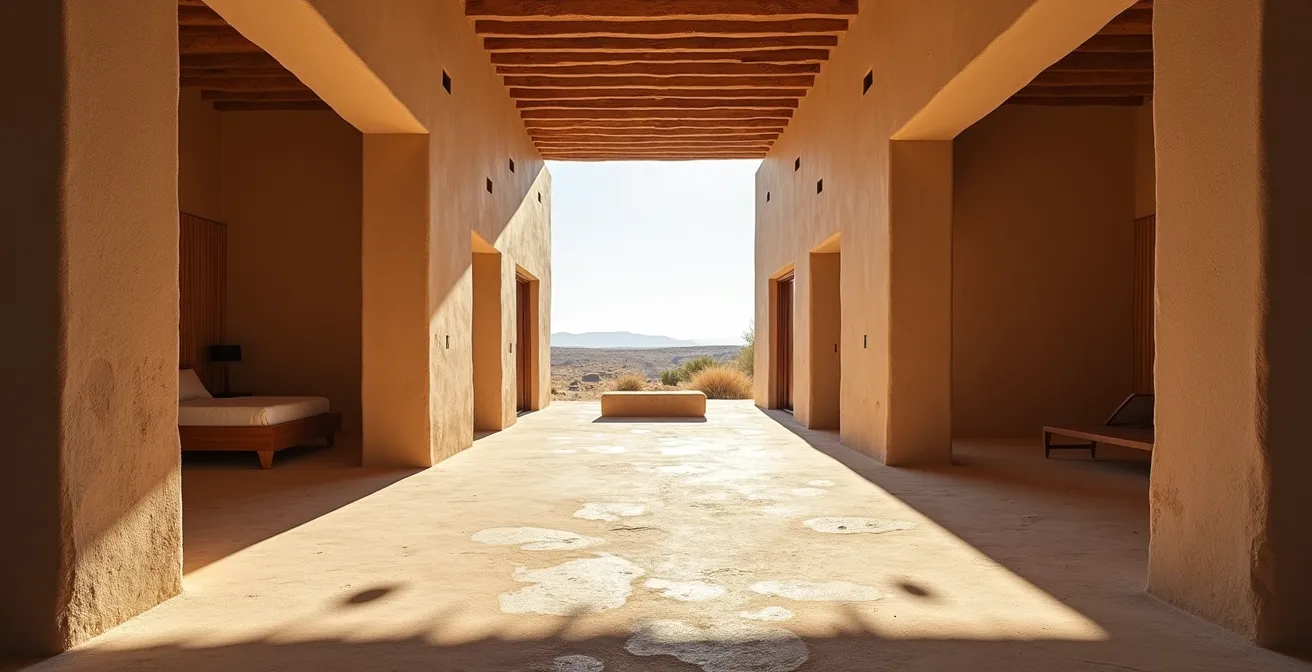
As a guest in such a lodge, you are not a passive consumer of conditioned air; you are an active participant in the building’s performance. Understanding how to use these features is key to maximizing your comfort. This involves a daily routine: trapping cool night air in the morning by closing windows and shutters, minimizing heat gain midday, and then opening the building up in the evening to flush out accumulated heat and welcome the cool desert night. This interaction is a direct engagement with the principles of sustainable design.
A lodge that relies on passive design will often provide guidance on how to best use the space. This itself is a positive sign, indicating a desire to educate guests about the building’s intelligent design. The ability to remain comfortable in an extreme environment without relying on energy-intensive mechanical systems is the ultimate testament to architectural excellence.
“Eco-Friendly” or Greenwashing: Which Labels Actually Mean Something?
The marketplace of “green” certifications is a bewildering alphabet soup of logos and labels. Terms like “eco-friendly,” “green,” or “conscious” are legally meaningless and often serve as a smokescreen for inaction. To a critical eye, self-declared status is an immediate red flag. Real commitment is demonstrated through submission to a rigorous, expensive, and transparent third-party verification process. This is where a clear hierarchy of proof emerges, and where certifications like LEED, B Corp, and Green Globe distinguish themselves.
These top-tier certifications involve comprehensive audits that scrutinize every aspect of a property’s design and operation, from supply chain ethics to energy performance and waste management. They require annual re-verification, ensuring that standards are maintained over time—a building can indeed lose its certification if it fails to perform. The U.S. Green Building Council reports over 4,100 LEED-certified hotel projects, with a significant number undergoing the continuous process of recertification. This ongoing accountability is what gives the label its weight. Mid-tier certifications like Green Seal are also valuable, though they tend to focus on specific operational areas rather than a holistic 360-degree assessment.
The following table provides a critical framework for decoding these labels, sorting them by the rigor of their verification process—the only metric that truly matters. A self-declared “eco” hotel and a LEED Platinum building do not belong in the same category.
This pyramid of proof, based on an analysis of leading hospitality certifications, illustrates the vast difference in credibility between self-proclaimed “green” status and rigorously audited standards.
| Tier | Certification | Audit Type | Cost Range | Rigor Level |
|---|---|---|---|---|
| Top-Tier | LEED, B Corp, Green Globe | 3rd-party annual audit | $10,000+ | Comprehensive 360-degree assessment |
| Mid-Tier | Green Seal, Audubon | 3rd-party verification | $1,950-$5,000 | Specific focus areas |
| Bottom-Tier | ‘Eco-friendly’ claims | Self-declared | Free | No verification |
Hotel Apps vs. Direct Booking: Which Offers Better Upgrade Chances?
While booking through a major hotel app or Online Travel Agency (OTA) offers convenience, it erects a wall between you and the property. For the purpose of a sustainability audit, this is a critical failure. Direct booking is not about chasing upgrades; it is an indispensable investigative tool. The ability to speak directly with knowledgeable staff before making a financial commitment is your single best opportunity to probe beyond the marketing veneer and assess the depth of a lodge’s sustainable practices.
A truly committed eco-lodge will welcome detailed questions. Staff who are deeply involved in the property’s mission will be able to speak with authority about their solar array’s capacity, their water recycling methods, or their waste diversion rates. Evasive, uncertain, or scripted answers are a major red flag, indicating that sustainability is a marketing department talking point, not an integral part of the company culture. This direct conversation serves as a real-time indicator of how deeply these values are embedded in the property’s operational DNA.
Furthermore, booking direct ensures that the full value of your stay supports the property. OTAs typically charge commissions of 15-25%, siphoning funds that could otherwise be reinvested into sustainable operations, staff training, or community projects. Choosing to book direct is, in itself, a vote for a more sustainable economic model for independent hospitality. It transforms the booking process from a simple transaction into the first step of your forensic investigation.
To make the most of this opportunity, you must be prepared with a list of precise, incisive questions. General inquiries about being “eco-friendly” will elicit generic responses. You need to ask questions that require specific, factual answers.
- Which specific wing or building has LEED certification and what level (Certified, Silver, Gold, Platinum)?
- Can I request a room that best showcases your passive cooling or heating features?
- What percentage of your total energy consumption comes from on-site renewable sources?
- Can you describe your waste diversion program and share your most recent diversion rate?
- What are you doing to manage and protect the local watershed and biodiversity on your site?
Key Takeaways
- True sustainability is proven by operational systems (energy, waste, water), not marketing labels.
- Third-party certifications like LEED are the baseline for credibility, as they require rigorous, ongoing verification.
- The discerning traveler must act as a critic, using tools like satellite analysis and direct-booking inquiries to conduct their own forensic audit.
How to Choose a Glamping Site That Offers Hotel-Quality Climate Control?
The principles of sustainable design and architectural criticism are not limited to traditional buildings. The burgeoning glamping industry presents a new frontier for greenwashing, where the rustic aesthetic can mask a heavy environmental footprint. A canvas tent powered by a noisy, diesel generator or a cheap, inefficient electric heater is a step backward, not forward. True luxury in this context is, once again, achieved through intelligent, passive design and a commitment to renewable energy.
When evaluating a glamping site, your critical analysis should focus on the construction of the tent and its interaction with the environment. High-quality, insulated canvas, often in double layers, provides a much better thermal barrier than a simple sheet of fabric. The platform design is also crucial; a raised platform allows for airflow underneath, preventing ground moisture from creating a damp, cold interior. Look for sites that leverage natural shading from mature trees or have built shade structures to mitigate solar gain. The most sustainable climate control solutions will be low-energy, such as solar-powered fans for ventilation rather than energy-intensive portable AC units.
Some forward-thinking operators are explicit about their design philosophy. This transparency is a positive signal. For example, some cabin companies state their commitment to a circular economy and low-impact materials.
The cabins are powered by nature. The cabin electrics are powered by solar and are built with low carbon impact materials. Cabins are built with the circular economy approach so the building can live many lives
– Unplugged Cabins, Company Sustainability Statement
This kind of statement, while still a self-declaration, provides specific claims (solar power, circular design) that can be investigated further. The discerning glamper should apply the same rigor here as they would with a permanent lodge, looking for evidence of a systems-based approach to comfort and sustainability, rather than a reliance on brute-force mechanical solutions.
Ultimately, verifying the credentials of a US eco-lodge requires a paradigm shift. You must move from being a passive consumer of marketing to an active, critical investigator. By arming yourself with this forensic framework, you can cut through the noise, reward genuine commitment, and ensure your travel investments align with your values. Begin today by applying this critical lens to your next travel decision.