
Contrary to popular belief, noise-canceling headphones are not the solution to open-office distractions. The key is to architect a ‘cognitive sanctuary’ by mastering your body’s natural rhythms, reconfiguring your technology, and adopting specific rituals to build an invisible shield against the high, hidden cost of interruptions.
The modern open-plan office was designed with collaboration in mind, yet for the knowledge worker, it has become an arena of perpetual distraction. The familiar tap on the shoulder, the low hum of a dozen parallel conversations, the constant barrage of digital alerts—each one a tiny fissure in your concentration. The common advice is to simply buy better noise-canceling headphones or block out “focus time” on a shared calendar. These are reactive, surface-level fixes for a problem that runs much deeper.
These tactics treat the symptoms, not the disease. They fail to address the profound cognitive cost of each interruption and the relentless erosion of our ability to perform the deep, concentrated work that generates real value. The challenge isn’t merely to block out noise; it’s to fundamentally reclaim your cognitive sovereignty in an environment designed to splinter it. But what if the solution wasn’t a better wall, but a better system? What if you could build a personal fortress of focus, an invisible shield that protects your mental acuity?
This guide provides the architectural blueprint for that fortress. We will move beyond generic tips to construct a robust system for deep work. We will dissect the cognitive science behind distraction, re-engineer your digital and physical environment, and align your workflow with your body’s natural biological rhythms. This is your strategy for architecting a personal cognitive sanctuary, enabling you to thrive not just in spite of the open office, but because you have mastered its chaos.
This article provides a complete framework for achieving deep work. Below, you will find a detailed breakdown of the strategies we will cover, from understanding the cognitive cost of distractions to rebuilding your biological rhythms for peak performance.
Summary: The Architect’s Guide to Deep Work in a Chaotic Open-Plan Office
- Why Switching Tasks Costs You 40% of Your Daily Productivity?
- How to Configure Your Phone to block Distractions During Focus Blocks?
- Coffee or Nootropics: Which Offers More Stable Focus?
- The Morning Routine Mistake That Drains Your Willpower by Noon
- When to Tackle Complex Tasks Based on Your Ultradian Rhythm?
- Why Looking at Your Phone at 10 PM Destroys Deep Sleep Quality?
- Why “Instant Response” Culture Destroys Deep Work in Remote Teams?
- How to Fix Your Circadian Rhythm After Years of Shift Work?
Why Switching Tasks Costs You 40% of Your Daily Productivity?
The true cost of an interruption is not the minute spent answering a question; it’s the 15-20 minutes of cognitive fog that follows. This phenomenon, known as attention residue, is the invisible productivity tax of the open office. First identified in 2009 by researcher Sophie Leroy, it describes how our brain doesn’t immediately switch from Task A to Task B. Instead, a part of our cognitive bandwidth remains “stuck” on the previous task, reducing our capacity to perform the new one effectively.
When a colleague interrupts your complex report to ask a quick question, your brain is still processing the report’s structure even as you formulate an answer. When you return to the report, you don’t pick up where you left off. You must first rebuild the complex mental model you had, a process that can take up to 23 minutes. Multiply this by a dozen small interruptions, and the cumulative effect is devastating. The American Psychological Association confirms that this constant task switching can cost up to 40% of a knowledge worker’s productive time.
This isn’t a matter of willpower; it’s a limitation of human cognition. Each switch acts like a cognitive reboot, flushing your short-term memory and forcing you to reload the context. Understanding this “Interruption Tax” is the first step in justifying the need to build a protective cognitive sanctuary. It reframes focus not as a personal preference, but as a critical operational requirement for high-value work.
How to Configure Your Phone to block Distractions During Focus Blocks?
Your smartphone is the most potent agent of distraction ever invented. Its Pavlovian loop of notifications and infinite novelty is fundamentally at odds with the demands of deep work. Simply putting it on silent is not enough; you must architect its settings to create a digital deadbolt during your focus blocks. The goal is to make accessing distractions require more effort than staying on task.
Modern operating systems offer powerful “Focus Mode” tools that can be customized far beyond the basic “Do Not Disturb.” Instead of a single, generic mode, create specific profiles for deep work. Use geofencing to automatically activate a “Deep Work Office” profile when you arrive at your desk. This profile should be ruthless: it should block all notifications except for calls from a few critical contacts (e.g., family) and disable badges and banners from communication apps like Slack and Teams. The slightest hint of a notification can shatter a fragile state of flow.
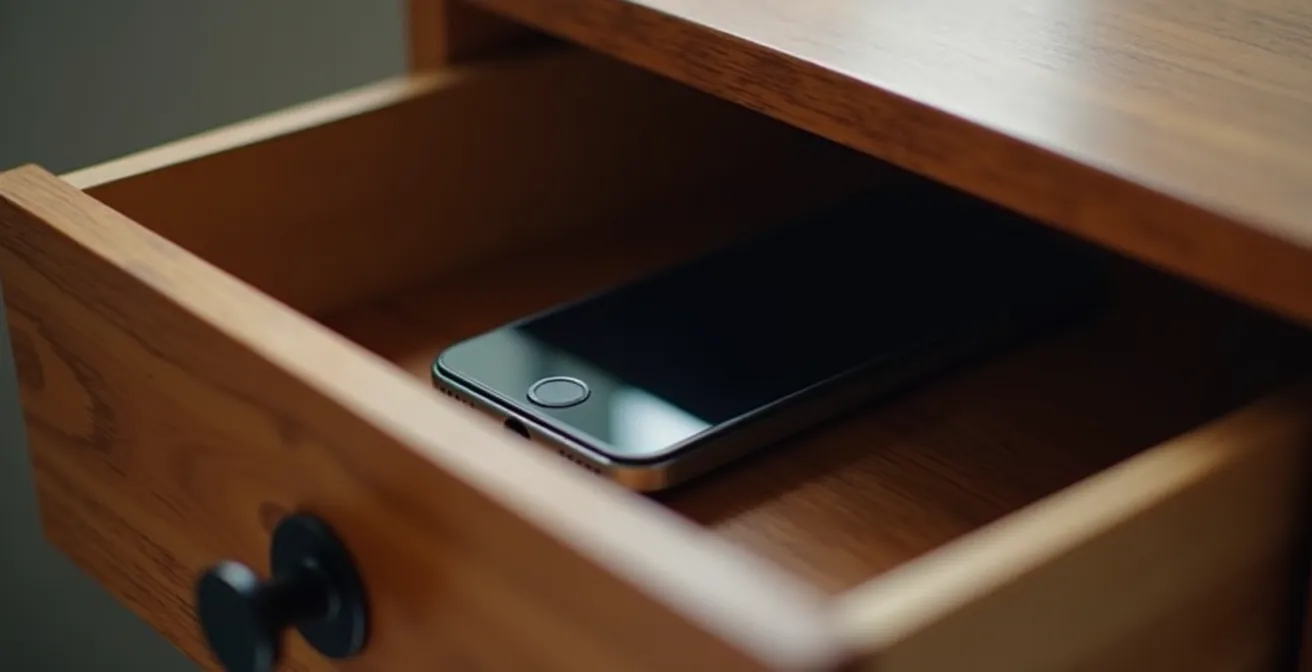
To go a step further, reduce the device’s inherent appeal. Enable grayscale mode to strip away the vibrant, dopamine-triggering colors of app icons. Bury distracting social media and messaging apps in nested folders, requiring multiple swipes and taps to access them. The ultimate move, for a 90-minute sprint, is to physically separate yourself from the device. Place it in a drawer or a bag, as shown in the image above. This physical barrier reinforces the psychological one, making it a deliberate choice to engage with the distraction, rather than a mindless habit.
Coffee or Nootropics: Which Offers More Stable Focus?
In the quest for sustained concentration, many knowledge workers turn to chemical assistance. The default choice is coffee, but its effects—a sharp peak followed by a jittery crash—can be counterproductive in a noisy open office, potentially heightening anxiety and sensitivity to distractions. Architecting your focus requires a more stable fuel source. This is where a strategic approach to nootropics, particularly the combination of L-Theanine and caffeine, offers a superior alternative for sustained deep work.
L-Theanine, an amino acid found in green tea, works synergistically with caffeine. It smooths out the “jitters” and anxiety often associated with high doses of coffee, promoting a state of calm, alert focus. Instead of the volatile spike and crash, this combination provides a longer, more stable plateau of concentration, making it ideal for 90-minute deep work sprints. Beyond chemical aids, it’s also crucial to consider sensory alternatives that help create your focus bubble without ingestion.
The following table, based on an analysis of deep work techniques, compares these options to help you choose the right tool for the job. The goal isn’t just a burst of energy, but stable, resilient focus that can withstand the ambient chaos of the office.
| Factor | Coffee | L-Theanine + Caffeine | Sensory Alternatives |
|---|---|---|---|
| Duration | 2-4 hours with crash | 4-6 hours stable | Variable, no crash |
| Anxiety Level | Can increase in noisy environments | Reduces jitters, promotes calm focus | No anxiety impact |
| Best For | Short reactive tasks | Sustained deep work sessions | Creating focus bubble |
| Open Office Impact | May heighten sensitivity to distractions | Helps maintain focus despite chaos | Creates personal sanctuary |
Choosing the right cognitive fuel is like choosing the right material for your building. For the demanding architecture of deep work, a stable and resilient compound like the L-Theanine and caffeine stack is often a more reliable choice than the volatile energy of straight coffee.
The Morning Routine Mistake That Drains Your Willpower by Noon
The most significant mistake knowledge workers make happens within the first ten minutes of waking up: they check their phone. This single act is a declaration of war on your day’s cognitive resources. It immediately plunges your brain into a reactive state, flooding it with other people’s priorities—emails, news alerts, social media updates. This hijacks your agenda before you’ve even had a chance to set it, and it comes at a time when our ability to focus is already under siege. Research shows human attention spans on screens have dropped dramatically from 2.5 minutes in 2004 to a mere 47 seconds in 2024, making this initial focus more precious than ever.
Every small decision you make, from what to wear to what to eat, depletes your finite daily reserve of willpower, a concept known as decision fatigue. By engaging with your phone first thing, you are squandering this peak mental energy on low-value reactive tasks. The solution is to architect a “Mental Shielding” morning routine designed to preserve and direct your willpower.
This routine is built on two principles: eliminating trivial decisions and setting a powerful intention. Start by moving your alarm clock across the room, forcing you to get out of bed without your phone in hand. Automate your morning by preparing your outfit the night before and standardizing your breakfast. These small changes save precious cognitive fuel. The most crucial step is to define your one Most Important Task (MIT) for the day during this quiet, disconnected time. Write it on a physical index card. This card becomes your “intention shield,” a tangible reminder of your priority that makes it easier to say no to the inevitable distractions that will arise.
When to Tackle Complex Tasks Based on Your Ultradian Rhythm?
Productivity isn’t linear. Our energy and ability to focus naturally ebb and flow throughout the day in 90- to 120-minute cycles known as ultradian rhythms. Trying to force deep work during a cognitive trough is like swimming against the tide—inefficient and exhausting. The architectural approach to productivity involves identifying your personal energy peaks and aligning your most demanding tasks with them.
For most people, the first major peak of cognitive performance occurs around 10 AM. This is the golden window for tackling your Most Important Task. Instead of checking emails or attending low-energy meetings, this time must be fiercely protected as a 90-minute deep work sprint. As productivity expert Cal Newport suggests, start with manageable sessions and gradually build your focus stamina. The power of this approach is validated by hard data.
Case Study: Microsoft Viva’s Protected Focus Time
A pivotal 2024 analysis using Microsoft Viva Insights found that employees with at least 4 hours per week of protected focus time report 121% higher engagement and 68% fewer instances of cognitive fatigue. The effect was most potent when these focus periods were standardized across teams and aligned with natural energy cycles, confirming the immense value of working with, not against, your biology.
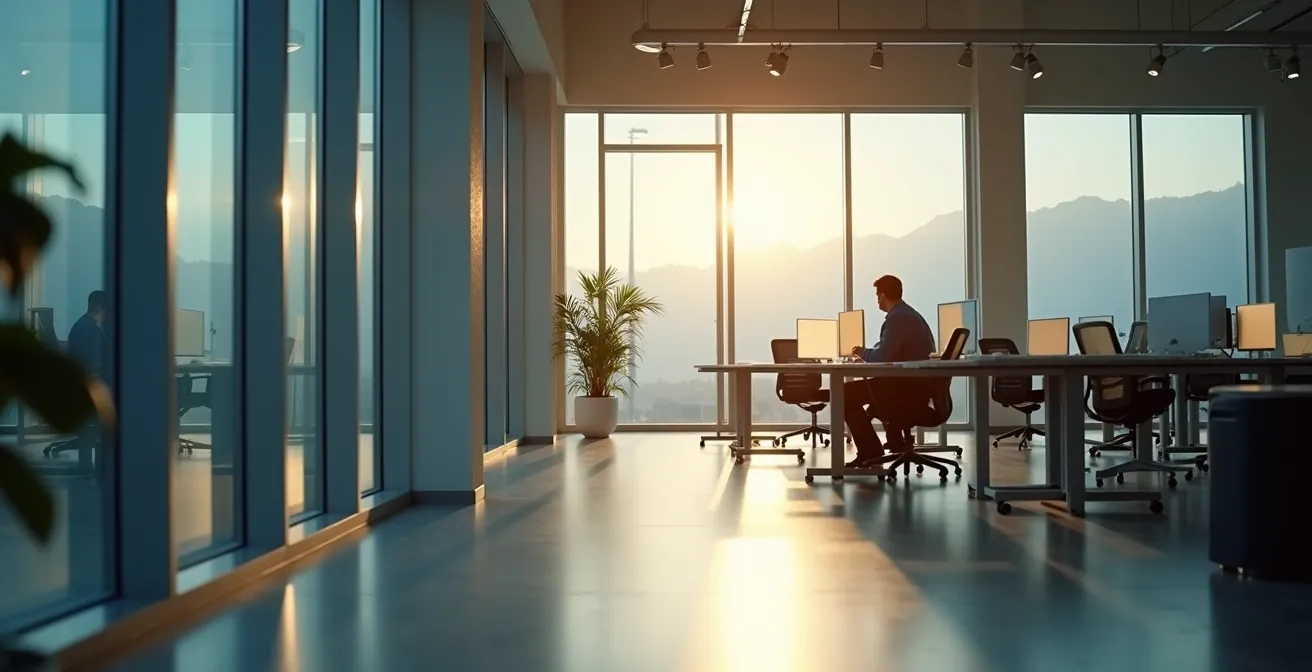
The trough that follows each peak is equally important. This 20-minute dip isn’t a sign of failure; it’s a biological signal to rest and recharge. Instead of pushing through with more caffeine, use this time for a “sanctuary break”—a short walk, some light stretching, or simply looking out a window. By embracing this “Sprint and Sanctuary” strategy, you create a sustainable rhythm for high performance, turning your biological clock into your greatest productivity asset.
Why Looking at Your Phone at 10 PM Destroys Deep Sleep Quality?
The foundation of your cognitive sanctuary isn’t built during the workday; it’s laid the night before. High-quality sleep is the single most effective cognitive enhancer, yet it’s the first thing we sacrifice. The chief culprit in our modern sleep crisis is late-night screen use. Looking at your phone at 10 PM sends a powerful, destructive signal to your brain, sabotaging the deep, restorative sleep necessary for peak mental performance the next day.
The problem is biological. The blue light emitted by screens is particularly effective at suppressing the production of melatonin, the hormone that signals to your body that it’s time to sleep. This delays the onset of sleep and, more critically, reduces the quality of the sleep you do get. Furthermore, the content you consume—work emails, stressful news, or stimulating social media—keeps your mind in an alert, problem-solving state, preventing the mental “cool-down” needed to transition into deep sleep. The result is a night of shallow, fragmented rest, leaving you with a depleted cognitive battery before your workday has even begun.
To build your biological armor against office chaos, you must architect an “evening wind-down” routine that is as disciplined as your morning one. This routine creates a buffer zone between the stimulation of the day and the rest your brain requires. It involves systematically shutting down digital inputs and replacing them with calming, analog activities. This isn’t about luxury; it’s essential maintenance for a high-performance brain.
- Set your phone to charge outside the bedroom by 9 PM every day.
- Replace screen time with reading a physical book for at least 30 minutes.
- Practice light stretching to release the physical tension of a day spent at a desk.
- Write down tomorrow’s MIT on paper to offload mental loops and clear your mind.
- Maintain a consistent sleep schedule, even on weekends, to anchor your body’s clock.
Why “Instant Response” Culture Destroys Deep Work in Remote Teams?
While this guide focuses on the physical open office, its digital equivalent—the culture of instant response—is just as destructive to deep work. Whether you’re in an office or working remotely, communication tools like Slack and Teams have created an expectation of constant availability. This “always-on” culture is the digital manifestation of the tap on the shoulder, fragmenting attention and making sustained focus nearly impossible.
This culture forces knowledge workers into a state of permanent, low-level anxiety, always half-listening for the next ping. It penalizes focus and rewards reactivity, creating an environment where deep work cannot survive. Breaking this cycle requires a conscious architectural shift from synchronous to asynchronous communication. This doesn’t mean never responding; it means establishing clear windows for communication and protecting the time in between. The results of such a shift are profound. Atlassian’s internal pilot program found that adopting asynchronous updates and defined response windows increased project-milestone completion by 22 percent and reduced reported stress.
A powerful strategy to implement this is to flip the default assumption of availability. Instead of being “on” by default, be “off” by default. Productivity expert Cal Newport advocates for a system of dedicated “office hours,” a concept that can be adapted for any team:
I think more offices should reverse this strategy and require employees to specify when they can be disturbed. Imagine, for example, that each employee has a 30-minute ‘office hour’ every two hours during the work day. During these hours they are fully accessible.
– Cal Newport, How to Make Space for Deep Work
By batching communication into predictable blocks, you create large, uninterrupted expanses for deep work. It’s an architectural choice that redesigns team workflow around focus rather than reactivity.
Key Takeaways
- Deep work is a skill that requires environmental and biological architecture, not just willpower.
- The cost of interruptions is measured in “attention residue,” a cognitive lag that can consume up to 40% of your productivity.
- Aligning your most difficult tasks with your body’s natural 90-minute ultradian rhythms is more effective than forcing constant focus.
How to Fix Your Circadian Rhythm After Years of Shift Work?
For many, the ability to focus has been compromised not just by the immediate office environment, but by years of misaligned biological clocks, whether from actual shift work, inconsistent schedules, or poor sleep hygiene. Re-architecting your circadian rhythm—your body’s master 24-hour clock—is the foundational layer for building sustainable “biological armor” against the chaos of the workday. A stable, well-anchored rhythm is what gives you the resilience to deflect distractions and the energy to engage in deep work.
The most powerful signal for setting your circadian rhythm is light. Specifically, getting 15-20 minutes of natural light exposure within the first hour of waking is critical. This morning light hits receptors in your eyes and sends a strong “wake up” signal to your brain, anchoring the start of your biological day. Conversely, avoiding bright, especially blue, light in the evening is just as important for allowing melatonin to rise naturally. Consistency is the second pillar. Your body thrives on routine. Eating meals, exercising, and, most importantly, waking up at consistent times—even on weekends—reinforces your internal clock, making your energy levels more predictable and robust.
This process of circadian repair is about creating a strong, predictable internal environment to buffer against an unpredictable external one. It’s about front-loading your day with the right biological signals so that by the time you enter the distracting open office, your brain and body are already operating from a position of strength and stability.
Your Action Plan: Auditing Your Circadian Alignment
- Light Exposure Audit: For one week, log the exact time you first get 15+ minutes of natural sunlight. Is it within 60 minutes of waking?
- Consistency Check: Track your wake-up times for seven consecutive days, including the weekend. Is the variation greater than 60 minutes?
- Mealtime Inventory: Note your meal times. Are they scattered or do they fall within consistent 90-minute windows each day?
- Evening Cool-Down Review: For three nights, record all activities after 9 PM. How many involved a bright screen versus an analog activity?
- Action Plan: Based on the audit, identify your single biggest point of misalignment and commit to fixing just that one variable for the next two weeks.
By systematically implementing these architectural principles—from managing attention residue and configuring your technology to aligning with your body’s natural rhythms—you can transform your experience of the open office. The journey begins not with a new set of headphones, but with the first strategic decision to build your cognitive sanctuary. Start today by choosing one routine to re-architect and begin laying the foundation for sustained, high-value deep work.