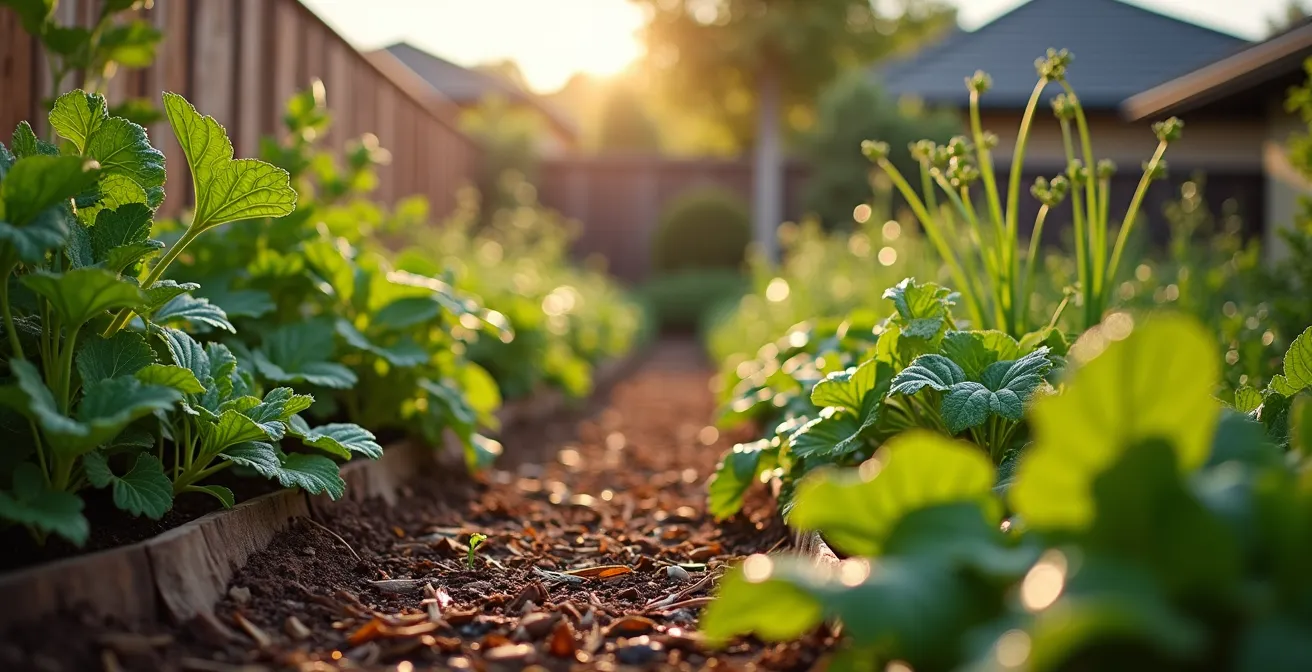
A gray water system is a powerful tool, but its true impact is only unlocked when viewed as part of a larger, interconnected home ecosystem.
- The “virtual” resources you consume (like water embedded in beef) often have a far greater environmental impact than your direct usage (like showers or laundry).
- Optimizing energy and waste streams—from unplugging “vampire” appliances to effective composting—is technically and legally inseparable from efficient water conservation.
Recommendation: Stop chasing individual eco-hacks and start performing a systems-level audit of your home’s resource flows to identify the most impactful changes.
For a homeowner in a drought-stricken area, the appeal of a gray water system is immediate and tangible. The idea of redirecting water from the laundry machine to the garden—a “laundry-to-landscape” setup—seems like a straightforward, win-win solution. Standard advice revolves around choosing biodegradable detergents and avoiding contact with root vegetables. While technically correct, this perspective is dangerously incomplete. It treats a home’s sustainability as a checklist of isolated actions rather than a complex, integrated system.
As a water conservation engineer, I must insist on a more rigorous approach. Focusing solely on the plumbing of a gray water system without considering the energy needed to pump it, the quality of waste that feeds your soil, or the “virtual” water embedded in your lifestyle choices, is like trying to optimize a single gear without understanding the entire machine. True efficiency and sustainability emerge not from a single component, but from understanding the interconnected flows of water, energy, and material waste within your domestic ecosystem. This requires a shift in thinking: from “how do I install this pipe?” to “how does this pipe fit into my home’s overall resource lifecycle?”
This guide, therefore, will not simply provide installation steps. Instead, it will equip you with a systems-thinking framework. We will analyze the often-invisible dependencies between your daily choices—what you eat, what you plug in, and how you dispose of waste—and their profound impact on your home’s overall environmental footprint. The goal is to move beyond simple fixes and empower you to become the chief engineer of your own sustainable domestic ecosystem.
To navigate this systemic approach, this article is structured to explore the key resource flows within your home. The following summary outlines how we will deconstruct your consumption habits to build a truly efficient and sustainable living environment.
Summary: Deconstructing Home Sustainability for a Systems-Based Approach
- Why Eating Beef Uses More Water Than Taking Long Showers?
- How to Identify Which Appliances Drain Power When Turned Off?
- Rooftop Solar or Small Wind Turbine: Which Works for Your Climate?
- The Pizza Box Mistake That Ruins an Entire Batch of Recycling
- When to Turn Your Compost Pile to Accelerate Decomposition?
- How to Spot if a Hotel Composts Food Waste Effectively?
- The Watering Mistake That Breeds Fungus Gnats in Your Home
- How to Verify if a US “Eco-Lodge” is Truly LEED Certified?
Why Eating Beef Uses More Water Than Taking Long Showers?
The most significant flaw in conventional water-saving advice is its exclusive focus on direct consumption—the water flowing from your taps. A systems engineering approach demands an analysis of “virtual water,” the hidden water footprint embedded in the products you consume. Food production, particularly animal agriculture, represents the largest component of a household’s virtual water usage. The comparison between beef and showers is not hyperbole; it is a stark illustration of this principle.
The key lies in understanding the resource chain. Producing a single pound of beef requires a staggering amount of water for growing feed crops, hydrating the animal, and processing. In contrast, the water used in a shower is a direct, one-time withdrawal from a municipal or well system. According to comprehensive analysis, it takes approximately 1,800 gallons of water per pound of beef produced. A standard 10-minute shower uses about 25 gallons. This means that forgoing one pound of beef saves as much water as skipping 72 showers. This is not to say that shorter showers are pointless, but to emphasize that without accounting for virtual water, you are ignoring the largest part of the equation.
This data forces a re-evaluation of priorities. From an engineering standpoint, optimizing a system requires targeting the points of highest leverage. Reducing consumption of high-footprint products like beef offers a much greater return on investment for water savings than marginal gains in domestic fixture efficiency. Understanding your “water diet” is therefore more critical than timing your showers with a stopwatch. It’s the first step in seeing your home not as a simple plumbing network, but as a terminal in a global resource flow.
How to Identify Which Appliances Drain Power When Turned Off?
Just as “virtual water” represents a hidden resource drain, “vampire power” or “phantom load” constitutes a significant and often overlooked energy outflow in the domestic ecosystem. This is the electricity consumed by appliances and electronics while they are turned off or in standby mode. From an engineering perspective, this is a constant, low-level system inefficiency. This wasted energy has a direct cost, both financially and environmentally, and could otherwise be used for productive purposes, such as powering the pump for your gray water system.

Identifying these phantom loads is the first step toward optimizing your home’s energy flow. Devices with remote controls, continuous displays (like a microwave clock), or external power adapters are the primary culprits. While a single device may seem insignificant, their cumulative effect is substantial. According to an analysis by the Natural Resources Defense Council (NRDC), vampire energy costs Americans $19 billion annually, which translates to a significant portion of a household’s electricity bill. The key is to triage these devices based on their standby wattage to prioritize your efforts.
The following table categorizes common household devices, allowing for a systematic approach to mitigating phantom loads. This kind of data-driven prioritization is central to an engineering mindset, focusing efforts where they will yield the greatest return.
| Category | Examples | Standby Wattage | Annual Cost | Priority |
|---|---|---|---|---|
| Energy Vampires | Gaming consoles, Cable boxes | 11-48.5W | $15-40 | Unplug First |
| Nuisance Ghouls | TVs, Desktop computers | 7.5-9.5W | $9-12 | Use smart strips |
| Benign Ghosts | Microwave clocks, Washers | 1-6W | $1.33-8 | Keep plugged |
Using smart power strips that cut power to a group of devices when the main one (like a TV) is turned off, or simply unplugging high-draw “Energy Vampires” like gaming consoles when not in use, can reduce phantom loads by up to 75%. This reclaimed energy directly improves the overall efficiency of your home system.
Rooftop Solar or Small Wind Turbine: Which Works for Your Climate?
Once you have minimized energy waste by eliminating phantom loads, the next logical step in optimizing your domestic ecosystem is generating your own power. This closes the energy loop, transforming your home from a passive consumer into a proactive producer. The choice between rooftop solar and a small wind turbine is not a simple matter of preference; it is a technical decision dictated by your specific geographic and regulatory environment. An engineer’s approach requires a feasibility study, not a gut feeling.
The primary determinant is your local climate resource. Solar panels depend on “solar insolation” (the amount of sunlight hitting a surface), while turbines rely on consistent wind speeds. A home in the desert Southwest is a prime candidate for solar, whereas a property on a coastal bluff or a high ridge may be better suited for wind. However, many locations have viable resources for both, making the decision more complex. You must also consider seasonal variations—does your region have sunny winters and calm summers, or cloudy winters and windy conditions? This data is crucial for modeling your potential energy generation throughout the year.
Beyond climate, a host of logistical and legal factors must be analyzed. Your home’s physical characteristics (roof orientation, structural integrity, shading from trees) and local regulations (building permits, zoning laws, homeowner association restrictions) are critical constraints. Furthermore, the economic viability depends on net metering policies, which determine how you are compensated for excess energy fed back to the grid. To make an informed decision, a holistic assessment is necessary:
- Local Climate Assessment: Analyze annual average sun hours versus wind speed data from sources like the National Renewable Energy Laboratory (NREL).
- Regulatory Check: Consult your local planning department and utility company regarding permits, interconnection agreements, and net metering policies.
- Site Evaluation: Assess your roof’s condition, south-facing exposure, and any potential shading. For wind, evaluate open space and potential turbulence from nearby structures.
- Energy-Water Nexus: Consider how your renewable system will power critical infrastructure, such as pumps for a gray water or well system, ensuring resilience during grid outages.
- Community Options: Research shared renewables like community solar farms, which are a growing trend. In fact, 5.7 gigawatts of community solar capacity were installed as of 2023, offering a way to benefit from solar without installing panels on your own property.
The Pizza Box Mistake That Ruins an Entire Batch of Recycling
Managing the material waste flow is a critical, yet frequently misunderstood, part of the domestic ecosystem. The “Pizza Box Mistake” serves as a powerful case study in system contamination. A common belief is that all cardboard is recyclable. However, the grease and food residue on a used pizza box bottom are contaminants. When this single item is placed in a recycling bin, it can render an entire batch of otherwise clean paper and cardboard un-recyclable at the Material Recovery Facility (MRF).
MRFs are complex industrial systems designed to sort and process massive quantities of materials. Their economic viability depends on the quality of the incoming stream. When contamination rates from non-recyclable items, food waste, and liquids are too high, the cost of sorting exceeds the value of the recovered materials. A single greasy pizza box can cause an entire truckload of recyclables to be rejected and diverted to a landfill. With contamination rates above 25% making batches economically unviable, the consequence of a single household’s mistake is magnified across the entire municipal system.
To manage this waste stream effectively, an engineer would adopt a clear sorting protocol, much like separating different types of water. Consider a “Three Buckets” mental model for your household waste:
- Clean Water (Perfect Recyclables): This stream is for pristine materials only. Think clean paper, rinsed metal and plastic containers, and dry, uncontaminated cardboard (like the top half of the pizza box).
- Gray Water (Compostables): This is the destination for organic matter. Food scraps, coffee grounds, yard waste, and the greasy bottom of the pizza box belong here. These are not “trash” but valuable inputs for another process: composting.
- Black Water (True Trash): This is the landfill-bound stream for materials that cannot be recycled or composted. This includes plastic bags (which jam MRF machinery), styrofoam, broken ceramics, and any item smaller than a credit card that will fall through sorting screens.
This systematic approach prevents cross-contamination and ensures that each material flow is directed to its proper destination, maximizing resource recovery and minimizing the burden on municipal systems. It transforms waste management from a guessing game into a precise engineering process.
When to Turn Your Compost Pile to Accelerate Decomposition?
The compost pile is the heart of a circular domestic ecosystem, transforming the “Gray Water” waste stream (food scraps, yard trimmings) into a valuable resource: nutrient-rich soil amendment. This process is not passive; it is an active biological system that requires management to function optimally. A common question is when to turn the pile. The answer, from an engineering standpoint, depends on monitoring key performance indicators: temperature, moisture, and smell.

An active compost pile should reach temperatures between 130°F and 160°F, which is necessary to kill weed seeds and pathogens. This heat is generated by microbial activity. As microbes consume the most readily available material, the pile begins to cool. This drop in temperature is a primary signal that it’s time to turn the pile. Turning introduces oxygen (aeration) into the center and mixes the un-decomposed outer layers into the hot core, reigniting the microbial process.
Moisture is another critical parameter. The pile should feel like a wrung-out sponge. If it’s too dry, decomposition slows dramatically. If it’s too wet, it becomes anaerobic, leading to a foul, ammonia-like smell instead of a pleasant, earthy one. This is where gray water can be strategically used. Water from a washing machine using plant-based, low-sodium detergents can be an excellent source for rehydrating a dry pile. However, gray water containing bleach, borax, or high salt concentrations must be avoided as it will kill the beneficial microbes. This direct link between your laundry habits and soil health exemplifies the interconnectedness of your home’s systems.
Action Plan: Your Compost Diagnostic Checklist
- Moisture Check: Once a week, grab a handful of compost (with gloves). It should feel like a damp, wrung-out sponge. If it’s dry, it’s time to add moisture.
- Gray Water Use: If adding moisture, use only gray water from washing machines with eco-friendly, low-sodium, and bleach/borax-free detergents.
- Turn Signals: Turn the pile when its internal temperature drops below 90°F, you notice significant dry patches, or a sharp ammonia smell develops (indicating it needs oxygen).
- Activator Input: Add “green” activators like fresh grass clippings or coffee grounds weekly to provide nitrogen and fuel microbial activity.
- Decomposition Monitoring: Look for the desired outputs: a dark, rich color, a pleasant earthy smell, and a fine, crumbly texture. This indicates the process is working correctly.
By monitoring these inputs and outputs, you are no longer just “making compost”; you are managing a bioreactor to efficiently process organic waste into a valuable resource for the garden that your gray water system irrigates.
How to Spot if a Hotel Composts Food Waste Effectively?
The principles of systems thinking are not confined to your home; they are a powerful lens for evaluating the sustainability claims of any entity, such as a hotel advertising its “eco-friendly” practices. “Greenwashing”—the act of making misleading claims about environmental benefits—is rampant. An engineer’s approach is to look for system coherence. Do all the observable components of the system align with the primary claim?
If a hotel heavily advertises its food waste composting program, you must look for corroborating evidence and potential contradictions in its other operations. Is the composting claim consistent with the hotel’s overall material flow management? A single claim, in isolation, is meaningless. You must audit the entire system for consistency. For instance, a hotel that composts food scraps but serves all its meals with disposable plates and cutlery has a fundamentally broken system. The energy and material waste from the disposables likely negates any benefit from composting.
As the Sustainable Hospitality Alliance notes when identifying red flags, the contradictions often lie in adjacent systems. This critical perspective is essential for any sustainability audit, whether of a commercial enterprise or your own home.
The hotel heavily advertises composting but still uses disposable cutlery and plates in its restaurant, or they have a composting program but their landscaping consists of a water-guzzling lawn instead of native plants.
– Sustainable Hospitality Alliance, Greenwashing Red Flags in Hospitality
Apply this logic to your own “domestic ecosystem.” Do you meticulously sort your recycling but leave all your electronics on standby, bleeding vampire power? Do you have a rain barrel but maintain a pristine, non-native lawn that requires immense amounts of water? System integrity requires that all parts work in harmony. A contradiction in one area undermines the efficiency of the whole. Spotting greenwashing in a hotel is excellent practice for identifying the weak points in your own sustainability strategy.
The Watering Mistake That Breeds Fungus Gnats in Your Home
Even at the micro-level of houseplants, the principles of system management apply. Fungus gnats, a common household pest, are not a random misfortune; they are a direct output of a system imbalance, specifically, over-watering. These small flies thrive in perpetually damp soil, where their larvae feed on fungi and organic matter. When you use gray water for houseplants, which is an excellent way to conserve resources, the risk of this imbalance can increase if not managed properly.
The issue is not the gray water itself, but the management of the soil moisture and nutrient content. Some gray water sources, particularly from kitchens, can contain small organic particles that provide an abundant food source for both fungi and gnat larvae. If this water is applied too frequently, the top layer of soil never dries out, creating a perfect breeding ground. This is a classic engineering problem of an uncontrolled input leading to an undesirable output. The solution is to regulate the input (water) and monitor the system’s state (soil dampness).
Not all gray water is suitable for houseplants. The chemical and organic load must be considered. Water from boiling vegetables is excellent, once cooled, as it’s low in contaminants and even contains some nutrients. Water from washing dishes, however, is generally unsuitable due to high concentrations of fats, oils, and detergents that can harm plants and create a breeding ground for pests. The following guide provides a clear framework for selecting appropriate gray water sources for indoor use:
| Water Type | Safe for Houseplants | Preparation Needed | Gnat Risk |
|---|---|---|---|
| Vegetable boiling water | Yes (cooled) | Let cool to room temp | Low |
| Rice rinse water | Yes | Use immediately | Low |
| Shower water | Maybe | Only with eco-soap | Medium |
| Dishwater | No | Too many contaminants | High |
The key takeaway is that even a “good” practice like reusing water requires process control. Allow the top one to two inches of soil to dry out completely between waterings. This simple step disrupts the fungus gnat life cycle and is the most effective control method. Managing the frequency, not just the source, of water is paramount for maintaining a healthy indoor plant system.
Key Takeaways
- “Virtual” resource consumption, especially the water embedded in food like beef, often dwarfs direct household use and represents a critical area for optimization.
- Hidden energy drains from “vampire” appliances constitute a significant and continuous inefficiency in the domestic system, with measurable financial and environmental costs.
- True sustainability is an interconnected system; the efficiency of your water conservation (gray water), waste management (compost), and energy generation (solar) are technically and legally interdependent.
How to Verify if a US “Eco-Lodge” is Truly LEED Certified?
In a world of greenwashing, third-party certification provides a crucial, data-driven framework for verifying sustainability claims. For buildings in the United States, the most recognized standard is LEED (Leadership in Energy and Environmental Design), administered by the U.S. Green Building Council (USGBC). An “eco-lodge” claiming to be green is making a subjective statement; a lodge claiming to be “LEED Certified” is making a verifiable, technical claim that can be audited against a public standard.
LEED certification is a holistic, points-based system that evaluates a building’s performance across multiple categories, including energy efficiency, water conservation, site management, material selection, and indoor environmental quality. It embodies the engineering systems approach we have discussed: it doesn’t just reward a single feature like solar panels, but rather the integrated performance of the entire building. A building cannot achieve certification without demonstrating competence across this wide range of metrics. The number of certified buildings demonstrates the standard’s widespread adoption as a reliable benchmark.
To verify a property’s claim, you should not rely on their marketing materials. The USGBC maintains a public, searchable directory of all LEED-certified projects on its website. This is the single source of truth. You can search by project name, city, or state to confirm if a building is certified and to what level (Certified, Silver, Gold, or Platinum). As of early 2024, the U.S. Green Building Council reports over 36,886 LEED certified buildings in North America, making this database a robust tool for verification. If a property claims to be LEED certified but does not appear in this official directory, the claim is unsubstantiated and should be treated with extreme skepticism.
This process of verification is the final step in the engineering mindset: trust, but verify. Make claims measurable, and then measure them against a recognized, independent standard. Applying this same rigor to your own home—measuring your water usage, tracking your energy bills after unplugging vampire devices, testing your compost’s pH—is how you move from well-intentioned amateur to effective domestic systems engineer.
The first step toward engineering your own domestic ecosystem is to conduct a thorough audit. Start by using a power meter to identify your home’s top “energy vampires” and consolidate them on smart power strips. This single, measurable action will provide a clear and immediate return, building the foundation for more complex optimizations like gray water and composting systems.