
The constant downtime from moving between cities is the biggest threat to a nomad’s productivity; the solution is not better time management, but a repeatable, location-agnostic operational system.
- Your work environment—ergonomics and connectivity—must be portable and redundant, not dependent on your temporary housing.
- Proactively manage systemic risks like state income tax laws and insecure Wi-Fi to prevent catastrophic disruptions to your career and finances.
Recommendation: Shift your mindset from “finding” a productive space to “deploying” your pre-configured productivity system in any environment within minutes.
For the digital nomad moving across the US every two weeks, the promise of freedom often collides with a harsh reality: operational drag. The time lost to packing, transit, setting up in a new space, and solving logistical puzzles is a constant drain on focus and output. You’re not just a remote worker; you are a logistics manager for a company of one, and every minute spent on non-billable setup is a minute of lost productivity. Many nomads try to solve this with generic advice like “build a routine” or “find a good café,” but these platitudes fail because they don’t address the core problem: the friction of constant mobility.
The true challenge isn’t a lack of discipline, but the absence of a system. Relying on the inconsistent quality of hotel chairs, the questionable security of public Wi-Fi, or the luck of finding a good local network is a strategy for failure. The relentless context-switching depletes your cognitive resources, leaving you reactive and perpetually catching up. The secret to maintaining 100% productivity isn’t about working harder or managing your time better. It’s about engineering a ‘frictionless mobility system’ that makes your ability to perform deep work completely independent of your physical location.
This guide provides the blueprints for that system. We will deconstruct the key friction points that cost nomads time and money—from physical setup and digital security to tax liabilities and travel logistics. By implementing these disciplined protocols, you can transform your nomadic lifestyle from a series of chaotic sprints into a smooth, efficient, and highly productive operation, no matter which city you’re in this week.
This article breaks down the essential systems every 14-day US nomad needs to master. Below is a summary of the core pillars we will build to ensure your productivity remains constant, even when your address doesn’t.
Summary: The Nomad’s Productivity System Blueprint
- How to Set Up an Ergonomic Workstation in a Hotel Room in 10 Minutes?
- Why Relying on Hotel Wi-Fi is a Career Suicide for Nomads?
- Airbnb or Co-living: Which is Better for Networking in a New City?
- The State Income Tax Trap That Costs US Nomads Thousands
- When to Switch to a ‘One-Bag’ Strategy to Save on Airline Fees?
- Why “Instant Response” Culture Destroys Deep Work in Remote Teams?
- Why Flight Prices Increase After You Search the Same Route Twice?
- How to Lead a Brainstorming Session on Zoom That Actually Generates Ideas?
How to Set Up an Ergonomic Workstation in a Hotel Room in 10 Minutes?
Your physical environment is the foundation of your productivity. Relying on a hotel’s random desk and chair is a gamble you can’t afford to take. Hunching over a laptop on a bed or a low table for eight hours a day isn’t just uncomfortable; it’s a direct assault on your focus and long-term health. The goal is location agnosticism for your body. You need a system to replicate a healthy, supportive work setup in any room, in under 10 minutes. This isn’t about luxury; it’s about professional sustainability.
The solution is a portable ergonomic kit—a non-negotiable part of your travel gear. This ‘office in a bag’ ensures your posture, wrist alignment, and screen height are correct, regardless of the furniture provided. A lightweight laptop stand, a compact external keyboard, and a vertical mouse are the holy trinity of nomadic ergonomics. These tools prevent the physical strain that leads to cognitive fatigue, allowing you to sustain deep work sessions from day one in a new city. Your body shouldn’t have to ‘adapt’ to a new, painful setup every 14 days; your setup must adapt to you, instantly.
This system eliminates the guesswork and the physical pain that quietly kills productivity. Instead of spending your first morning in a new city trying to stack books under your laptop, you deploy your kit and get straight to work. The initial investment pays for itself within weeks by preserving the one asset you can’t replace: your physical well-being and ability to concentrate.
Your 10-Minute Ergonomic Deployment Plan
- Pack a lightweight laptop stand (like a Roost or Nexstand) to elevate your screen to perfect eye level, eliminating neck strain.
- Include a compact, split ergonomic keyboard (such as the Goldtouch Go!2) to ensure your wrists and arms maintain a neutral position.
- Carry a vertical mouse to prevent the wrist pronation and shoulder tension that leads to repetitive strain injury.
- Systematically use hotel pillows as immediate lumbar support on any chair or as a footrest to ensure proper leg posture.
- Strictly apply the 20-20-20 rule: create a recurring timer to look at something 20 feet away for 20 seconds every 20 minutes to combat eye strain.
Why Relying on Hotel Wi-Fi is a Career Suicide for Nomads?
Your internet connection is your professional lifeline. Treating hotel Wi-Fi as a reliable and secure utility is one of the most dangerous assumptions a digital nomad can make. These networks are notoriously unstable, slow, and, most importantly, insecure. A single dropped video call can damage your professional reputation, but a security breach can end your career. Public networks are hunting grounds for cybercriminals looking to intercept data, and security research shows that hotels are the third most common target of cyber attacks, representing 13% of all compromises. Using hotel Wi-Fi without safeguards is not a calculated risk; it’s professional negligence.
The solution is to build a personal ‘Connectivity Trinity’ based on the principle of system redundancy. This system ensures you are never dependent on a single, untrusted network. Your primary connection should be your own mobile hotspot. Your secondary backup is tethering to your smartphone. The hotel’s Wi-Fi is your tertiary, last-resort option, and it should only ever be accessed through a reputable, paid VPN (Virtual Private Network). A VPN encrypts your traffic, making it unreadable to anyone snooping on the network.
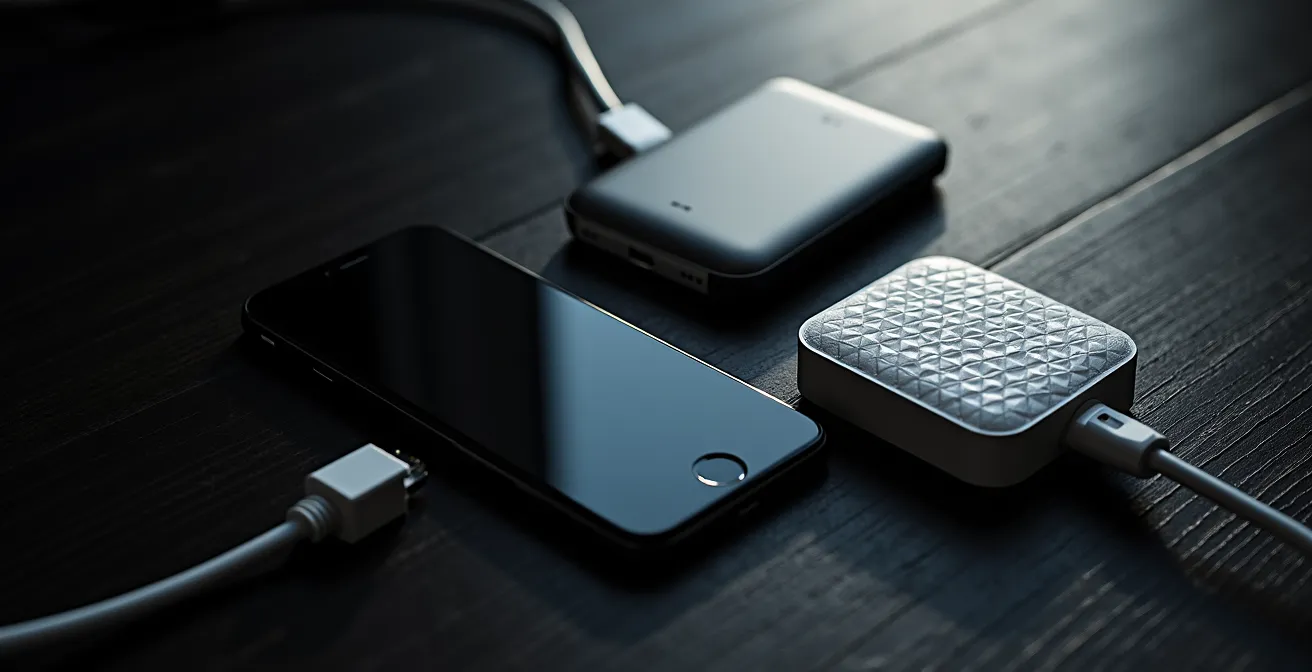
This multi-layered approach provides both security and reliability, transforming your connectivity from a source of anxiety into a fortress. You achieve true location agnosticism, where your ability to work securely is entirely within your control, not at the mercy of a hotel’s IT budget. This system isn’t about paranoia; it’s about maintaining professional standards in an inherently insecure environment.
Case Study: The Universal Failure of Hotel Network Security
In a sobering 2019 security assessment, researchers tested Wi-Fi vulnerabilities across 45 hotel locations in five different countries. The results were alarming: not a single hotel network passed the security tests. They consistently failed to protect against common hacking methods like man-in-the-middle attacks and data interception, proving that trusting your sensitive work data to these networks is an unjustifiable risk.
Airbnb or Co-living: Which is Better for Networking in a New City?
The choice between an Airbnb and a co-living space seems to present a trade-off: privacy versus community. For the nomad on a 14-day cycle, however, this is a false dichotomy. The primary goal is to minimize operational drag and maximize productivity. While co-living spaces are marketed as instant communities, they often fail to deliver for the short-term traveler. The social dynamics and organized events are typically geared towards residents with longer stays, creating a barrier to quick integration.
For a two-week sprint in a new city, an Airbnb is the more efficient choice for focused work. It provides a controlled, private environment where you can instantly deploy your ergonomic and connectivity systems without navigating shared spaces or social obligations. It offers a predictable sanctuary for deep work, which is your highest-value activity. Attempting to network through your housing is an inefficient strategy on a short timeline. Your energy is better spent on highly targeted networking: attending industry-specific meetups, connecting with professionals on LinkedIn before you arrive, or working from a specific café known as a hub for your field.
As one analysis on remote work lifestyles points out, the time it takes to socially integrate into a new group can be significant. The most disciplined nomads separate their living space from their social strategy. Your accommodation is your productivity headquarters; your networking happens outside of it, on your own terms.
The ‘social spin-up time’ in a co-living space is often longer than a week, making it inefficient for a 14-day stay.
– Digital Nomad Community Research, Remote Work Lifestyle Analysis 2024
The State Income Tax Trap That Costs US Nomads Thousands
For US-based digital nomads, the greatest financial threat isn’t flight costs or rent; it’s tax residency. The freedom to move between states comes with a complex web of tax obligations that can lead to double taxation or surprise six-figure bills. Many nomads operate under the dangerous misconception that they only owe taxes where they spend the most time. In reality, multiple states can claim you as a resident for tax purposes, demanding a share of your entire worldwide income. The most common pitfall is the statutory residency rule. A comprehensive tax residency analysis reveals that most US states use a 183-day rule, which, if triggered, establishes you as a full-time tax resident.
The ‘183-day rule’ means that spending more than half a year (approximately 183 days) in a single state makes you liable for income tax on all your earnings for that year, regardless of where the money was earned. For a high-earning nomad spending extended time in a high-tax state like California or New York, this can be a devastating financial blow. Meticulously tracking your days in each state is not optional; it is a critical defense mechanism.
The disciplined solution is a proactive tax-domicile strategy. This involves formally establishing your primary, permanent home (‘domicile’) in one of the few states with no state income tax, such as Florida, Texas, Nevada, or South Dakota. This requires more than just getting a P.O. box. You must take clear steps to sever ties with former high-tax states and demonstrate your intent to reside in your new domicile state, including obtaining a driver’s license, registering to vote, and opening local bank accounts. This system provides a clear, defensible tax home and is the only way to protect your income while legally enjoying a nomadic lifestyle.
When to Switch to a ‘One-Bag’ Strategy to Save on Airline Fees?
The debate over checked luggage versus one-bag travel is often framed around saving on airline fees. For the hyper-productive nomad, the real currency isn’t dollars; it’s time and operational resilience. The cost of a checked bag is trivial compared to the cost of lost productivity. A travel efficiency analysis shows that the average 45 minutes lost per flight waiting for checked baggage—both at drop-off and pickup—adds up to two full workdays per year for a nomad moving every 14 days. This is pure operational drag that directly eats into your earning potential.
The switch to a ‘one-bag’ strategy becomes mandatory the moment your goal shifts from ‘traveling’ to ‘operating while mobile.’ It eliminates the single biggest point of failure and delay in your transit process. You walk off the plane and are immediately on your way, while others are still waiting at the carousel. This strategy is not about minimalism for its own sake; it is about building a resilient, frictionless mobility system that protects your time and eliminates dependencies on failure-prone airline baggage handling.
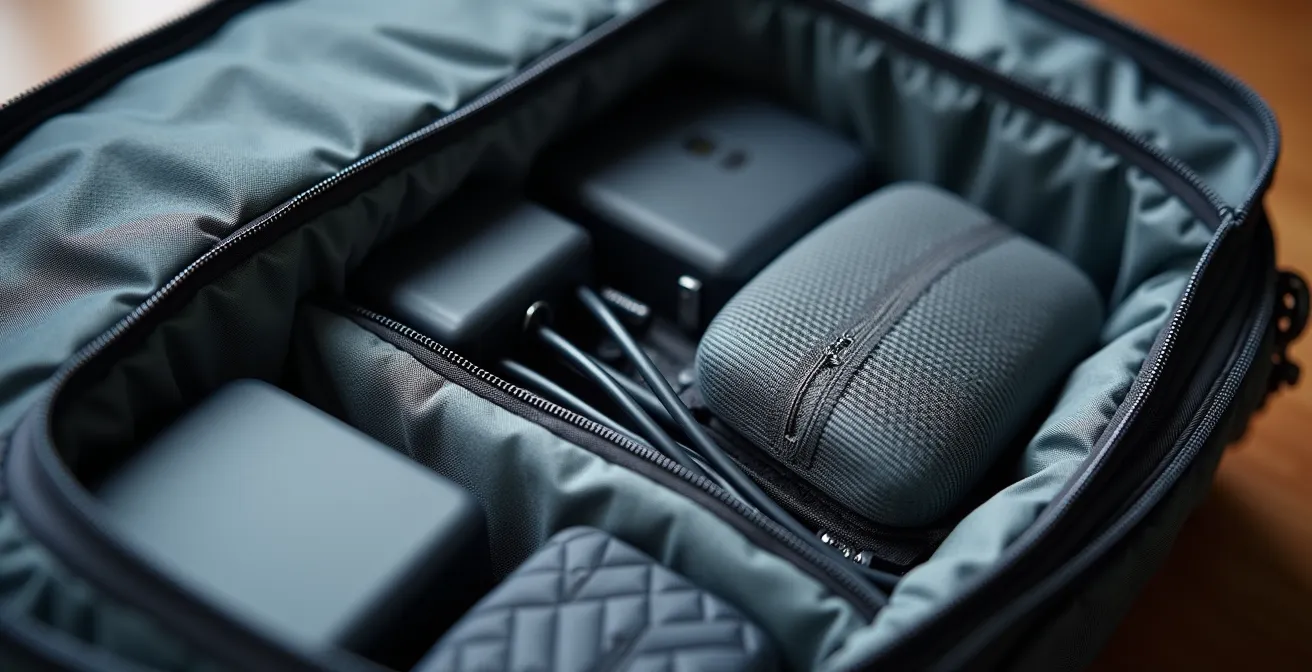
Adopting this approach forces a disciplined mindset, compelling you to optimize every item you carry. It’s not just about packing less; it’s about packing smarter with modular, multi-purpose gear. This system ensures you are always agile and in control of your most critical assets.
Case Study: The Modular Go-Bag System for Zero Downtime
Elite digital nomads have perfected a modular system that guarantees operational continuity. It consists of a maximum-size carry-on for clothing and secondary items, and a personal-item backpack that functions as a complete, self-contained mobile office. This ‘Go-Bag’ holds all essential work equipment: laptop, chargers, ergonomic kit, and the ‘Connectivity Trinity’. Nomads using this system report being able to maintain 100% work capability and meet all deadlines even when their main carry-on is unexpectedly gate-checked and lost for days.
Why “Instant Response” Culture Destroys Deep Work in Remote Teams?
In a remote team, the pressure to be constantly available is a silent killer of productivity. This ‘instant response’ culture, fueled by chat notifications and status indicators, creates an environment of perpetual interruption. For a digital nomad, this problem is amplified by time zones. You are always out of sync with someone, which can create an implicit expectation to be responsive across a 12-hour window. This constant, low-level anxiety fragments your attention and makes the sustained, focused concentration required for deep work almost impossible.
Every notification you react to pulls you out of a state of flow, and it takes significant time and mental energy to get back in. Answering a ‘quick question’ on Slack might seem harmless, but it’s a profound act of self-sabotage. It trains your brain to operate in a reactive, shallow-work mode, prioritizing responsiveness over results. As a productivity coach, I see this as the single biggest impediment to high performance in distributed teams. You must treat your focus as your most valuable, and most fragile, asset.
The solution is to reject the culture of immediacy and proactively implement an asynchronous-first communication protocol. This means establishing and communicating clear boundaries. Use descriptive Slack statuses like “Deep Work until 2 PM CST – will respond after.” Block out “Focused Work” sessions on your shared calendar. Use auto-responders that clarify your current time zone and typical response windows. The goal is to shift the team’s expectation from instant answers to thoughtful, consolidated communication. This isn’t about ignoring your colleagues; it’s about structuring your day to deliver high-quality work, which is ultimately what the team needs from you.
Why Flight Prices Increase After You Search the Same Route Twice?
One of the most persistent myths in travel is that airlines track your searches with cookies and raise prices on you personally. This belief leads to wasted time clearing cookies, using incognito mode, and feeling paranoid. The reality is both simpler and more complex. Airlines use sophisticated ‘dynamic pricing’ algorithms, but they aren’t targeting you individually. Instead, they react to overall market demand in real-time. The price you see is determined by ‘fare buckets’.
Airlines allocate a certain number of seats on each flight to different price levels, or buckets. The cheapest bucket might have only a handful of seats. When those seats are sold—by you or anyone else in the world searching at the same time—the system automatically moves to the next, more expensive bucket. The price increase you perceive after a second search is not a penalty; it’s a reflection of the cheapest seats having been sold in the minutes since your last search. This is especially true on popular routes where many people are booking simultaneously.
Instead of fighting a non-existent enemy (personal tracking), a disciplined nomad should focus on understanding and leveraging the system. This means shifting from reactive searching to proactive analysis. Use tools like Google Flights’ Price Graph to see pricing trends over several months and identify the historically cheapest weeks to travel. Set up automated ‘Track Prices’ alerts for your target route. Most importantly, leverage your flexibility. Being able to shift your travel date by a single day can often drop you into a much cheaper fare bucket, saving you hundreds of dollars. Booking on Tuesdays or Wednesdays, when airline inventory is often refreshed, can also be advantageous.
Reality Check: The Fare Bucket System in Action
The perception of being personally targeted by airlines has been repeatedly debunked. The core mechanism is the ‘Fare Bucket’ system, which responds to aggregate demand. When multiple users book the last few seats in the “K” fare bucket (a cheap fare class), the next person to search for that flight is automatically shown the price for the “L” or “M” bucket, which is higher. It’s an automated, impersonal process of supply and demand, not a personal pricing strategy against you.
Key Takeaways
- True nomadic productivity comes from a location-agnostic system, not from adapting to your environment.
- Systemic risks (insecure Wi-Fi, state taxes) pose a greater threat to your career than daily distractions. Proactive mitigation is mandatory.
- Your time is your most valuable asset. Ruthlessly eliminate operational drag from travel, setup, and repetitive tasks.
How to Lead a Brainstorming Session on Zoom That Actually Generates Ideas?
Standard virtual brainstorming sessions are often unproductive. They tend to be dominated by the loudest voices, while introverted or more thoughtful team members struggle to break into the conversation. The result is groupthink and a shallow pool of recycled ideas. For a nomad leader, whose connection to the team is entirely digital, running a session that genuinely sparks innovation is a critical skill. The key is to abandon the traditional, verbal-first approach and implement a structured, asynchronous-first process.
The most effective method is ‘silent brainstorming.’ Instead of starting with a verbal free-for-all, the session begins with 10-15 minutes of silent, individual idea generation. The leader posts the problem statement on a shared digital whiteboard like Miro or Mural. Each team member then adds their ideas as virtual sticky notes, anonymously or not. This parallel process prevents the first few ideas from anchoring the group’s thinking and gives everyone an equal opportunity to contribute without interruption. This simple change dramatically increases the volume and diversity of ideas.
The Silent Brainstorming Success Method
A study of remote teams found that groups implementing just 10 minutes of silent, individual idea generation on shared digital whiteboards before any discussion began, reported a remarkable outcome. They generated 40% more unique ideas and saw significantly better participation from introverted team members compared to teams using traditional, conversation-first virtual brainstorming sessions. This demonstrates that structure, not unstructured talk, is the key to virtual creativity.
After the silent generation phase, the group can then move to clustering, discussing, and voting on the generated ideas. This transforms the synchronous Zoom call from a chaotic idea-generation free-for-all into a focused and efficient decision-making meeting. As a nomad, you can even inject unique value by sharing a 2-minute ‘field report’ from your current city, offering a fresh real-world perspective to prime the session. This structured, disciplined approach respects everyone’s thinking style and consistently delivers superior results.
The components of this article form a complete blueprint for a frictionless mobility system. By moving from a reactive, adaptive mindset to a proactive, systems-based approach, you reclaim the hours lost to logistical friction and protect your ability to do the deep, valuable work that defines your career. The next step is to stop just thinking about these concepts and start implementing them as a core part of your operational discipline.