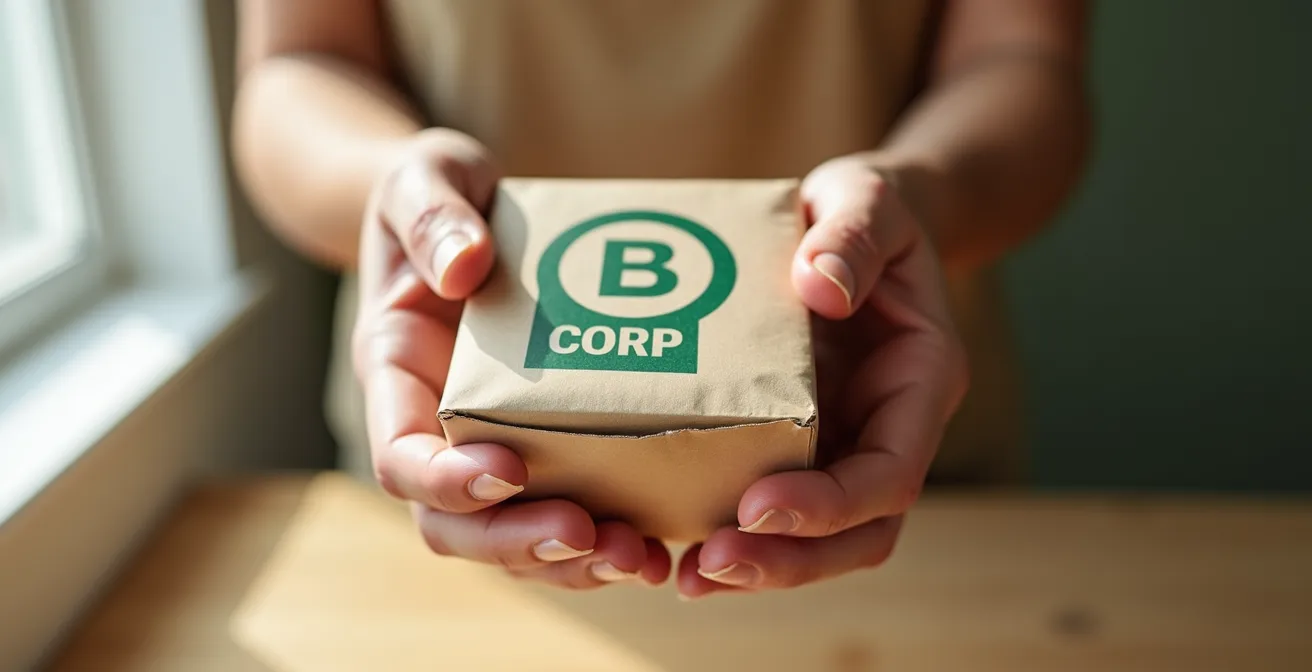
Supporting ethical businesses is more than buying ‘green’—it’s a calculated act of economic divestment from the failing ‘take-make-waste’ model.
- The dominant linear economy is deliberately designed for instability and engineered failure, wasting your money and resources.
- Shifting to an “access-over-ownership” model (renting, libraries) and prioritizing local B-Corps activates a powerful economic multiplier effect in your community.
Recommendation: Use the B-Corp certification not just as a shopping label, but as a framework to analyze a business’s entire environmental and social impact before you spend.
You feel it every time you throw something away that should have lasted longer. It’s a quiet frustration, a sense that the economic system is rigged against both you and the planet. You want your money to support better practices, to be a vote for a more sustainable and equitable world. Mainstream advice often says to “buy local” or “look for eco-labels,” but these suggestions barely scratch the surface. They treat you as a passive consumer, asking you to simply choose from a pre-approved list of “good” products.
This approach is fundamentally flawed because it fails to address the root cause: the linear, “Take-Make-Waste” economy that dominates our lives. But what if the solution wasn’t just about choosing a different product, but about choosing a different economic system entirely? What if every dollar you spend could be a strategic act of divestment from this broken model and a direct reinvestment in a circular, community-focused alternative? That is the real power of supporting Certified B Corporations and the broader circular economy.
This guide moves beyond the platitudes. We will deconstruct the economic model that encourages waste and planned failure. Then, we will equip you with practical strategies to shift your spending—from leveraging sharing economies to understanding the real impact of buying local. This isn’t about guilt or perfection; it’s about making informed, powerful choices that align your spending with your values and actively build a better economy.
This article provides a comprehensive framework for transforming your consumer habits into meaningful economic action. Explore the sections below to understand the systemic issues and discover actionable solutions.
Summary: A Strategic Guide to Divesting from Waste and Reinvesting in B-Corps
- Why the “Take-Make-Waste” Model is Economically Unstable?
- How to Use Tool Libraries to Avoid Buying Things You Use Once?
- Buying vs. Renting: Which is More Sustainable for Occasional Needs?
- The Design Trick That Kills Your Appliances Just After Warranty
- When to Buy Local: The Economic Multiplier Effect Explained?
- Fair Trade or Made in USA: Which Has Lower Carbon Impact?
- The Sign That a Vendor is Reselling Costco Produce as “Local”
- How to Shop at a Farmers Market for a Week of Meals Under $100?
Why the “Take-Make-Waste” Model is Economically Unstable?
The “Take-Make-Waste” model is the engine of modern consumerism. It operates on a simple, linear path: we extract raw materials, manufacture products with a limited lifespan, and then discard them, often in a landfill. This system is not just environmentally catastrophic; it is fundamentally unstable from an economic perspective. It relies on infinite growth on a finite planet, creating a perpetual cycle of resource depletion, price volatility, and waste management costs that are ultimately passed on to society.
This model’s inherent weakness is its inefficiency. Every item thrown away represents a loss of materials, energy, and labor. In contrast, a circular economy seeks to close this loop. By designing products for durability, repairability, and reuse, we retain their value within the system for as long as possible. The rise of the sharing economy is a direct challenge to the linear model’s inefficiencies. By facilitating access over ownership, it proves that economic activity can be decoupled from constant production. In fact, projections show the global sharing economy is expected to reach $794 billion by 2031, signaling a massive market shift towards more sustainable and resilient models.
Case studies provide tangible proof of this alternative’s power. The Toronto Tool Library, for example, is more than just a place to borrow a drill. It’s a micro-economy built on circular principles. By enabling its members to share resources, it has reportedly saved them over a million dollars and diverted tons of waste from landfills. This is not just environmentalism; it’s smart economics. It demonstrates that by breaking the “Take-Make-Waste” cycle, communities can build wealth, reduce costs, and create a more stable local economy.
How to Use Tool Libraries to Avoid Buying Things You Use Once?
One of the most wasteful aspects of the linear economy is the single-use purchase. Think of the power drill for one afternoon of hanging pictures, the carpet cleaner for a single spill, or the specialized baking pan for a one-time recipe. These items are expensive, take up storage space, and are destined to gather dust. Tool libraries and other “Libraries of Things” offer a powerful, economically rational alternative: access over ownership. For a small membership fee, you gain access to a vast inventory of items you might only need occasionally.
Effectively using these resources requires a shift in mindset. Before any non-routine purchase, your first question should be, “Can I borrow this?” Start by locating your local tool library, often run by community centers or non-profits. For travel, investigate peer-to-peer rental platforms like Fat Llama, which allow you to rent items directly from locals at your destination, saving you from buying or packing bulky gear like camping equipment or formal wear.
The economic logic is undeniable. The cost of a one-year tool library membership is often less than the purchase price of a single high-quality power tool. Given that data shows power tools account for 35% of rental shares in the sharing economy, the savings potential is enormous. Furthermore, these institutions are community hubs. Many offer workshops on how to properly use equipment, fostering new skills and a culture of repair and reuse. By participating, you are not just saving money; you are actively divesting from the disposable goods market and investing in a community-based, circular system.
Buying vs. Renting: Which is More Sustainable for Occasional Needs?
When faced with an occasional need, the modern consumer has more choices than ever. The old binary of buying or not buying has been replaced by a spectrum of options, including tool libraries, peer-to-peer sharing, and traditional rental services. Deciding which path is more sustainable requires looking beyond just the product and considering the entire system it supports. While both renting and sharing reduce the need for individual ownership, they operate on different economic and social principles.

As the image of well-maintained, shared tools suggests, durability and reuse are at the heart of the circular economy. Tool libraries, often operating as non-profits, are designed to maximize the lifespan of an item and foster a culture of collective ownership. Traditional rental companies, while offering access, are for-profit entities whose model can still involve significant logistical and transportation-related carbon footprints. The table below outlines the key differences to help you make an informed decision.
| Factor | Tool Libraries (Buy Once, Share) | Traditional Rental |
|---|---|---|
| Cost Structure | Nominal membership fee or donation | Per-use rental fees |
| Environmental Impact | Promotes reuse and waste reduction | Higher carbon footprint from logistics |
| Community Building | Fosters sharing culture and collective ownership | Limited community interaction |
| Service Level | Community support and volunteerism | Professional maintenance and delivery |
Ultimately, for occasional needs, participating in a community-based sharing system like a tool library is often the most sustainable choice. It not only minimizes waste and resource consumption but also strengthens community bonds and supports a non-profit, circular economic model. It represents a deeper commitment to systemic change rather than a simple transaction.
The Design Trick That Kills Your Appliances Just After Warranty
It’s not your imagination: your appliances are failing faster than ever before. This phenomenon isn’t a sign of declining quality control; it’s a deliberate business strategy known as planned obsolescence. To maintain sales in a saturated market, manufacturers intentionally design products with a limited lifespan, ensuring you’ll have to buy a replacement sooner rather than later. This strategy takes many forms, from using fragile plastic parts in critical components to making devices impossible to open without specialized tools, effectively killing the right to repair.
The data on this “engineered failure” is stark. A report from the Public Interest Research Group (PIRG) notes that while major appliances built in the 1970s generally lasted between 30 to 50 years, we now replace them at about a decade. This is not accidental. As one repair expert highlights, the problem is systemic. In the same report, Myles Ong of J&M Appliances explains the economic reality of this strategy:
Replacement parts are no longer available after only three to five years
– Myles Ong, J&M Appliances repair expert
This practice is economically extractive, forcing consumers into a constant cycle of repurchasing. However, the political tide is turning. Recognizing the immense waste and consumer harm, governments are beginning to act. In a landmark move, the EU voted in 2023 to support a directive to ban planned obsolescence. This legislation aims to hold manufacturers accountable, mandating the availability of spare parts and fighting against unjustified software upgrades designed to slow down older devices. This political action is a crucial step in shifting the economic incentives away from disposability and towards durability and repair.
When to Buy Local: The Economic Multiplier Effect Explained?
“Buy local” is a common refrain in ethical consumerism, but its true power lies in a specific economic principle: the economic multiplier effect. When you spend a dollar at a locally-owned business, that dollar doesn’t just disappear into a corporate headquarters in another state or country. A significant portion of it stays within your community. The local business uses it to pay its employees (your neighbors), who then spend their wages at other local businesses. The business also buys services from other local firms, like accountants or marketers. This cycle, where one dollar of local spending creates more than one dollar of local economic activity, is the multiplier effect in action.

This is where supporting B-Corps becomes particularly powerful. Many B-Corps are inherently community-focused, making them ideal conduits for this multiplier effect. By definition, they are legally required to consider their impact on workers, community, customers, and the environment. While not all local businesses are B-Corps, and not all B-Corps are small and local, choosing a local B-Corp is a powerful combination. It ensures your money supports not only a business with high ethical standards but one that is also actively recirculating wealth within your community. The B-Corp movement is a growing global force for this kind of economic change. According to Wikipedia, as of March 2025, there are 9,576 certified B Corporations across 160 industries in 102 countries, creating a vast network of businesses committed to a better economic model.
Therefore, the decision “when to buy local” should be strategic. It is most impactful when you are consciously choosing to invest in a business that is rooted in your community and committed to its well-being. This is how your individual spending transforms from a simple transaction into an act of community wealth-building.
Fair Trade or Made in USA: Which Has Lower Carbon Impact?
Consumers often face a confusing choice between competing ethical claims. Is it better to buy a “Fair Trade” certified coffee shipped from across the world, or a non-certified product made locally? The answer is rarely simple because “carbon impact” is not just about “food miles.” A product’s true environmental footprint is determined by its entire lifecycle carbon analysis (LCA), which includes raw material extraction, manufacturing processes, transportation, and end-of-life disposal.
A locally made product might seem like the obvious winner, but if its factory is powered by coal and you drive your individual car to buy it, its carbon impact could be higher than a Fair Trade product from a farm using regenerative agriculture, processed in a solar-powered facility, and shipped efficiently in bulk via sea freight. This is where holistic certifications like B-Corp provide immense value. They move beyond single-issue labels. To become a B-Corp, a company’s entire social and environmental performance is measured, verified, and held to a high standard of transparency.
Crucially, the standards are evolving to be even more rigorous. B Lab, the non-profit behind the certification, is rolling out new requirements. By 2025, B-Corps will be required to meet specific performance standards across key areas, including measuring and reporting their greenhouse gas (GHG) emissions. This forces companies to look at their entire operation, from supply chain to final product, and provides consumers with a more reliable benchmark than a simple origin label. To make the most informed decision, you must become adept at evaluating these complex factors yourself.
Action Plan: Evaluating a Product’s True Carbon Impact
- Look beyond origin labels to examine if the company provides a full lifecycle carbon analysis (LCA).
- Consider the manufacturing energy source; check if the company reports using renewable energy versus fossil fuels.
- Evaluate transportation efficiency: large-scale sea freight often has a lower per-item footprint than multiple individual car trips for local shopping.
- Check for a B-Corp certification, which requires a comprehensive measurement of a company’s entire environmental impact, not just one aspect.
- Compare raw material extraction methods, looking for commitments to regenerative or sustainable sourcing practices.
The Sign That a Vendor is Reselling Costco Produce as “Local”
Shopping at a farmers market feels like a direct investment in your local food system. However, the integrity of this system relies on the authenticity of its vendors. Unfortunately, some vendors exploit the “local” label by reselling wholesale produce—sometimes from large distributors like Costco or Restaurant Depot—at a premium. As a consumer making a political and economic choice, learning to spot these resellers is crucial to ensuring your money reaches actual farmers.
The first clue is often visual: unnatural uniformity. Nature is varied. A real farm’s produce will have slight differences in size, shape, and color. If every tomato, zucchini, or apple on a vendor’s table is a perfect, blemish-free clone of the others, it’s a red flag for mass wholesale sourcing. Look for the small imperfections that signal authentic cultivation. Similarly, check the packaging. Faint sticker residue on fruit, identical rubber bands on every bunch of greens, or wholesale boxes (often from other states or countries) hidden under the table are tell-tale signs of reselling.
The most effective tool, however, is your own voice. Engage the vendor with specific, seasonal questions. Instead of asking “Is this local?”, which invites a simple “yes,” ask something a real farmer would know intimately. “Are these the first of your Sungold tomatoes this season?” or “How have the recent rains affected your kale?” A genuine farmer will likely give you a detailed, enthusiastic answer about their crops and growing conditions. A reseller, on the other hand, will often be vague or evasive. Your informed questions are a powerful tool for verification, ensuring your support goes to the local growers who form the backbone of a resilient food economy.
Key Takeaways
- The dominant “Take-Make-Waste” economy is designed for failure, making ethical consumption a necessary act of economic resistance.
- Shifting from ownership to access through tool libraries and rental services is a powerful way to reduce waste and save money.
- Supporting local B-Corps maximizes the “economic multiplier effect,” ensuring your money circulates and strengthens your community.
How to Shop at a Farmers Market for a Week of Meals Under $100?
Applying the principles of ethical and economic consumption can feel abstract, but it translates into tangible, everyday actions—like shopping for groceries. A farmers market is a perfect laboratory for putting these ideas into practice. Not only can you directly support local agriculture, but with a strategic approach, you can also eat well for a week on a surprisingly modest budget, such as $100 for an individual or couple.
The key is to shop like a chef: go with a plan, but be flexible. Start by walking the entire market before buying anything. See what’s abundant—this is what will be freshest and most affordable. Plan your week’s meals around these seasonal stars. Root vegetables, hardy greens, and seasonal fruits often provide the best value. Engage with the farmers; ask them what’s best or what they’re excited about. They can offer cooking tips and point you toward deals, like “seconds” or “ugly” produce that are perfect for soups and sauces at a fraction of the price.
Focus on whole, unprocessed foods. A bag of potatoes, a bunch of carrots, onions, and seasonal greens can form the base for dozens of meals, from stews to roasted dishes. Combine these with protein from a local rancher and you have a week of nutrient-dense, flavorful meals. This approach not only connects you to your food source but also yields significant economic benefits. While it’s a different context, the principle of smart consumption is universal; studies have shown the average household savings from participation in sharing economy services is estimated at $250 annually. By applying a similarly strategic mindset to your local food purchases, you compound the benefits: you save money, support local farmers, reduce your carbon footprint, and eat healthier.
Your journey as an active economic participant starts now. Begin by evaluating one upcoming purchase not by its price, but by the economic system it supports.
Frequently Asked Questions on Ethical Shopping
What visual signs indicate mass wholesale sourcing rather than local farming?
Perfectly identical, flawless produce without the natural variation in size, shape, or minor cosmetic blemishes that are typical of authentic farm products is a major red flag. Real farm produce shows diversity.
What packaging clues reveal non-local sourcing?
Look for faint sticker residue on fruit (where a brand sticker might have been removed), identical rubber bands or twist ties across all bunches, or non-local wholesale boxes hidden under tables or in the vendor’s truck.
What questions can expose a reseller versus a real farmer?
Ask specific seasonal questions like, “Are these the first asparagus of the season?” or “How did the late frost affect your strawberries?” Real farmers can provide detailed, context-rich answers, while resellers will often remain vague or change the subject.