Entering the backcountry is not an invitation to relax the rules; it is a summons to uphold them with absolute rigor.
- Your presence must be temporary and invisible; the standard is not “clean,” but “pristine.”
- Every action, from waste disposal to campsite selection, has a permanent ecological consequence that you are ethically bound to prevent.
Recommendation: Treat the Leave No Trace principles not as a checklist, but as an unbreakable ethical code. Your goal is to leave the wilderness not just as you found it, but as if you were never there at all.
When you leave the designated campsite behind—with its fire pits, picnic tables, and restrooms—you are not stepping into a land of fewer rules. You are entering a domain where the rules are more critical than ever, dictated not by park rangers, but by the fragile biology of the ecosystem itself. For the first-time dispersed camper, the allure of freedom can mask a profound responsibility. The common refrain “pack it in, pack it out” is a starting point, not the destination. It’s the bare minimum in a complex system of ethics.
Many believe that as long as trash is gone, no harm is done. This overlooks the lasting, often invisible, damage caused by improper waste disposal, trampled vegetation, and irresponsible hygiene. This is where the true mastery of Leave No Trace (LNT) begins. It’s an understanding that goes beyond the surface. The real challenge isn’t just carrying out your litter; it’s comprehending the ecological imperative behind every choice you make. If the foundational principle of your wilderness ethic isn’t an unwavering commitment to zero impact, you are not ready for dispersed camping.
This guide is not a gentle introduction. It is a strict, practical manual for the serious camper. We will move past the platitudes and dissect the scientific and ethical reasons that make these principles non-negotiable. This is about transforming your mindset from a visitor to a guardian, ensuring the wild remains wild for generations to come. We will explore the precise techniques for waste, the science of durable surfaces, the truth about soap, the permanent scars of campfires, and the absolute necessity of proper food storage, among other critical topics.
This article provides an in-depth framework for applying these principles with the discipline they demand. The following sections break down the core ecological imperatives you must master before your next trip into the backcountry.
Summary: The Uncompromising Guide to “Leave No Trace” in Areas Without Facilities
- Why Burying Waste 6 Inches Deep is Crucial for Soil Health?
- How to Camp on Durable Surfaces to Avoid Killing Alpine Grass?
- Soap or No Soap: Which is Safer for Alpine Lakes?
- The Campfire Mistake That Leaves Permanent Scars on Rocks
- When to Use a Bear Canister Instead of a Hang Bag?
- The Refillable Bottle Strategy That Saves You $50 on Bottled Water
- Why Arriving After 9 AM at Zion National Park Ruins Your Experience?
- How to Visit Protected Monuments Without Accelerating Their Erosion?
Why Burying Waste 6 Inches Deep is Crucial for Soil Health?
Disposing of human waste in the backcountry is a matter of public health and ecological integrity. The 6-to-8-inch depth for a “cathole” is not an arbitrary number; it is a prescription based on soil science. This layer, known as the organic soil horizon, is rich with microorganisms, fungi, and bacteria. It is the only zone where decomposition can occur effectively and rapidly. Burying waste shallower leaves it exposed to runoff and animals, while burying it deeper places it in mineral soil where decomposition slows to a near halt.
The primary danger of improperly buried waste is the transmission of disease. Waterborne pathogens like Giardia and Cryptosporidium can contaminate water sources if waste is left too close to rivers or lakes, or buried too shallowly where rain can unearth it. In fact, sobering research has discovered that pathogens can persist in the soil for a year or more when not buried at the correct depth, posing a long-term threat to both wildlife and other visitors. Your responsibility is to facilitate decomposition, not just hide the evidence.
This is an ecological imperative. A single mistake, repeated by thousands of campers, transforms a pristine environment into a hazardous one. The practice is not optional. It is a fundamental duty of any individual who ventures into areas without facilities. Mastering the correct technique is a non-negotiable skill.
Action Plan: Executing the Perfect Cathole
- Site Selection: Choose a site at least 200 feet (approximately 70-80 adult paces) away from any water source, trail, or campsite to prevent contamination.
- Forest Soil Protocol: In rich, organic forest soil, use a trowel to dig a hole 6 to 8 inches deep. This depth optimizes contact with microbial decomposers.
- Desert Soil Protocol: In arid desert environments, dig only 4 to 6 inches deep. The goal here is to leverage the intense heat from the sun to destroy pathogens, which is more effective at this shallower depth.
- Alpine/Arctic Protocol: In high-altitude or arctic zones, decomposition is nearly non-existent. Do not dig a cathole. You must use WAG bags or other approved human waste pack-out systems.
- Finalization: After use, cover the cathole completely with the original soil and disguise it with natural materials like leaves or pine needles to restore its natural appearance.
How to Camp on Durable Surfaces to Avoid Killing Alpine Grass?
The ground beneath your feet is not just dirt; in many ecosystems, it is a living, breathing entity. The principle of “travel and camp on durable surfaces” is about preventing environmental scarring that can last for centuries. Durable surfaces are areas like rock, sand, gravel, dry grasses, or snow, which can withstand traffic without being permanently damaged. In contrast, fragile surfaces include living soil, delicate vegetation, and desert wildflowers.
Perhaps the most critical and misunderstood fragile surface is cryptobiotic soil. Found in arid regions, this dark, bumpy crust is a community of cyanobacteria, lichens, and mosses. It prevents erosion and creates nutrients for desert plants. The case study of its fragility is stark: research in Utah’s deserts confirms that a single footprint can crush this crust, and it can take 50 to 250 years for it to fully recover. When you pitch a tent on “crypto,” you are inflicting a wound that will outlive you.

The rule is simple: if you are not on an established trail or a designated campsite, your every step is a choice. Your tent, your cooking area, and your path to fetch water must all be on the most durable surfaces available. This means consciously choosing rock slabs over meadows, or walking in a dry wash instead of on its vegetated banks. This is the difference between a visitor and a vandal. The hierarchy of surface selection must be ingrained in your mind:
- Priority 1: Use established trails and designated campsites to concentrate impact.
- Priority 2: Rock, gravel, and sand. These surfaces are highly resistant to impact.
- Priority 3: Dry grasses and snow. These are resilient but not indestructible.
- Avoid at all costs: Living soil crusts (cryptobiotic), delicate vegetation like mosses and wildflowers, and wet meadows.
Soap or No Soap: Which is Safer for Alpine Lakes?
The answer is unequivocal: no soap is safe for an alpine lake. Even biodegradable soaps are harmful. “Biodegradable” means the soap will break down over time, but it requires soil to do so. When introduced directly into a water source, it pollutes the water, harms aquatic life, and can trigger algal blooms that choke the ecosystem. The pristine clarity of a mountain lake is a sign of a delicate nutrient balance, one that soap immediately disrupts.
The ethical camper must adopt a no-soap hygiene system. For personal washing, a swim in the lake is acceptable, but do not use soap. Wash yourself on land, at least 200 feet away from the water’s edge, using a small amount of water from a bottle. This allows the soil to act as a natural filter. For dishwashing, the same principle applies. Never wash dishes directly in a lake or stream. Collect water, take it 200 feet away, and use a system that protects the environment.
This requires a shift in thinking from household convenience to backcountry responsibility. Your goal is not to have squeaky-clean dishes, but to leave zero trace of your meal. The following no-soap system is not a suggestion; it is a required practice for anyone washing items in the backcountry:
- For Dishes: Use hot water, a scrub pad, and a bit of sand or gravel as an abrasive. Scrape all food particles into your trash bag to be packed out.
- For Greywater: Dig a small “sump hole” to strain your dishwater through. This allows the soil to filter the water before it goes anywhere else. Disperse the strained water broadly.
- For Personal Hygiene: A backcountry bidet (a simple squirt bottle) is far more effective and has less impact than toilet paper. If soap is absolutely necessary for handwashing, use a tiny amount of biodegradable soap in a cathole, far from any water.
Your comfort does not supersede the health of the ecosystem. The biological integrity of alpine water systems depends on your discipline.
The Campfire Mistake That Leaves Permanent Scars on Rocks
A campfire is a potent symbol of the outdoors, but it is also one of the most significant sources of lasting impact. The most egregious campfire mistake is building a new fire ring, especially on or near large rocks. The intense heat from a fire can heat-shock rocks, causing them to crack and spall. This damage, known as environmental scarring, is permanent. The blackened “fire scar” on a boulder will remain for thousands of years, a permanent monument to a moment of thoughtlessness.
Modern LNT ethics strongly advocate for forgoing a fire altogether. Lightweight stoves are more efficient for cooking, provide better heat control, and have zero impact. For ambiance, a candle lantern is a far more responsible choice. A fire should be considered a high-impact activity, only to be done when and where it is explicitly permitted and can be executed without leaving a trace. According to the National Park Service, the best practice is always to use a stove. If a fire is permissible, you must use an existing fire ring. Never create a new one.
In areas where fires are allowed but no rings exist, advanced LNT techniques like mound fires or fire pans are required. These methods prevent the fire from scarring the ground. A mound fire involves building an insulating mound of mineral soil on a ground cloth, while a fire pan is a metal tray that contains the fire and ash. Both are then completely removed after use. The days of simply clearing a circle of dirt are over.
| Technique | Impact Level | Setup Requirements | Best Environment |
|---|---|---|---|
| Mound Fire | No trace | Mineral soil mound on ground cloth | Areas with mineral soil available |
| Fire Pan | No trace | Metal pan elevated on rocks | Any location |
| Established Ring | Concentrated impact | Use existing ring only | High-use campsites |
| Stove Only | Zero impact | Lightweight camping stove | All environments (preferred) |
When to Use a Bear Canister Instead of a Hang Bag?
The simple answer is: you should use a bear canister whenever possible, and it is mandatory in many high-use areas. While hanging a food bag (the “PCT method”) was once standard, it is increasingly seen as an inferior and often ineffective technique. It requires specific tree conditions that are not always available, it is difficult to execute perfectly, and intelligent animals—not just bears, but raccoons, marmots, and squirrels—frequently defeat it.
A hard-sided bear canister is a fortress. It is the most effective and reliable method for protecting your food and, more importantly, protecting wildlife. The issue is not just about losing your dinner; it’s an ethical crisis. As the Pacific Crest Trail Association tragically notes, when bears become habituated to human food due to improper storage, wildlife managers are often forced to kill them. A bear that has learned to associate backpacks with food is a danger to all humans and cannot be safely relocated.
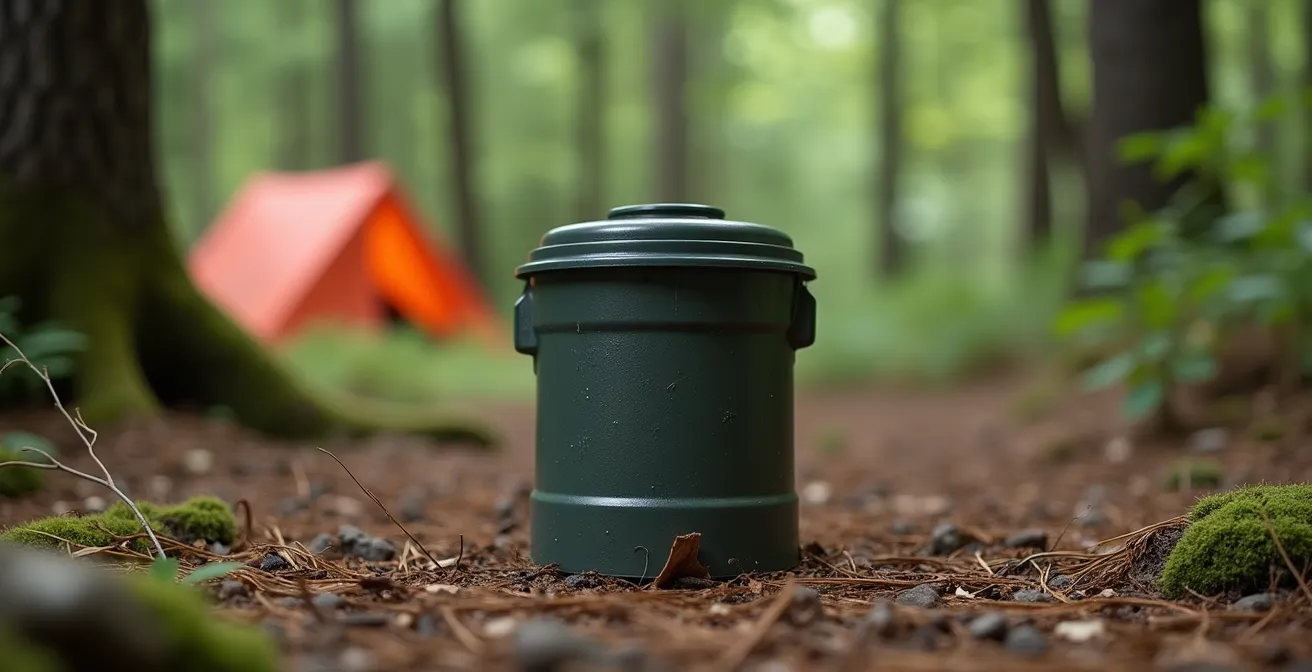
Therefore, carrying a bear canister is not about convenience; it is about taking absolute responsibility for preventing the death of an animal. It works in every environment, from deserts with no trees to alpine zones where trees are too small or fragile. When using a canister, you must also store it correctly: at least 100 feet from your tent, on flat ground, and away from cliffs or water sources where a bear might knock it. Remember to also store all scented items—including toothpaste, soap, and trash—inside the canister. Your car is not a secure storage container in the backcountry.
The Refillable Bottle Strategy That Saves You $50 on Bottled Water
The principle of “Plan Ahead and Prepare” extends to your hydration system. Relying on single-use plastic water bottles in the backcountry is not only expensive and heavy, but it also violates the core ethic of minimizing waste. Every disposable bottle you carry is a piece of trash waiting to happen—a potential micro-impact that could be left behind. The professional standard is a robust, reusable water system that eliminates single-use plastics entirely.
Adopting this strategy is not just about environmental ethics; it is about self-sufficiency and financial sense. A single weekend trip could easily require $50 worth of bottled water, which is heavy, bulky, and creates unnecessary waste. In contrast, a one-time investment in a quality water filter or purifier provides you with unlimited safe drinking water from natural sources for years. Your system should be viewed as essential life-support equipment.
A well-designed system gives you flexibility and security. It allows you to carry less weight and travel further, confident in your ability to safely resupply from streams and lakes. The setup is simple but must be executed with discipline:
- The Container System: Carry at least one hard-sided bottle (like a Nalgene) for easy drinking on the go, and a larger, soft-sided reservoir (like a Dromedary or Cnoc bag) to store “dirty” water at camp. This prevents cross-contamination.
- The Treatment Method: Choose a treatment device suited to your environment. A filter (like a Sawyer Squeeze or Katadyn BeFree) removes bacteria and protozoa, sufficient for most North American backcountry. A purifier (using UV light like a SteriPen or chemical drops) also eliminates viruses and is necessary for international travel or areas with high agricultural runoff.
- Electrolyte Management: Instead of single-serving drink packets, use bulk electrolyte powders or dissolvable tablets to add to your treated water.
- Source Selection: Always collect water from clear, fast-moving sources whenever possible, and upstream from any campsites or animal crossings. Be careful not to stir up sediment or damage the stream bank during collection.
Key takeaways
- Ethical Obligation: Leave No Trace is a non-negotiable ethical code, not a set of optional guidelines. Your goal is zero impact.
- Scientific Basis: LNT rules are based on ecological science; proper waste burial aids decomposition, and avoiding fragile soil prevents centuries of damage.
- Proactive Prevention: The best impact is no impact. Use stoves instead of fires, canisters instead of hangs, and reusable systems instead of disposables.
Why Arriving After 9 AM at Zion National Park Ruins Your Experience?
The seventh principle of Leave No Trace, “Be Considerate of Other Visitors,” extends beyond simple trail etiquette. In today’s high-traffic national parks, it has become a crucial element of crowd management and resource protection. Arriving at a popular park like Zion after 9 AM is not just an inconvenience for you; it contributes to a cascade of negative impacts that degrade the wilderness experience for everyone and harm the park itself.
When parking lots fill, visitors begin parking on fragile roadside vegetation, causing soil compaction and erosion. Trails become congested, leading to a diminished sense of solitude and quiet. The collective noise and presence of large crowds disturb wildlife. As the National Park Service emphasizes, the goal is to schedule your trip to avoid times of high use. This is a form of dispersed impact applied to time instead of space. By visiting during off-peak hours (early morning) or off-season, you reduce the strain on the park’s infrastructure and ecosystem.
This principle forces you to think beyond your own desires and consider your role in the collective. Are you part of the problem or part of the solution? Choosing to visit popular spots at dawn, exploring less-trafficked trails, or visiting in the off-season are all powerful LNT actions. It also means managing your group size; small groups of 4-6 have a significantly lower impact than large groups. In the backcountry, this is even more critical. Your presence should enhance the solitude for others, not shatter it. This means keeping voices low, camping out of sight and sound of trails and other camps, and respecting the quiet of the wild.
How to Visit Protected Monuments Without Accelerating Their Erosion?
The final LNT principle, “Leave What You Find,” takes on a profound significance when encountering cultural or historical artifacts. Rock art, ancient ruins, and other protected monuments are irreplaceable records of human history. They are not merely “sights”; they are fragile, non-renewable resources. Your visit, however well-intentioned, is an agent of erosion. Your ethical duty is to minimize that erosion to the greatest extent possible.
The primary rule is absolute: never touch. The oils on your skin can damage ancient pigments on pictographs, and the physical pressure can destabilize fragile structures. Even the dust you kick up and the vibrations from your footsteps contribute to the slow, inexorable destruction of these sites. Photography itself must be ethical: never use a flash, which can fade ancient pigments, and never rest a tripod against a wall or artifact. Respect all barriers, ropes, and signs. They are there to protect the site from the cumulative impact of thousands of visitors.
Visiting these sacred places requires a specific code of conduct that goes beyond basic LNT. It is a practice of reverence and extreme care. You must move slowly, walk softly, and control the dust you create. This is not a place for loud conversations or rushed sightseeing. It is a place for quiet observation from a respectful distance. Your goal is to be a ghost—to see without being seen, to appreciate without leaving a single trace of your presence.
- Maintain Distance: Always stay on designated pathways and behind any barriers. Never touch rock art, walls, or artifacts.
- Control Your Impact: Move slowly and deliberately to minimize dust and vibration. Walk softly.
- Practice Ethical Photography: Never use a flash on pigments. Do not allow your equipment (tripods, bags) to make contact with structures.
- Leave Everything: Do not take artifacts, pottery shards, or even interesting rocks. Leave them for others to discover and for archaeologists to study in context.
Your journey into the backcountry is a privilege, not a right. Upholding this strict ethical code is the price of admission. Begin today by auditing your gear, planning your next trip with these principles at the forefront, and committing to becoming a true guardian of the wilderness.